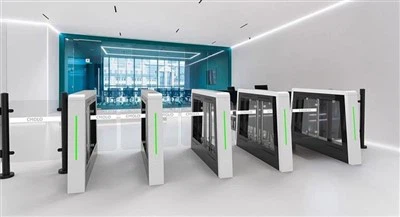
1. Technological Innovation: Moving from physical barriers to smart hubs
Most of the time, traditional turnstiles are only mechanical constructions that just govern the flow of people. The latest version of the rotary gate has become an intelligent terminal that combines mechanical control, biometrics, Internet of Things connection, and edge computing. In three key ways, this technological breakthrough is shown:
Combining several types of recognition technology
This state-of-the-art turnstile has several verification modules, including 3D structured light facial recognition, finger vein recognition, NFC near-field communication, and more. It can recognize people with 99.99% accuracy and respond in just 0.3 seconds. A high-end shopping mall, for example, used turnstiles during its store anniversary event. These turnstiles worked with the membership system through facial recognition, allowing VIP customers to quickly get through with "face recognition free coupons." This increased the efficiency of the VIP channel by 40% and the customer satisfaction index by 22%.
System for Adaptive Movement Control
The fourth generation movement uses servo motors and hydraulic shock absorption technology. This lets it change the speed of rotation based on the pressure of the passage. During times when there are a lot of people, the gate automatically converts to high-speed mode (45 people per minute). When people are carrying big things or pushing baby strollers, it switches to medium speed mode (25 people per minute), which lowers the risk of injury. The real test data from a commercial complex demonstrates that this system cuts the number of complaints from customers by 67% and the number of equipment failures by 0.02%.
Edge computing and making a decision about where to put things
The turnstile has an ARM architecture CPU built in, so it can do complicated tasks like checking access permissions and looking for strange behavior without needing to connect to cloud services. Even when the network goes down, the device can still do fundamental tasks thanks to an offline rule engine. This makes sure that the mall can keep running. The test of a regional chain store reveals that the edge computing architecture cuts the time it takes for the system to respond from 1.2 seconds to 0.15 seconds and uses 85% less network bandwidth.
2. Scenario Empowerment: From Simple Control to Full Link Optimization
Turnstiles are no longer only a security feature; they've become an important part of how malls work, creating a full closed loop of "drainage conversion retention":
Exact control of marketing efforts
When there are limited-time discounts or other special events, the turnstile is connected to the mall's POS system and member database in real time. This means that only consumers who meet the prerequisites for the activity can enter the exclusive area. During the "Double 11" era, a department shop put up a sign at the entrance that said, "exclusive channel for customers over 500 yuan." This raised the conversion rate of high-net-worth consumers by 31% while keeping the activity area from being too crowded with regular customers. The equipment has a passenger flow heat map feature that can keep track of how many people are moving about in different places in real time. This information may be used to change the layout of the activity area on the fly.
Deep use of the membership system
Rotary turnstiles have turned into a real way to get membership perks. By giving members of different levels different access rights (for example, black gold members don't have to wait in line and gold card members have their own channels), a shopping center has raised the percentage of members who buy again by 18% and the percentage of members who spend money by 42% to 59%. AI can use the device's traffic data (such how often and how long people stay) to accurately guess what members want to buy, which is useful for tailored marketing.
Taking steps to protect against security threats
The full-height rotating gate has safety features including anti-tailgating radar and a pressure sensing matrix that can identify strange actions like unauthorized entry and reverse passage in real time. After putting the system in place, a certain shopping center was able to stop 12 thefts of products, and the amount of losses went down by 76% from the previous year. The fire protection system is connected to the equipment so that it can automatically unlock and sound an alert in case of an emergency. This makes sure that people can get out of the building without any problems.
Data Assets Value Mining
It is possible to create a "digital twin" of mall operations by cleaning and combining the daily traffic data from the turnstile, which includes information on the distribution of peak and valley passenger flows and the length of time people remain in a region. A particular commercial real estate group used gate data to improve the mall's flow design, which led to a 25% boost in rent in sections that weren't very popular. At the same time, they changed the cleaning schedule based on passenger flow and heat, which cut operating expenses by 14%.
3. Restructuring Costs: From spending money on capital to making operations better
Compared to regular turnstiles, modern rotary turnstiles save down on the initial investment and long-term operational costs of shopping malls by a lot. They do this through a "pay as you go" lease model and an efficient operation and maintenance system.
Deployment of light assets
For example, a retail mall in a second-tier city needs to spend 3 million yuan to buy a system with 50 turnstiles. But after switching to a lease arrangement, the first year's cost drops to 800,000 yuan, and there are no hidden costs like equipment depreciation and system upgrades. The leasing service provider's "7 × 24-hour" remote operation and maintenance service keeps the equipment available more than 99.5% of the time.
Ability to grow dynamically
During busy times like holidays and store celebrations, shopping malls can rapidly add more turnstiles by renting them from service providers. During the Spring Festival, a certain mall put up 20 extra turnstiles for a short time. It just took 4 hours to set them up. They were taken away right after the event to keep resources from going to waste. This "elastic resource pool" concept makes the cost of setting up gates in malls match the real demand very well.
Management of Energy Efficiency Optimization
The new turnstiles use less electricity than older models, using only 0.8 kWh per day per device, which is 60% less than older models. Some models come with solar-assisted power supply modules that let them run without using any energy in places with enough sunlight. A particular green retail mall has cut its carbon emissions by 12 tons a year by making its buildings more energy efficient. It also got a 500,000 yuan government grant.
Tall Turnstile Gate


WhatsApp : 0086-15999546575
Skype : cmolo.joy
Email : contact@cmolo.com
Tel : 0086-15999546575
CMOLO Industrial Park,NO. 144-1, Hengping Road,Henggang Street, Longgang District, Shenzhen City, China