



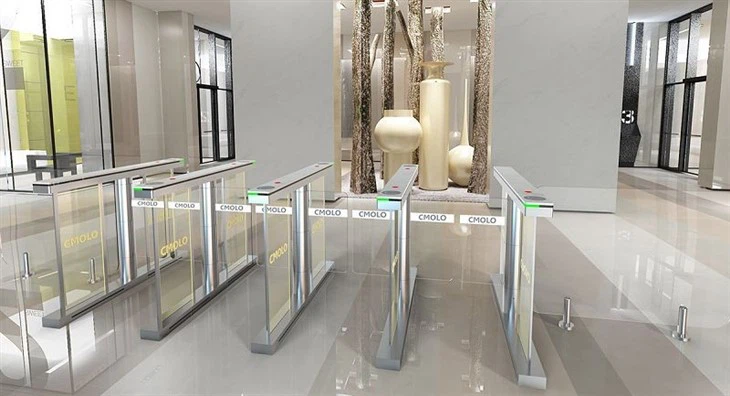
Hey there! As a supplier of Automatic Security Swing Turnstiles, I often get asked about the maximum throughput of these nifty devices. So, I thought I'd take a deep dive into this topic and share some insights with you.
First off, let's understand what throughput means in the context of an Automatic Security Swing Turnstile. Throughput refers to the number of people that can pass through the turnstile within a specific period, usually measured in people per minute. It's a crucial metric, especially in high - traffic areas like subway stations, office buildings, and stadiums.

Factors Affecting Throughput
There are several factors that can impact the maximum throughput of an Automatic Security Swing Turnstile.
User Behavior
One of the biggest factors is how quickly and smoothly people move through the turnstile. If users are familiar with the turnstile operation and move briskly, the throughput will be higher. For example, in a well - trained office environment where employees are used to swiping their cards and walking through the turnstile, the flow can be quite seamless. On the other hand, in a public area like a tourist attraction, where people may be unfamiliar with the system, there could be delays as they figure out how to use the turnstile.
Turnstile Design
The design of the turnstile itself plays a significant role. A well - designed turnstile with a wide passageway allows people to pass through more easily, increasing the throughput. For instance, our [Bi - directional Swing Barrier Turnstile](/forefront-turnstiles/bi - directional-swing-barrier-turnstile.html) is engineered with a spacious opening that enables quick and comfortable passage. Also, the speed at which the swing barriers open and close matters. Faster opening and closing times mean less waiting time for the next person, thus boosting the throughput.
Authentication Time
The time it takes to authenticate a user's access credentials, such as a card swipe, fingerprint scan, or facial recognition, can slow down the throughput. Advanced authentication technologies can reduce this time. For example, our turnstiles are equipped with high - speed card readers and state - of - the - art biometric scanners that can quickly verify a user's identity, minimizing the delay between users.
Traffic Direction
Whether the turnstile is set for uni - directional or bi - directional traffic also affects throughput. Bi - directional turnstiles, like the one I mentioned earlier, can handle traffic from both sides. However, they may have a slightly lower throughput compared to uni - directional turnstiles because there's a higher chance of congestion as people move in opposite directions.
Typical Throughput Ranges
On average, a well - functioning Automatic Security Swing Turnstile can achieve a throughput of 30 to 45 people per minute in normal operating conditions. In high - efficiency scenarios, where users are well - versed with the system and the turnstile has optimal settings, the throughput can go up to 60 people per minute.
For example, in a busy subway station, with a large number of commuters moving quickly and using pre - loaded transit cards, our turnstiles have been known to handle up to 55 people per minute. In a corporate office building, where employees use proximity cards and the traffic is more organized, we often see throughputs around 40 - 45 people per minute.
Comparison with Other Turnstile Types
Let's compare the throughput of Automatic Security Swing Turnstiles with other types of turnstiles.
Optical Turnstiles
Pedestrian Controlled Contactless Optical Turnstile Gate usually have a similar throughput range as swing turnstiles. However, optical turnstiles rely on infrared sensors to detect the passage of people. In some cases, false detections can occur, which may slightly reduce the throughput. Swing turnstiles, on the other hand, have physical barriers that provide a more definite way of controlling access, potentially leading to a more consistent throughput.
Metro Platform Validator Machines
Pedestrian Controlled Metro Platform Validator Machine are often used in subway stations. These machines are mainly focused on validating tickets or passes. The throughput of these machines can be lower compared to swing turnstiles because they require users to insert or scan their tickets, which can take a bit more time. Swing turnstiles, with their faster authentication methods, can generally handle more people in a given time frame.
How to Maximize Throughput
If you're looking to get the maximum throughput out of your Automatic Security Swing Turnstiles, here are some tips:
- User Training: Provide clear instructions and training to users on how to use the turnstile. This can significantly reduce the time it takes for people to pass through.
- Regular Maintenance: Keep the turnstiles in good working condition. Regularly clean the sensors, check the mechanical parts, and update the software. A well - maintained turnstile will operate more smoothly and have a higher throughput.
- Optimal Configuration: Set the turnstile parameters, such as the speed of the swing barriers and the authentication time, to the optimal values based on your specific traffic conditions.
Conclusion
In conclusion, the maximum throughput of an Automatic Security Swing Turnstile depends on various factors, including user behavior, turnstile design, authentication time, and traffic direction. On average, these turnstiles can handle 30 - 60 people per minute, making them a great choice for high - traffic areas.
If you're in the market for Automatic Security Swing Turnstiles and want to discuss how to achieve the best throughput for your specific needs, don't hesitate to reach out. We're here to help you find the perfect solution for your access control requirements.
References
- Industry reports on turnstile technology and performance.
- In - house testing and data from our installations.


