



As a supplier of speed gate turnstiles, I often get asked about the sensors these nifty gates use. So, let's dive right in and explore the different types of sensors that make speed gate turnstiles work like a charm.
Infrared Sensors
Infrared sensors are the most common type used in speed gate turnstiles. They work on a simple principle. There are usually two parts: a transmitter and a receiver. The transmitter sends out infrared light beams, and the receiver is there to catch them. When someone walks through the turnstile, they break these beams, and the sensor immediately detects the movement.
These sensors are great because they're highly reliable and can detect even the slightest movement. They're also very fast, which is crucial for speed gate turnstiles. They can sense whether a person is walking through or trying to sneak through in between the proper opening and closing times. Infrared sensors can be set up in a grid pattern, allowing the turnstile to accurately detect the position and movement of the person passing through.
For example, in locations like corporate offices where Office Security Speed Gate Turnstile are installed, infrared sensors help ensure that only authorized personnel enter. If an unauthorized person tries to slip through by breaking the beams in an improper way, the turnstile can trigger an alarm immediately.
Radar Sensors
Radar sensors are another type of technology used in speed gate turnstiles. These sensors work by emitting radio waves and then analyzing the reflections of these waves. When a person moves through the turnstile, the reflections of the radio waves change, and the sensor can detect this movement.

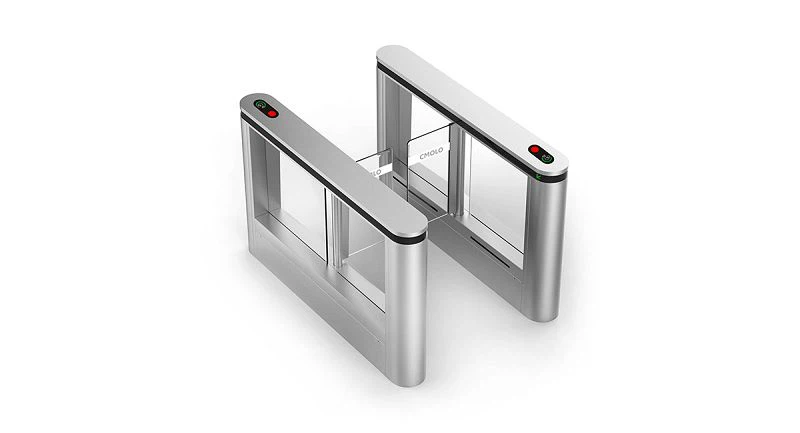
The advantage of radar sensors is their ability to detect movement from a distance. They can sense a person approaching the turnstile even before they get close. This allows the turnstile to start the opening process earlier, making the passage through the turnstile seem more seamless and efficient.
In addition, radar sensors are not affected by environmental factors like dust, fog, or rain as much as some other sensors. This makes them suitable for outdoor or industrial environments where the conditions may be less than ideal. For example, in some manufacturing plants or outdoor event venues where Card-swiping Automatic Speed Gate Turnstile are used, radar sensors can ensure smooth operation regardless of the weather.
Ultrasonic Sensors
Ultrasonic sensors use high - frequency sound waves to detect movement. The sensor emits ultrasonic waves, and when these waves hit an object (like a person passing through the turnstile), they bounce back to the sensor. By measuring the time it takes for the waves to return, the sensor can determine the distance of the object.
One of the benefits of ultrasonic sensors is their ability to detect the size and shape of the object. This can be useful in preventing tailgating, where a non - authorized person tries to follow closely behind an authorized person. The turnstile can analyze the size and shape of the object passing through and determine if there are multiple people trying to enter at once.
However, ultrasonic sensors may have some limitations. They can be affected by background noise, and the accuracy of the distance measurement can be reduced in certain environments. But overall, they still play an important role in enhancing the security and functionality of speed gate turnstiles, especially in combination with other sensors.
Magnetic Sensors
Magnetic sensors are used in speed gate turnstiles mainly for detecting the position of the gate leaves. These sensors can sense when the gate leaves are in their proper closed or open positions. They work based on the principle of magnetic fields.
There are usually magnets installed on the moving parts of the gate leaves, and the magnetic sensors detect the presence or absence of these magnetic fields. When the gate leaf moves to the open or closed position, the magnetic field changes, and the sensor sends a signal to the turnstile's control system.
This is crucial for the safety and proper operation of the turnstile. If the gate leaves don't close properly, the magnetic sensors can detect this and prevent the turnstile from malfunctioning. In addition, magnetic sensors can also help in monitoring the wear and tear of the gate leaves over time.
Biometric Sensors
In today's high - tech world, biometric sensors are becoming more and more popular in speed gate turnstiles. These sensors can use technologies like fingerprint recognition, facial recognition, or iris recognition to identify individuals.
Fingerprint recognition sensors work by capturing the unique patterns on a person's fingertip. When a person places their finger on the sensor, the sensor compares the pattern with the pre - registered fingerprint. If there's a match, the turnstile opens.
Facial recognition sensors use cameras to capture a person's face. The sensor then analyzes the facial features, such as the distance between the eyes, the shape of the nose, and the contour of the face. It compares these features with the pre - stored facial data. This technology is very convenient as people don't need to carry any cards or tokens.
Iris recognition sensors are even more accurate. They analyze the unique patterns in a person's iris. The iris patterns are highly unique, and it's very difficult to forge. Biometric sensors are often used in high - security areas like government buildings or research facilities where Intelligent Swing Gate are installed to ensure only authorized personnel can enter.
How Sensors Work Together
In most speed gate turnstiles, multiple sensors work together to provide a comprehensive security and functionality system. For example, infrared sensors can detect the movement of a person passing through the turnstile, while biometric sensors can verify the person's identity. Radar sensors can help with the approach detection, and magnetic sensors can ensure the proper operation of the gate leaves.
This combination of sensors makes the turnstile more robust and reliable. It can prevent unauthorized entry, detect any abnormal behavior, and provide a smooth and efficient passage for authorized personnel.
Conclusion
The sensors used in speed gate turnstiles play a crucial role in their operation and security. Whether it's the common infrared sensors, the long - range radar sensors, or the high - tech biometric sensors, each type has its own advantages and functions. By using a combination of these sensors, speed gate turnstiles can provide a high level of security and convenience for various applications.
If you're in the market for speed gate turnstiles and want to learn more about the sensor technology that can meet your specific needs, don't hesitate to reach out. We can help you choose the right turnstiles with the appropriate sensors for your location, whether it's an office, a factory, or any other facility. Contact us to start the procurement and discussion process.
References
- Sensor Technology Handbook. John Wilson.
- Security and Access Control Systems. Mark Johnson.


