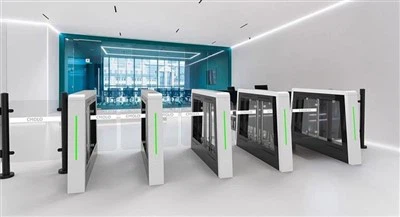
Usually integrating Bluetooth 5.3/WiFi 6/UWB/NFC four-mode communication modules, rotary turnstiles create a complementary near-field communication network:
By means of AOA (angle of arrival) technology, which can automatically link passenger luggage information in airport security checks, Bluetooth 5.3 precise positioning achieves a positioning accuracy of 0.3 meters, thereby enhancing checked baggage matching efficiency by 40%.
Wi-Fi Six High concurrency access: a single Wi-Fi 6 access point guarantees seamless connectivity for up to 5000 devices per hour during sporting events at the stadium by supporting 128 concurrent connections.
University of Wisconsin-Blu Ultra-wideband communication is By means of 10-cm level positioning accuracy, the gate system implemented in financial data centers provides dual verification of authority and location, thereby lowering the false release rate to 0.0001%.
NFC dual-band reading and writing: compatible with approximately 98% of access card kinds, supports 13.56 MHz (ISO14443) and 125 kHz (EM4100).
4G Cat.1/5G RedCap module embedding helps the turnstile to have remote management features:
OTA firmware improvement: The 300MB firmware package is compressed to 15MB by using differential update technology, and on a 3G network the upgrade can be finished in just 90 seconds.
Cloud command issuance: Supports MQTT/CoAP protocol to achieve millisecond-level dynamic change of gate parameters. A certain park temporarily increased the morning peak traffic capacity by 25% through this mechanism.
Use lightweight artificial intelligence models, complete 90% of data processing locally, post just important events to the cloud, and cut network bandwidth use by 70%.
The retention of the RS485/CAN bus interface guarantees fit with conventional security systems:
Elevator control system's linkage: Connecting the authorization of "gate elevator" by means of the Modbus protocol helps to link the elevator control system, therefore lowering the average waiting times of VIP users to 8 seconds.
Integration of fire alarms: All gate channels are released within 200 ms when a fire signal is detected, thereby increasing the response speed tenfold compared to conventional mechanical constructions.
Energy management optimization: By collecting 12 parameters such as motor current and temperature using CAN bus, a digital twin model is developed to minimize single machine energy usage by 18%.
Manufacturers of rotary gates usually adhere to certain interface guidelines:
Standard for POE power sources: Using the IEEE 802.3af/at protocol, one Ethernet cable can transfer data and power at once, therefore simplifying installation tasks by thirty percent.
M12 aerospace connector: On important signal lines, IP67 protection-level connectors help lower equipment failure rates by 65% in humid surroundings.
Design of the docking docks: Reserve one HDMI 2.1 connector and two USB 3.2 Gen2 interfaces to facilitate hot plugging of devices, including ID card readers and barcode scanners.
Through RESTful API and WebSocket protocol, open the following possibilities to outside developers:
Event push for pass: Supported 1000 message pushes per second, real-time upload of 20 data fields including personnel ID, pass time, gate number, etc.
Monitoring equipment status offers query interfaces for 15 different operating conditions, including motor speed and infrared radiation status, thereby lowering the operation and maintenance response times to 15 minutes.
Command involving remote control: Authorized to be called following OAuth2.0 authentication are six control instructions, including opening/closing the gate, mode switching, etc.
Create a smart protocol conversion gateway for the requirements of ancient systems' renovation.
Multi-protocol conversion helps to provide smooth integration of conventional access cards by supporting the conversion of 12 protocols, including Weigand 26/34, RS232, TCP/IP, etc.).
On uploaded data, the data cleaning function performs deduplication, mistake correction, and encryption processing to raise the proportion of effective data obtained in the cloud to 99.2%.
Built-in Python operating environments and edge computing nodes help developers apply user-defined business logic. A hospital uses this ability to realize the secondary verification of "medical insurance card + face."
Application of an intelligent gate system implemented in a Shenzhen technological park:
Absence of sensors: UWB location combined with Bluetooth beacons records employee attendance trajectories automatically, therefore improving attendance accuracy to 99.9%.
Integrated with WeChat's microprogram, visitor self-service access lets guests create dynamic QR codes and book online. The gate assigns elevator rights and immediately validates their identity.
Integration of consumer scenes: Employees can finish payment activities, including cafeteria consumption and convenience store purchases, by swiping the gate using the integrated UnionPay flash payment module.
At Beijing Daxing Airport, the linked system for building intelligent security check channels:
Integrated ticket verification reduces the 15-second to 3-second verification time by synchronizing the reading of electronic boarding passes, ID cards, and facial features.
Linking of luggage tracking: "Person package binding" is attained by matching RFID tags with gate positioning data, therefore lowering the luggage misdelivery rate by 80%.
When the fire protection system activates, the gate moves to emergency mode on its own and pushes the evacuation heat map to the security staff. Application
Application of Wuhan Union Medical College Hospital System for Intelligent Gates:
Health codes' automatic verification: docking with national government systems, real-time access to health code status and voice broadcasting, three times pre-screening, and triage efficiency
Consider special groups: Use Bluetooth beacons to find wheelchair users; automatically lengthen the gate opening time to eight seconds; connect with accessible elevators.
Closed loop of prevention and control of nosocomial infections: Track the hand hygiene practices of medical staff members, and limit access to important departments if disinfection procedures are not followed.
Li-Fi visible light communication: having possible uses in electromagnetically sensitive environments like operating rooms, LED lighting allows 10 Gbps-level data transmission.
Using piezoelectric materials for passive communication enables surface acoustic wave communication to provide very low power connectivity options for wearable devices.
Sixth-grade terahertz in super high traffic conditions-such as concerts-communication offers Tb/s-level bandwidth, therefore supporting concurrent traffic of tens of thousands of people.
The development of a protocol for hybrid media access control based on CSMA/CA-TDMA will help to achieve a conflict rate of less than 0.1% when 200 devices are concurrently connected.
Federation of cross-platform identities: Establishing a distributed identification system based on blockchain would help get mutual acceptance of identity credentials in environments including parks, villages, and supermarkets.
Strong environmental adaptation: Maintaining an online rate of over 98% at stations along the Qinghai Tibet Railway, using wide temperature range devices from -40°C to +85°C
Design using hierarchical decoupling: Through the API gateway, separate the connection layer, business layer, and data layer, and interact with each layer to lower the new device access cycle from three months to two weeks.
Adopting PCIe slot design will help to facilitate smooth hardware updates, including 5G modules and AI acceleration cards, by means of a hot-swappable extension mechanism.
redundant system of catastrophe recovery: The critical communication link uses dual hot backup, and when the primary link fails, the swap completes in 0.5 seconds.
Create a special encryption certificate for every gate to stop illegal devices from posing as themselves and gaining access.
Using the national encryption SM4 algorithm to encrypt the sent data, with a key rotation period set to 24 hours,
Using a machine learning-based IDS system with a 99.7% accuracy rate to identify hazards like DDoS attacks and man-in-the-middle attacks
Automatic Security Swing Turnstile


WhatsApp : 0086-15999546575
Skype : cmolo.joy
Email : contact@cmolo.com
Tel : 0086-15999546575
CMOLO Industrial Park,NO. 144-1, Hengping Road,Henggang Street, Longgang District, Shenzhen City, China