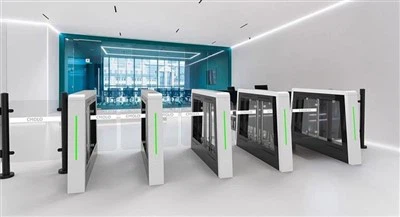
一,The main idea behind multi-channel parallel technology is to go from "single point control" to "global coordination."
When there is a lot of flow at sports arenas, traditional single-channel turnstiles sometimes have drawbacks including long lines and low verification efficiency. If a sports venue can hold 30,000 people and only one channel gate (30 people per minute) is open, it will still take more than 1.5 hours for everyone to get in. Modern turnstiles can cut this down to 30 minutes or less by using multi-channel parallel design and high-speed verification technology.
Companies like Haoyun Intelligence have introduced a multi-channel solution that lets them deploy dozens of channels at the same time using a single administration platform. Its main benefits are:
Hardware collaboration: using modular design, allowing for the mixed deployment of different models like three roller gates, wing gates, swing gates, etc., and being able to be combined in different ways depending on the width of the entrance and the flow of foot traffic. For instance, the main entrance has facial recognition wing gates that can let in 65 people per minute, the secondary entry has QR code swing gates that can let in 45 people per minute, and the roadway has license plate identification barriers that make a three-dimensional traffic network.
Software connection: All channels connect to the same administration backend so that personnel permissions can be configured in one place and entrance and exit data can be synced in real time. Management staff may keep an eye on the entire traffic situation and send resources from afar using mobile phones or computers. This gets rid of the problems that come with the old way of "information silos in different channels."
Dynamic scheduling: The system can change the number of open channels on its own based on how many people are walking by at the time. For instance, during the busiest time for tickets at a performance, convert 80% of the channels to admission mode. During halftime, certain channels switch to playing mode to balance the strain of two-way flow.
二, The path for technological implementation is to go from mechanical structures to smart algorithms.
The technical basis for achieving multi-channel parallel operation of rotary turnstiles arises from the profound integration of their distinctive mechanical design and intelligent control system.
1. Innovation in mechanical structure: physical support for high-density deployment
The full height rotary gate has a rotating construction with many sectors, and each blade is coupled by high-precision bearings to make a closed channel that goes all the way around. This design not only keeps people from climbing over and tailgating, but it also makes it easy to put a lot of units in a small space (each unit takes up about 0.8 to 1.2 square meters). For instance, in a project to renovate an international football stadium, engineers put in 10 full-height turnstiles next to each other in a 12-meter-wide entrance area. This allowed 650 people to pass through at once while still keeping fire exits and accessible places.
2. Intelligent control system: the "brain" of parallel verification
The main problem with multi-channel parallelism is figuring out how to make sure that numerous devices can verify and communicate data at the same time. The most popular solutions right now are:
Distributed architecture: Each gate has its own control board, and industrial-grade switches connect them to form a local area network that allows hundreds of devices to talk to each other in real time. For instance, Haoyun Intelligent's solution uses both 4G wireless transmission and cable networking to work in both indoor and outdoor settings.
Edge computing technology: install a lightweight AI system at the gate to quickly recognise a two-dimensional code or face (in less than 0.3 seconds) and cut down on the time it takes to upload data. In a large concert case, our technology caused the concurrent verification error rate to be less than 0.02% for 30 channels.
Cloud platform administration: The SaaS management system makes it possible to run and maintain various venues and projects from one place. For instance, a sports group runs gate equipment in 20 venues across the country using the same cloud platform. This cuts costs for running and maintaining the equipment by 40%.
三, A typical use case is full coverage, from event assistance to daily operations.
1. For big events, a "crowd firewall" that works in seconds
At the basketball sites for the 2024 Paris Olympics, full-height turnstiles will be closely linked to security and ticketing systems. When people buy tickets, they send in pictures of their faces. When you enter the venue, the gate immediately checks the ticket data against your biometric features to make sure the ticket is valid. The gate turns and lets the ticket go after it has been verified. The technology counts how many users are entering each channel in real time. When the number of people walking in a specific location goes over a certain level, some channels automatically close and the flow of people is directed to places with less people, which keeps them from getting trampled.
2. Concert Economy: The "Efficiency Revolution" with 30 Minutes of Cleaning
Haoyun Intelligent's multi-channel solution was used at a concert by a well-known singer. There were eight ticket gates put up around the gymnasium, and each gate had four gates (two for access and two for exit). After the show, the system automatically turns to "entrance mode." By changing the direction of the channels, 30,000 people may exit in an orderly way in 30 minutes, which is three times faster than the old way.
3. Daily operation: "cost reduction tool" that works 24 hours a day without people
After the university gym got smart full-height turnstiles, the job of verifying tickets by hand was no longer needed, saving the school over 500,000 yuan a year in labour expenditures. The technology limits who can enter by using card swiping or facial recognition. It also automatically collects entry data and connects to the venue reservation system to stop people from "skipping the venue." The gate also has anti-pinch sensors and emergency door opening buttons to make sure it meets fire safety standards.


WhatsApp : 0086-15999546575
Skype : cmolo.joy
Email : contact@cmolo.com
Tel : 0086-15999546575
CMOLO Industrial Park,NO. 144-1, Hengping Road,Henggang Street, Longgang District, Shenzhen City, China