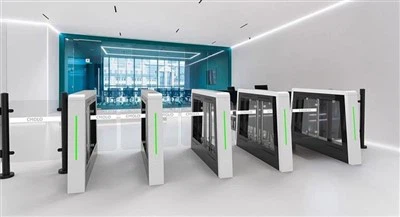
1. Technological innovation: raising response speed and awareness
High-precision identification technique
Turnstiles must be fast and precise in identifying passenger identity information under high pedestrian density. High-precision recognition technologies, including facial recognition, ID card swiping, and QR code scanning, should therefore be prioritized for introduction. These technologies not only enhance the speed of recognition but also effectively reduce errors and omissions, thereby ensuring consistent gate operation.
There is a mechanism for quick response transmission.
The key to guaranteeing the rotary gate's quick opening and closing is its transmission mechanism. Together with the improved transmission design, high-precision motors and sensors help speed up and smooth out gate openings and closings. Reducing mechanical friction and inertia simultaneously helps lower the gate's opening and shutting times, thereby optimizing the traffic speed.
Smart control mechanism
The brain of the turnstile, the intelligent control system, regulates the transmission mechanism, monitors the turnstile's condition, etc. It is responsible for absorbing recognition signals. Intelligent control systems need to quickly respond to identification signals, accurately manage transmission mechanisms, and monitor gate status in real time when there are many pedestrians to ensure it works properly. Advanced algorithms and artificial intelligence technologies help raise the intelligence degree of the control system and increase the gate passage speed.
2. Enhancement of Traffic Efficiency and User Experience in Optimization Design
Appropriate turnstile arrangement
Improving traffic efficiency in highly pedestrianized locations depends mostly on a reasonable gate layout. Scientifically arranging the turnstile count and location helps distribute pedestrian flow evenly, therefore lowering congestion and waiting times. Depending on people's direction and flow, we can install one-way or two-way gates to further increase traffic efficiency.
The design of the large channel is impressive.
Turnstile channel design is also a crucial determinant of traffic flow. Widening the channel and optimizing the form and location of the gate will simplify passenger passage, reduce physical contact and friction, and enhance traffic speed. Moreover, we can configure easily accessible channels to facilitate the passage of special groups.
Humanized operational interface
A user-friendly interface helps to lower waiting times and misoperation as well as enhance passenger experience. Passengers can quickly understand how to use the gate and what to be careful about thanks to a simple and clear interface, clear voice instructions, and light signals, which improves traffic flow.
3. Rather than Intelligent Management: Best Allocation of Resources and Emergency Reaction
Real-time observation and data analysis
Intelligent management systems need to monitor the current status of gates and how many people are moving around, especially when there are many pedestrians, to help manage operations effectively. Big data and artificial intelligence technologies allow one to thoroughly mine and analyze gate data, forecast peak flow periods and traffic trends, and offer a basis for gate layout and quantity change.
Change the gate configuration dynamically.
Real-time pedestrian flow data allows the intelligent management system to dynamically change the quantity and direction of gate openings to satisfy the demand for passenger flow in various directions. For instance, during busy hours, the system can lower the number of exit gates and raise the number of entrance gates to speed up passenger entry.
A system of emergency response
The gate may experience issues or congestion due to the high pedestrian density. Establishing a successful emergency response system is thus especially crucial. Remote monitoring and fault diagnosis technology help identify and address gate failures quickly, thereby lowering downtime. Simultaneously, we can configure backup gates and emergency channels to manage unforeseen events.
Bridge-Type Electronic Pedestrian Controlled Barrier


WhatsApp : 0086-15999546575
Skype : cmolo.joy
Email : contact@cmolo.com
Tel : 0086-15999546575
CMOLO Industrial Park,NO. 144-1, Hengping Road,Henggang Street, Longgang District, Shenzhen City, China