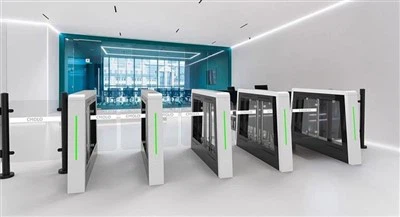
1. Technical collaboration: the logic for moving from physical isolation to smart interaction
The digital integration of the two main scenarios of "channel management" and "transaction management" is what makes turnstiles and self-service cash register systems work together. There are three key ways that its technology partnership shows up:
Linkage between identity identification and payment verification that is closed loop
The turnstile employs technologies like facial recognition, QR code scanning, NFC near-field communication, and others to swiftly check a customer's identity and let them through. When clients go to the self-service checkout area, the system immediately links their membership information, past purchases, and coupon pool. For instance, a certain chain supermarket has a 3D structured light facial recognition gate that can verify a person's identity in 0.8 seconds and sync their membership level, point balance, and other information with self-service checkout terminals in real time. This lets customers directly enjoy exclusive discounts at checkout and cuts down on the need for manual intervention.
Data sharing between route planning and managing inventories
The self-service cash register system keeps track of sales data for goods in real time and sends it to the gate management system over an API interface. When the stock of a given type of goods falls below a certain level, the gate can change the way it directs traffic to make sure that customers access the restocking section first. A quick fashion firm, for instance, used the connection between the gate and the self-service cash register system to find out that a certain T-shirt had a low conversion rate in the fitting room area. They quickly changed the gate queue to lead people to the most important promotional booths, which led to a 27% rise in weekly sales of the item.
Warning in real time about safety issues and strange behaviour
The rotary gate uses infrared sensors and pressure sensors to check that the amount of products that clients are carrying matches the shopping receipt. The gate locks itself and sounds an alarm when the system finds something wrong. It also sends data to the store's security centre. A test at a specific 3C store indicated that this functionality cut the theft loss rate by 92% and also cut down on customer complaints caused by human spot checks.
2. Scenario Revolution: Upgrading the whole link experience from a single transaction.
The combination of turnstiles and self-service checkout technologies is changing the four main experiences in retail scenes:
Correct reach scenarios for members
The technology automatically sends personalised welcome greetings and exclusive offers to members based on their level of membership. For instance, a certain cosmetic business has added an AR makeup test feature to the gate screen. When members enter the store, they may try on virtual makeup and get a voucher for "50 yuan off purchase after makeup test." This makes them 28% more likely to buy again. Also, the gate can be connected to the member's birthday system so that a personalised blessing voice can play on the member's birthday, which would make them feel more connected.
Scenario for peak period diversion
During the promotional period, the gate changes the speed of traffic based on the customer's past consumption statistics. During the "Double 11" era, for instance, a big supermarket sped up the gate from 30 people per minute to 45 people per minute. At the same time, high-value consumers were told to use self-service devices first by the "fast checkout channel" sign on the self-service checkout terminal. This cut peak wait times by 40% and raised the sales rate by 19%.
A retail situation with no people
In tiny establishments like community convenience stores, turnstiles with self-service checkout devices can make a "contactless payment" loop. The technology immediately links a customer's payment account after they enter the store using facial recognition. When they check out, the gate automatically completes the deduction by checking the weight sensor and the RFID tag of the goods twice. A test experiment for a certain chain convenience store indicated that this technique raised the daily average number of customers at a single location by 35% and cut labour expenditures by 60%.
Emergency management situation
There are 12 safety features on the turnstile, such as automatic power-off lowering and fire linkage, that make sure the channel can be cleared in three seconds in an emergency. For instance, during a fire drill at a retail shop, the turnstile responded to the situation three times faster than traditional access control. At the same time, the self-service cash register system automatically stopped transactions and made an unsettled order list, which made it easier for customer support to follow up later.
3, Data-driven: from traffic stats to detailed information about how people act as consumers
The structured data produced by turnstiles and self-service cash register devices is changing how stores make decisions about how to run their businesses.
Thermal study of passenger flow
The system can make heat maps of client flow by using Wi-Fi probes and Bluetooth beacons. For instance, a quick fashion firm learnt that 65% of customers lingered at the gate entrance for more than 8 seconds. They moved their promotional booth 3 meters forward based on this, which led to a 22% increase in try-on rates. The system can also look at gate traffic data from different times of day to help with personnel scheduling. For example, a chain restaurant linked gate traffic data to the ordering system during lunch peak hours, which cut meal wait times by 40% and raised turnover rates by 18%.
Predicting how people will act as consumers
When used with membership system data, the gate can find out what traits a high-potential customer has. For instance, a certain mother and baby business looked at the ages of their customers' babies and their own pregnancies and sent personalised product recommendations three days in advance. This raised the conversion rate by 34%. The technology can also guess how often consumers will pass through the gate and send them reminder messages before restocking. This will make customers happier.
Improving the efficiency of operations
Real-time tracking of how efficiently gates are used and how often self-service cash register terminals are used, with the option to change the arrangement of the equipment on the fly. For instance, a big supermarket used data analysis to find out that the self-service cash register terminals in the fresh food section were used less than those in the apparel section. So, they quickly put up gate guiding signs in the fresh food section and turned part of the manual cash register counters into self-service machines. This made the whole checkout process 25% faster.
4. How to carry out: From Choosing Equipment to Building for the Environment
Stores must use the "four step eight step" procedure to set up turnstiles and self-service cash registers.
Stage of need diagnosis
Passenger flow analysis: Find out the speed needed for the gate to work by counting passengers by hand or using temporary cameras to watch the busiest times. For instance, a community grocery used a 90° turnstile because there wasn't enough room. This conserved 30% of the space while keeping traffic moving smoothly.
Planning the route: Using the store layout plan, figure out where the gate and the self-service cash register terminal should be in relation to each other. A test in a department store found that putting the barrier within 5 meters of the lift entrance can boost the number of consumers going to the self-service checkout area by 40%.
The phase of system integration
Interface development: Make sure that the gate system can share data with self-service cash register terminals, membership systems, and inventory systems. For instance, a certain 3C store made a custom API so that the gate could instantly sync the warranty information of its members to the self-service checkout terminal after recognising them. This made the after-sales care experience better.
Payment docking: add support for member points deduction and connect several payment methods, like WeChat payment, Alipay, UnionPay cloud flash payment, and more. A test at a certain chain restaurant found that businesses that accept "points+cash" mixed payment have a 15% greater rate of members buying again than establishments that only accept one type of payment.
Stage for optimising operations
Building a data dashboard: Set up a platform for real-time monitoring that has 12 key indications, such as the efficiency of the gate, the rate of self-service checkout use, and the rate of member conversion. Through data analysis, a fast fashion firm discovered that the gate failure rate on Friday night was 40% higher than normal. So, the equipment maintenance cycle was changed to make the system available 99.97% of the time.
Training employees: Teach them how to do things like fix self-service cash registers and operate turnstiles in an emergency. Statistics from a supermarket show that workers who have had regular training are 60% more efficient at dealing with gate problems than workers who haven't had any training.
The period of continuous iteration
Technical improvements: To maintain the technology up to date, the biometric algorithm for the gate and the payment agreement for the self-service cash register system should be updated on a regular basis. For instance, a certain beauty business updates their gateway face recognition model every three months, making it more accurate from 98% to 99.5%.
Scenario expansion: Look into how gate machines, virtual fitting mirrors, smart shopping carts, and other equipment are connected. A pilot project for a quick fashion business reveals that connecting turnstiles and virtual fitting mirrors can keep customers in the store for 10 more minutes, which leads to a 25% boost in sales.
5. Future trend: moving from one gadget to a smart retail entry
As 5G and AIoT technology come together, turnstiles and self-service checkout systems are becoming super entrances for smart retail:
Integration of payment without thinking
A trial project at a convenience shop that used UWB ultra wideband technology to achieve "face recognition and instant payment" demonstrated that this feature made transactions 65% faster and customer satisfaction 40% higher during breakfast time.
Extension for managing health
Integrated infrared temperature measurement and health code recognition function. During the epidemic, a certain shopping mall passed the gate health screening. This made customers 41% more likely to enter the store, and the speed of passenger flow recovery was 30% faster than shopping malls without gate deployment.
Entrance to Metaverse Interaction
Customers can get virtual shopping help as they enter the business thanks to the connection between AR glasses and gate screens. A test by a sports brand found that this feature made customers 38% more likely to try on new products and kept them in the store for 8 more minutes.


WhatsApp : 0086-15999546575
Skype : cmolo.joy
Email : contact@cmolo.com
Tel : 0086-15999546575
CMOLO Industrial Park,NO. 144-1, Hengping Road,Henggang Street, Longgang District, Shenzhen City, China