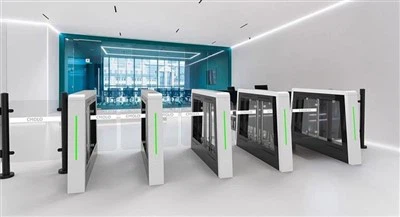
1. The technical principle: Deep integration of machines and smart technology
The main job of the rotary gate is to precisely manage the movement of people through the rotary gate arm. Its technical design has three main parts:
The structure of the machine: It is made of 304 stainless steel that has been stamped and shaped. It is resistant to rust and impact, and it can work in temperatures from -15 °C to 60 °C. The gate arm is normally 500 to 600 mm long and can handle traffic in either direction. It locks the zero position using an imperfect gear transmission system, which means that when the power goes out, the gate automatically lowers the rod, which meets fire safety standards.
Smart control system: It has an integrated RS485 communication port that lets it connect to access control systems, payment terminals, monitoring cameras, and other devices. It can recognise many types of identities, such as IC cards, QR codes, and facial recognition. In IC card mode, it can process up to 20 persons per minute. For instance, a chain supermarket's revolving gate system can automatically charge fees and open the gate by connecting to the member system through facial recognition. Non-members, on the other hand, have to scan the code and pay before they can pass through, which makes exit checkout 40% faster.
Safety features include collision sensors, anti-pinch gratings, emergency switches, and other devices. The brake arm stops moving and pulls back right away when it sees something in its way or an unusual impact. During pressure testing, a certain brand of gate machine can handle an impact force of 500 kg without bending. This makes sure that special groups like children and the elderly can pass through safely.
2, Scenario for use: from one exit to complete scene coverage
The use of turnstiles in managing supermarket exports has gone beyond traditional limits and created a variety of scene solutions:
Standard management of exports: The turnstile is connected to the self-checkout system in big grocery stores. The turnstile opens itself and records the time of departure when the passenger has paid. According to data from a global chain supermarket, the rate of export congestion dropped by 65% and the cost of manual inspection dropped by 80% after they put in turnstiles.
Channel just for members: It uses facial recognition technology to make travel easier for high-net-worth members. A high-end supermarket demonstrates that the use of member channels has gone up by 30% and the number of members who buy again has gone up by 15%.
Route for emergency evacuation: In event of a fire or other emergency, the gate can get fire signals and immediately lower the pole. It can also guide clients to the safe escape with speech cues. The gate system was connected to emergency broadcasting in a simulation of a shopping centre to cut the time it took to get everyone out from 5 minutes to 2 minutes.
Adaptation for special scenarios: The gate can have dust coverings and waterproof coatings for situations like fresh food supermarkets and warehouse-style businesses. It can also accommodate a broad channel design (with a maximum channel width of 600mm) to make it easy for shopping carts to get through. A certain warehouse supermarket's customised gate solution has cut the number of shopping carts that get stuck from 12% to 0.5%.
3. Main Benefit: Three-way balance of cost, safety, and efficiency
The value of turnstiles in managing supermarket exports is shown by how well they improve three main areas:
Improving efficiency: Automating traffic flow means less need for people to get involved. According to data from a chain supermarket in a given area, after the installation of turnstiles, the number of exit duty staff needed in a single store dropped by an average of 2 per day, saving the store over 500,000 yuan in labour costs each year. The gate can also handle traffic from multiple channels at once, and its processing speed during peak hours is three times that of standard manual channels.
Control of security: By recognising identities and keeping track of data, you can stop theft, evasion, and other bad behaviours. The loss rate for products in a supermarket went down from 1.2% to 0.3% after turnstiles were put in. This was especially true for fresh produce, where the loss rate went down a lot. The gate system can also be linked to the public security system so that the information on fugitives can be compared in real time, which would make public safety better.
Making the user experience better: Non-contact access is what people need in the post-pandemic world. According to a poll, 92% of customers think that gate access is "convenient, efficient, and technologically advanced." The gate also has bilingual prompts and a design that is easy for everyone to use, which is good for an ageing and international society.
4. Problems and Solutions: Technological Iteration and Scene Adaptation
Even though rotating turnstiles have a lot of benefits, they nonetheless have problems when used in real life:
The cost of a single gate is between 15000 and 50000 yuan, which puts some strain on small and medium-sized supermarkets. To fight back, they are using a leasing model, asking the government for smart retail subsidies, and splitting costs with equipment suppliers. For example, the "equipment rental+traffic sharing" concept helped a community supermarket cut its original cost by 70%.
Risk of technical failure: The gate may close because of wear and tear on the machinery or a network problem. Choosing modular design equipment, setting up localised control systems, and creating a 24-hour operations crew are all part of the answer. A certain brand of gate offers a "5-year full warranty+4-hour response" service, which keeps the failure rate of the equipment below 0.2%.
Adaptation to special situations: Customers who are hauling big things or using strollers may have trouble getting through. Some ways to improve are to make gate arms that can be pulled back, add large channels, and make sensors more sensitive. To satisfy particular needs, a supermarket has set up a "manual auxiliary channel" adjacent to the gate. This has led to a 20% improvement in consumer satisfaction.
5. The future trend is the merging of intelligence and ecology.
As AI, 5G, and IoT technologies get better, turnstiles will change in three main ways:
Deep intelligence: algorithms that analyse behaviour, recognise unusual behaviour in real time (such tailgating or breaking barriers), and set off alarms automatically. A certain laboratory's prototype has been able to find strange behaviours with 98% accuracy.
Complete scenario ecologicalization: Linked to ERP, CRM, and supply chain systems to make a closed-loop data system for the whole process of "in-store shopping payment departure." For instance, the gate can send the time the consumer leaves back to the inventory management system to improve how it restocks items.
No experience with impact: Get "gate free" passage with technologies like UWB ultra wideband location and millimetre wave radar. A particular tech company devised an invisible gate system that uses a ground sensor array to detect people moving about. This gets rid of the physical gate arms that people can see, but it still keeps safety in mind.


WhatsApp : 0086-15999546575
Skype : cmolo.joy
Email : contact@cmolo.com
Tel : 0086-15999546575
CMOLO Industrial Park,NO. 144-1, Hengping Road,Henggang Street, Longgang District, Shenzhen City, China