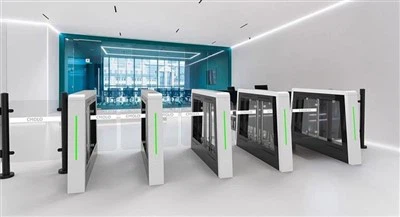
一, AI deep empowerment: from identity verification to behavior prediction
1. Integration of multimodal biometric recognition technology
Commonplace will be cross validation of facial recognition, fingerprint recognition, iris recognition, and vein recognition technologies. Under a test project in 2025, for instance, an international airport will implement "face+iris" dual factor authentication, therefore lowering the misidentification rate from 0.01% to 0.0001%. Simultaneously, it will incorporate mask recognition capabilities to strike a compromise between convenience and safety in the framework of an epidemic under control.
2. Behavior analysis and abnormal warning
Real-time analysis of human behavior trajectory by the rotary gate built on an artificial intelligence vision algorithm can For instance, a business complex has raised the interception rate of illegal incursion incidents to 99.2% after implementing deep learning models to recognize aberrant behavior such tailgating, backtracking, and roaming.
3. Group traffic optimising method
Dynamic change of rotation speed and channel width using artificial intelligence. Tens of thousands of spectators' entrance efficiency was raised by 40% by using a group traffic optimization algorithm in the refurbishment of a big sports stadium in 2026. Simultaneously, the channel load was tracked in real time using pressure sensors, therefore preventing trampling and crowding.
二, Sensorless traffic technology: from 'people adapting to devices' to' devices adapting to people '
1. Millimeter wave radar and UWB positioning
UWB technology achieves sub meter level positioning accuracy while millimeter wave radar can pass through garments to find human presence. Using these two technologies, the turnstile installed in a certain smart park in 2025 achieves "non-stop passage," so accelerating personnel's pace from 1.2 seconds per person to 0.3 seconds per person.
2. edge computing and localization decisions
To attain localized identity verification and behavior analysis, install artificial intelligence inference chips at the gate end. Edge computing architecture is applied to prolong the autonomous operation period of the gate from 15 minutes to 8 hours when the network is disconnected, therefore fulfilling the criteria of high security scenarios in the upgrading of a data center in 2026.
3. Multi device collaborative traffic
Devices include mobile phones, smartwatches, and access cards allow rotary turnstiles to reach cross terminal connection. Launched by a particular hospital in 2027, the "One Code Pass" technology lets patients automatically allocate medical channels depending on electronic medical record data and interact with the gate via Bluetooth on their mobile phones, therefore streamlining the hospital's internal flow.
三, Digital twins and full lifecycle management
1. Virtual debugging and predictive maintenance
Using digital twin technology, create a virtual picture of the rotary gate to get fault prediction and remote troubleshooting. This technology will be used at some rail transport hubs in 2025, therefore reducing the 2-week to 3-day equipment debugging cycle. Simulating 100000 failure scenarios will help to compress the maintenance response time from two hours to fifteen minutes by training AI diagnostic models.
2. Energy efficiency optimization and carbon footprint tracking
A rotary gate system installed in an industrial park in 2026 dynamically adjusts motor power and lighting brightness based on digital twin analysis of equipment energy consumption data, so lowering the annual power consumption of a single device from 120kWh to 45kWh and so reducing carbon footprint by 62.5%.
3. User behavior analysis and service optimization
The digital twin system follows user traffic patterns. Following the deployment of the system in a given office building in 2027 by means of an analysis of morning rush hour traffic patterns and gate channel layout, queuing time dropped from five minutes to one and half minutes. Simultaneously, tailored services-such as express reminders and coffee discounts-were pushed depending on user profiles.
4, Green Design: Sustainable Innovation from Materials to Energy
1. Biobased and Recyclable Materials
Using eco-friendly resources including bamboo fiber composite products and ocean recovered plastics. A particular scenic location will replace the outer shell of its rotary gate with bio based materials in 2025, accounting for 30% and so lowering its carbon footprint by 45%. Simultaneous with this will be modular design raising the shell recycling rate to 90%.
2. Solar energy and kinetic energy recovery
Mechanical kinetic energy recovery mechanism combined with flexible solar film. By means of solar power supply and mechanical energy conversion during pedestrian traffic, the rotary turnstile placed in a remote mountainous scenic area in 2026 achieves off grid operation, so lowering annual maintenance expenses by 80%.
3. Low power chips and adaptive sleep mode
implementing intelligent sleep algorithm and low-power semiconductor based RISC-V architecture. Combined with human body detecting technology, the improved turnstiles in a data center in 2027 have lowered idle power usage from 15W to 3W, so improving the equipment's general energy efficiency ratio by 80%.
5, Modular and Flexible Manufacturing: From Standardization to Scene Customization
1. Lego style functional modules
Turnstile supports hot plugging of modules like display panels, payment terminals, and sensors. Within 30 minutes by rapidly swapping modules, the gate system installed by a certain smart community in 2025 can go from "access control+attendance" to "access control+visitor registration" depending on different management requirements.
2. 3D printing and flexible production line
accomplishing small batch bespoke production with metal 3D printing technology. An increase of 60% above conventional technique, a high-end office building tailored a rotary gate in 2026 which reduced the thickness error of the shell within 0.1mm using 3D printing technology, and cut the delivery cycle to 7 days.
3. Scenario based AI model training
Train specific artificial intelligence models for factories, hospitals, and classrooms among other settings. By gathering 100000 images of the equipment to train the model, the explosion-proof rotary turnstile installed in a particular chemical industrial park in 2027 improved the accuracy of safety helmet recognition to 99.8% and lowered the false alarm rate from 5% to 0.2%.
Bridge-Type Electronic Pedestrian Controlled Barrier


WhatsApp : 0086-15999546575
Skype : cmolo.joy
Email : contact@cmolo.com
Tel : 0086-15999546575
CMOLO Industrial Park,NO. 144-1, Hengping Road,Henggang Street, Longgang District, Shenzhen City, China