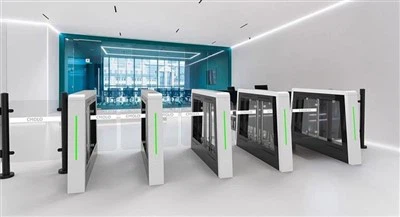
1. Mechanical Structure: Principles
Mostly made of the chassis, gate rod, transmission mechanism, limit device, and other components, the mechanical construction of the modern rotary gate forms the basis of its operation. The chassis, which serves as the supporting and protective framework of the entire device, is home to key components such as motors, reducers, and internal transmission shafts. Driven by the transmission mechanism to attain rotational motion, the gate rod is the fundamental component of the rotary gate; therefore, it regulates the opening and closing of the channel.
The transmission mechanism is responsible for converting the motor's rotational motion into the brake lever's rotational motion and serves as a main link between the motor and the brake lever. Usually speaking, the transmission mechanism uses gear or chain transmission, which offers low noise, excellent transmission efficiency, and long service life. The limit device is used to limit the rotation angle of the gate rod, therefore guaranteeing that the gate rod can be precisely in place when opening and closing and so preventing damage resulting from too great rotation.
2. Electrical Control Principles
Reaching automated operation with modern rotary turnstiles depends on electrical control. The electrical control system is mainly composed of the primary control board, motor drivers, sensors, power supply, and other components. Comprising the basis of the whole electrical control system, the main control board is responsible for receiving external signals (such as facial recognition signals, card swipe signals, etc.), so guiding the actions of motor drivers under preprogrammed control.
Driving the rotational motion of the brake lever depends on the motor driver transforming the control signal of the main control board into the driving signal of the motor. The gate's position, personnel's status in the channel, and other data are detected by sensors, which also send feedback to the main control board, allowing it to make matching control decisions. The power supply guarantees the regular operation of the equipment by giving the whole electrical control system consistent electricity.
3. Identification Technology: Foundations
Intelligent control of modern rotating turnstiles depends much on identification technology. Currently, the most often used mainstream recognition technologies available on the market include QR code scanning, RFID recognition, facial and fingerprint recognition, etc. Though they have different advantages and drawbacks, these recognition systems can all quickly and precisely verify identity.
Facial recognition technology, for example, uses cameras to record facial photos and algorithms to extract and match elements from the images to identify pedestrians. When a genuine user is found, the main control board will send a door opening signal, which drives the motor to rotate the gate rod to open the channel; when an unauthorized user is found, the main control board will set an alert signal and refuse to open the channel.
4. Working Methodology Principles
One may summarize the modern rotary gate's operation as follows:
When the device is in standby mode, the gate is closed, and the electrical control system is in low-power standby mode, waiting for outside signals to set.
Users may check their identity by card swipe, facial recognition, or other techniques should legislation call for it. The recognition system gathers user data and checks it against a pre-made database to confirm user validity.
Should the verification go through, the primary control board will signal a door opening action. The motor driver will drive the motor to rotate following the signal, therefore rotating the gate rod and opening the channel. Simultaneously, sensors track the location of the gate and personnel's state in the channel to guarantee a safe channel opening.
Users of the gate can easily go through the route. At this point, the electrical control system will be monitoring individuals in the channel to prevent violations such as tailgating.
The main control board will transmit a door-shutting signal, depending on the configured time delay or when the sensor detects no one in the channel after the user effectively goes through it. The motor driver will run the motor in the opposite direction to close the channel.
After the gate closes in position, the electrical control system moves back to standby mode to wait for the next traffic demand triggering.


WhatsApp : 0086-15999546575
Skype : cmolo.joy
Email : contact@cmolo.com
Tel : 0086-15999546575
CMOLO Industrial Park,NO. 144-1, Hengping Road,Henggang Street, Longgang District, Shenzhen City, China