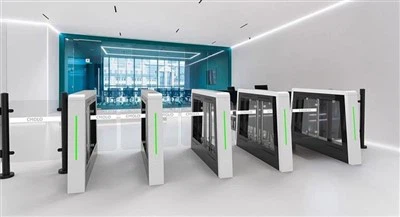
The difficulties of transit hubs and turnstile implementation
Transportation hubs, such as airports, train terminals, and subway stations, handle tens of thousands of people daily. Many difficulties have been brought about by this extensive flow of people: how to rapidly and successfully control personnel entrance and exit to guarantee orderly passage; how to prevent illegal intrusion or fare evasion and maintain operational security; and how to ease traffic during peak hours and improve passenger experience. These difficulties make conventional fence design or manual ticket verification insufficient to satisfy the requirements of contemporary transit hubs. Consequently, rotary turnstiles have become a useful tool for addressing the above-indicated issues.
Increase traffic flow.
The turnstile's distinctive mechanical structure design helps people to move in one or both directions orderly. Passengers only need to bring their ticket card or QR code close to the card reader; the gate will automatically open so they may pass fast. Especially during peak hours, turnstiles drastically cut passenger travel time when compared to conventional manual ticket checking or fence-style channels, therefore relieving congestion and enhancing general traffic efficiency. Furthermore, supporting several payment options, like mobile payments, NFC cards, etc., the turnstile helps travelers even more by speeding travel.
Improve security administration.
The main idea guiding the operation of a transportation hub is safety. By means of physical isolation, the turnstile essentially stops illegal intrusion or ticket evasion. Only travelers with valid tickets will be able to enter or exit the transit hub since the gate will open only after confirmation. Simultaneously, the turnstile features sophisticated sensors and monitoring systems that can track the state of the gate in real time and identify and manage aberrant events in a timely manner, including gate jamming, passenger retention, etc., so guaranteeing passenger safety and the regular running of the transportation hub.
Simplify the traveler experience.
One of the key markers of the caliber of transportation hub services is the passenger experience. With their simple, clear operational interface, rapid response gate opening speed, and comfortable driving environment, rotary turnstiles give travelers a handy and quick travel experience. Particularly for travelers with limited mobility or bags, the turnstile's roomy passageways and easy-to-use design help them pass through, minimizing passenger inconvenience and trouble during the passage. Furthermore, with a focus on aesthetics and durability, the turnstile's look, design, and material choice give the transit hub modernism and technological influence.
Advise on smart management.
As information technology develops constantly, transportation hubs are turning toward intelligence and informatization. Turnstiles, a vital part of intelligent management in transportation hubs, use seamless integration with information systems like ticketing systems and monitoring systems to achieve real-time data collection, analysis, and processing. Along with more customized and intelligent services for passengers, such integration gives significant data support for the operation and management of transportation hubs. By means of turnstile passenger flow data, for instance, transportation hubs can make real-time capacity arrangement adjustments and resource allocation optimizations; by means of passenger behavior data, more accurate travel recommendations and services may be given to passengers.
Intelligent Outdoor Turnstile Barrier Gate


WhatsApp : 0086-15999546575
Skype : cmolo.joy
Email : contact@cmolo.com
Tel : 0086-15999546575
CMOLO Industrial Park,NO. 144-1, Hengping Road,Henggang Street, Longgang District, Shenzhen City, China