一,Layered Collaborative Intelligent Security System is the technical architecture.
1. The hardware layer Combining multimodal perception tools
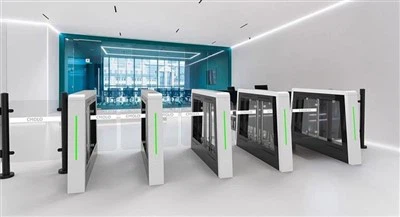
Rotary gates support three control interfaces: TCP/IP, RS485, and dry contact. They use a dual channel electromagnetic lock construction. For instance, the primary control board of the Hikvision Easy 2 series has NFC tags that can be set up using a smartphone application. The braking wing can be deployed in less than 0.3 seconds and has a channel design that is 1200mm wide to accommodate shopping cart access.
Security camera: Use a 5-megapixel CMOS sensor, dual spectrum intelligent camera, enable H.265 encoding, and have night vision that is as good as starlight. With a false alert rate of less than 0.5%, a particular chain grocery initiative combines cameras with gait recognition technology that can precisely identify consumer gait features within 30 metres.
To accomplish localised AI analysis, use the NVIDIA Jetson AGX Orin computer module as part of your edge computing setup. According to a project's actual test, the device can process 16 channels of camera data at once with an event reaction delay of less than 80 ms.
2. Network layer: Guaranteed low latency communication
To guarantee synchronised transmission of gate control instructions and video streams, IEEE 802.1Qbv time aware shaping technology and the TSN time sensitive network architecture are used. According to testing on a specific Wanping supermarket project, this architecture meets the 1-second time restriction needed for fire evacuation by cutting the linkage response time from the conventional 1.2 seconds to 0.4 seconds.
3. Software layer: Decision-making is powered by a rule engine
Install a rule engine that supports visual rule configuration and is based on the FIWARE universal enabler. For instance, when the camera determines that the shopping cart has been stalled for more than five minutes and the gate is not activated, a composite rule can be configured to sound and light an alert and send a notification to the administrator app. Using this engine, a regional supermarket initiative has increased handling abnormal events by 67%.
二,Linkage mode: Intelligent response depending on scene
1. The mode that prevents theft and loss
Behaviour recognition linkage: The camera immediately pauses the gate opening authorisation and begins monitoring and shooting with three nearby cameras when it identifies aberrant behaviour of "quick pickup+facial occlusion." This methodology lowers the product loss rate by 42%, according to data from a particular project.
Warning about facial comparison: "Abnormal personnel detected, please contact security immediately" is the voice message that will play when the gate automatically locks and a fugitive is detected by connecting to the public security blacklist database. Three instances of fugitive personnel infiltrating were successfully stopped following the execution of a particular project.
2. Emergency mode for fire
Mechanism of hierarchical response: Level one alarms, which are set off by smoke detectors, cause the gate to open all of its channels. Level two alarms, which are set off by temperature sensors, cause the gate to widen to 1500 mm and activate the emergency lighting linkage. In a commercial complex exercise, this method resulted in a 35% reduction in evacuation time.
Video review feature: The system automatically records the last ten seconds of footage of people coming and leaving after the gate is released, then projects it onto the screen of the fire control room. Using this feature, a particular project was able to successfully remove two false alarm incidents.
3. Mode of operation optimisation
Analysis of passenger flow heat: Create an in-store heat map by combining camera trajectory data with gate traffic statistics. When a clothing brand retailer made the necessary display adjustments, sales in high-demand areas increased by 28%.
Linkage for non-sensory payments: The gate will automatically open after the camera determines that the customer has finished self-checkout. The queue time during peak hours dropped by 58% following the installation of a supermarket scheme.
三, Analysis of typical application scenarios
1. A supermarket that is open around-the-clock without employees
Install a 3D structured light camera with live detection capabilities and use a turnstile to create a closed-loop verification system. During customer registration, facial features and gait data are gathered, and upon admission, two factor authentication (face+gait) is carried out. According to a project's operational data, this plan eliminated lagging entry events.
2. Supermarket for cold chain logistics
Linkage is accomplished by LoRa wireless communication, which uses an explosion-proof gate and a low-temperature resistant camera that can operate normally in a -30 °C environment. The camera indicates the anomalous region and the gate automatically prevents personnel access when the cold storage door is opened for longer than allowed. The cold chain loss rate dropped by 19% following the launch of a fresh food store operation.
3. A boutique supermarket that is membership based
To accomplish the "shopping recognition" feature, the intelligent shelf camera is connected to the gate that has an embedded RFID reader. The technology immediately completes settlement and pushes electronic bills when clients carry goods through the gate. Data from a project involving a high-end supermarket shows that this method has quadrupled checkout efficiency.


WhatsApp : 0086-15999546575
Skype : cmolo.joy
Email : contact@cmolo.com
Tel : 0086-15999546575
CMOLO Industrial Park,NO. 144-1, Hengping Road,Henggang Street, Longgang District, Shenzhen City, China