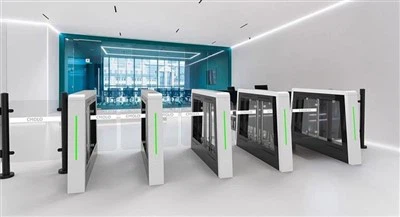
Modern turnstiles dynamically switch working modes and monitor traffic demand in real-time by means of built-in passenger flow density sensors (such as millimeter wave radar and infrared matrix sensors).
Peak mode: Full power operation (motor power 120 W), satisfying the 30 person/minute traffic requirement.
Peak shaving mode: fit for low-frequency situations with five individuals per minute by running at a lowered frequency (motor power of forty W).
Starting when there is no need for passage, standby mode is ultra-low power sleep (motor power 5W).
Using Beijing Daxing International Airport as an example, its intelligent turnstiles use dynamic power control technology to yearly save 1800 kWh for a single device, which is equivalent to lowering 1.2 tons of carbon dioxide emissions. This method lowers equipment idle operating time and improves energy use to 85%, 40% more than conventional turnstiles.
During the deceleration phase of the gate, the modern rotary gate creatively presents an electromagnetic damping power-generating module, which transforms mechanical kinetic energy into electrical energy.
Generating current by the relative motion of permanent magnets and coils is electromagnetic induction power generation.
Storage for supercapacitor energy: High-power-density capacitors with 10F capacity and 48V withstand voltage hold the recovered electrical energy.
Cycle powered by oneself: By providing power to sensors and controllers, the energy storage system helps lower outside power dependency.
Meeting 20% of its own demand, the rotary turnstile at Shanghai Hongqiao Hub recovers an average of 0.8 kWh of electricity per device daily. Promoted in major transportation hubs around the nation, carbon emissions can be dropped by more than 500,000 tons yearly.
To provide double energy savings, the rotary gate combines phase change energy storage materials with ambient light sensors:
Dynamic brightness adjustment of the display screen (50–500 cd/m²) based on the ambient illumination (0–100000 lux)
Thermal energy recovery: gradually releasing motor waste heat at night for equipment insulation utilizing phase change compounds (like paraffin) to absorb it
Whereas the thermal management system lowers the rate of equipment failure in winter by 82%, therefore reducing maintenance expenses by over 60% yearly, the rotating gate light detecting system at Guangzhou Baiyun Airport reduces the lighting energy consumption of a single device by 65%.
To accomplish localized data processing, the turnstile features a built-in edge computing module-like NVIDIA Jetson AGX Xavier:
Real-time decision-making: mode switching within 0.3 seconds and comprehensive passenger flow prediction
Data filtering: Send only important events (like fault alarms and peak energy use) to the cloud.
supports several industrial protocols like MQTT and OPC UA by means of protocol adaptation
Shenzhen Bao'an International Airport's turnstile edge computing system has lowered the data transmission volume by 90% and the network bandwidth consumption by 75% and raised the system response speed down to the millisecond level.
The cloud platform creates a virtual turnstile model using digital twin technology, therefore obtaining
Energy consumption simulation: projecting curves in energy consumption under several passenger flow conditions
Predicting Motor Life: Fault Warning Drawing on LSTM neural networks
Dynamic device parameter adjustment via reinforcement learning techniques optimizes strategy.
By means of the cloud platform system of the Hangzhou East Railway Station hub, average equipment energy consumption has been lowered by 32%, maintenance expenses by 45%, and equipment service life by 20%.
Connecting rotary turnstiles to the microgrid system of transportation hubs allows one to achieve
Either reversing it to the power grid or injecting recovered electricity into on-site energy storage systems connected to the grid
Demand response: Change equipment running strategy depending on signals of the power price.
Device-level energy consumption and carbon emission reports help to track carbon footprints.
By means of a 95% utilization rate of electricity recovered by turnstiles, the microgrid system at Chengdu Tianfu International Airport has lowered yearly electricity purchase expenses by 1.2 million yuan and generated carbon trading income of over 300,000 yuan.
Classifier of Energy Efficiency: Level 1 energy efficiency (standby power consumption) 5 W and Level 2 energy efficiency (standby power consumption) The category includes 10W rotary turnstiles.
Based on the heat map of passenger flow, change the gate's location to lower unnecessary operation.
Using changeable energy-saving components (like LED display panels and permanent magnet motors) and modular design
Phase of installation and debugging:
Calibration of parameters: Change the temperature and light sensing threshold in line with the on-site surroundings.
System integration debugging is using elevators and security inspection tools to achieve linkage start and stop.
On-site testing with the FLUKE 1736 energy analyzer aims at energy efficiency.
Stage: Operation and Maintenance Management
Preventive maintenance: based on vibration sensors, forecasts of mechanical wear
Energy Efficiency Audit: Create monthly equipment energy consumption and carbon emission reports.
The OTA technique helps optimize control algorithms, thereby improving firmware.


WhatsApp : 0086-15999546575
Skype : cmolo.joy
Email : contact@cmolo.com
Tel : 0086-15999546575
CMOLO Industrial Park,NO. 144-1, Hengping Road,Henggang Street, Longgang District, Shenzhen City, China