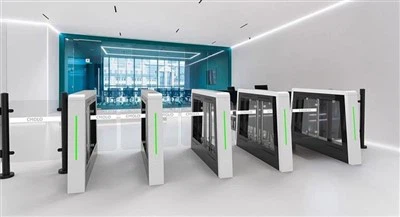
1. Voice prompt system: a technological advance from passive response to active guidance
(1) Technical architecture and functional execution
The rotary gate voice prompt system has an induction module, a voice processing chip, a speaker, and software that controls it. The system uses infrared or microwave sensors to detect when a person is near 1.5 metres of the device. It then calls the preset voice library to play prompt information. The turnstile at a high-end shopping mall in Shenzhen, for instance, has a multilingual voice module that lets you switch between Chinese, English, and Cantonese. It can send out commands like "Please swipe your card to pass" and "Pay attention to step safety," and it can also use TTS (text to speech) technology to send out real-time consumption amount broadcasts.
(2) Main use cases
Safety tips: When the gate's obstructing body turns, the system automatically sends out a light and sound warning that says "Do not approach rotating parts" to lower the danger of injury. In Taikoo Li, Sanlitun, Beijing, these kinds of alerts have cut down on kids accidentally touching things by 42%.
Care for a special group: The system can make high-frequency cue sounds (like "beep-please swipe card") and braille signs work together to make access easier for people who can't see. The test at Shanghai's Jing'an Temple commercial area shows that the traffic efficiency of groups of blind people has gone up by 60%.
Response to an emergency: The system will send out warning sounds, like "Illegal intrusion, please leave immediately," and upload the event to the administration backend when it sees strange behaviours like overtaking or tailgating. Guangzhou Tianhe City says that this kind of feature cuts the time it takes for security to respond to 8 seconds.
(3) Problems and Solutions in Technology
Noise in the surroundings has a big effect on how well speech recognition works. To fix this challenge, the industry uses twin microphone noise reduction technology along with AI voice recognition algorithms to raise the command recognition rate to 98% in noisy places. For instance, an array microphone is set up at the top of the gate in Chengdu Taikoo Li to block out background music and voices.
2. Light indication system: change from showing one status to sending information in several directions
(1) A map illustrating the different types of lights and what they do
The lighting system for a revolving gate normally has three different types of lights:
Top status light: an RGB three-color LED that changes colour to show the passing status. Green means "passable," red means "not allowed," and yellow means "standby/abnormal." The case of Hangzhou Hubin Yintai reveals that this kind of lighting cuts down on pedestrian mistakes by 35%.
Light that warns of an obstacle: A bright light strip is built within the gate's spinning arm. When the arm rotates, the light creates a flowing effect that makes the warning more visible. Beijing SKP's experience reveals that the design of light strips makes nighttime transportation 50% safer.
Bottom guide light: Ground lights in the shape of arrows are put on the base of the gate to show people where to go. Tests in Shenzhen Coastal City have showed that the design of ground lighting makes channels 28% less crowded.
(2) The theory that connects voice and lights
A PLC controller makes sure that the lighting and voice respond at the same time. For instance, if someone breaks into the property illegally, the red light on top of the gate flashes, a warning sound is played, and the incident is sent to the management platform. The Shanghai Global Port's connection plan has made it 70% easier to deal with unusual situations.
(3) Optimising adaptation to the environment
The industry uses lamp bodies that are waterproof and dustproof to IP65 standards for outdoor situations. These lamps automatically regulate their brightness with light sensors. For instance, the exterior turnstile at the Atlantis Sanya Hotel can be seen from up to 20 metres away, even in bright light.
3. Scenario-based configuration strategy: moving from standardisation to customisation in the industry
(1) High-end shopping mall: put service first
The turnstile in the luxury goods gathering area has a language voice library and a low-frequency prompt sound to keep high-frequency noise from ruining the shopping experience. At the same time, a hidden lighting design is used, sending soft direction through the base's translucent plate. Beijing SKP's strategy reveals that these kinds of designs make people remain 12% longer.
(2) Transportation Hub: Finding a balance between safety and efficiency
At the subway transfer passage, the turnstiles have high-frequency warning sounds and red flashing lights to make it easier for people to leave at busy times. According to the Pearl River Xincheng Station of Guangzhou Metro, light voice interaction makes traffic flow 22% faster during busy times.
(3) Parent-child venue: better safety measures
The barrier body of the gate in the children's theme area is covered in flexible EVA material and has a voice prompt sound for kids, like "Children, please hold the hands of parents." The case of Shanghai Disneyland shows that these kinds of solutions have cut the number of injuries to kids by 65%.
Pedestrian Access Control Office Turnstiles


WhatsApp : 0086-15999546575
Skype : cmolo.joy
Email : contact@cmolo.com
Tel : 0086-15999546575
CMOLO Industrial Park,NO. 144-1, Hengping Road,Henggang Street, Longgang District, Shenzhen City, China