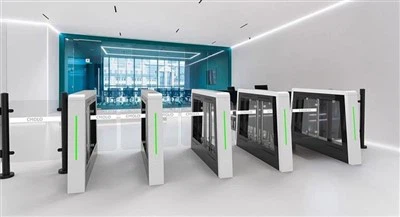
一, Design Optimisation: Changing from a physical space to a mechanical structure
1. Designing the width and height of the channel
A traditional turnstile's channel width is usually 550 to 600 mm, which is barely wide enough for one person to pass through. The channel width needs to be increased to 800–900 mm for baby strollers that are about 650–750 mm wide. For instance, the broad channel turnstile on Shenzhen Metro Line 14 has a channel width of 850mm, which is wide enough for a standard baby stroller and one person to pass through at the same time. The bottom of the gate wing should be at least 150mm above the ground so that it doesn't hit the storage basket at the bottom of the stroller.
2. New ideas for the structure of door wings
Because of how they are built, traditional three-roll brakes or scissor doors might become stuck on the wheels of infant strollers. The full height turnstile can greatly increase compatibility by making the gate wing design better:
The edges of the flexible door wings are encased in a 5mm thick silicone buffer layer that automatically retracts when the door hits something to lessen the impact on the stroller.
Adjustable angle door wing: The door wing may now rotate from 90° to 120°, making the path larger and less likely to become stuck.
Door wings that don't block access: Some high-end turnstiles, like those made by Shenzhen Jieshun Technology, include door wings that can be taken off by hand in case of an emergency. This lets strollers get through without any barriers.
3. Design for slope and anti-skid
The channel's entry should have an anti-slip slope that is less than 1:12 and a surface made of rubber or embossed steel plate with a friction coefficient of at least 0.6. For instance, the entrance slope of the turnstile at Guangzhou South Station is 1.2 metres long and 1:15 degrees steep, which makes sure that the baby stroller works smoothly. The ground inside the corridor should also be level so that the baby stroller doesn't tip over because of variances in height.
二,Technological Upgrade: Working together to make intelligent perception and dynamic control better
1. Multi modal sensor fusion
Traditional turnstiles just use infrared sensors to tell if someone is passing through, which might easily mistake strollers for "trailing" behaviour. The new generation gate has the following sensors built in:
Millimetre wave radar: finds out how big things are in the channel (accuracy ± 2cm) and automatically lengthens the time the door wing opens (from 3 seconds to 8 seconds) after finding the stroller;
Pressure sensor: A pressure sensing pad is put on the ground of the channel to measure the weight of the stroller (typically between 8 and 15 kg) and start the "wide channel mode."
Visual recognition: It can avoid the door wings closing by employing a camera to recognise the contour of a baby stroller and AI algorithms to figure out which way to go.
2. Optimisation of dynamic control logic
The control board has to be updated to an intelligent system that can make decisions based on more than one condition:
Priority control: When a baby stroller is spotted, the gate automatically stops the door wing movement of other channels to avoid a collision;
Delayed closure: After the door wings are opened, they should stay fully open for 5 to 8 seconds (traditionally 3 seconds) to make sure the stroller goes all the way through.
If the sensor fails, the gate will automatically go to the "normally open" position and the LED panel will show "manual push rod passage."
3. Watching and acting from afar
Real-time monitoring features need to be built into the management platform:
Video review: When the gate alarm goes off, managers can use the mobile app to see the video in the channel and tell from a distance if it's a stroller going through;
In case of an emergency, management may easily open all the gate wings with one click to keep the baby stroller from being stuck.
Data statistics: The system keeps track of how many times baby strollers travel by, how often there are jams, and how long it takes to process, all of which help improve design.
三, How to manage: Building plans for anything from on-site help to emergency plans
1. Help and identification on site
Identifying a special channel: Put up a sign next to the gate that says "priority channel for baby strollers" using symbols that are recognised around the world, like a baby stroller icon and an arrow.
speech prompt: When a baby stroller is identified, the gate's built-in speech module plays the prompt "Please use wide channel."
Staffing advice: At busy times, have staff at the gate to help those with strollers find the right channel.
2. Making a plan for emergencies
Quick reaction mechanism: If the baby stroller gets stuck, staff need to get there within 30 seconds and fix the problem by unlocking the door or changing the angle of the door wing;
Backup channel: Make sure there is at least one channel next to the gate group that is wide enough (≥ 1.2m) and has manual push rods so that special equipment like strollers and wheelchairs can get through.
How to handle complaints: Keep a log of times when strollers get stuck, get in touch with users within 24 hours, and finish checking and improving the equipment within 48 hours.
3. Testing and maintenance on a regular basis
Checking the mechanics: Every month, check the door wing buffer layer, pressure sensor, and slope anti-skid performance, and replace any worn parts.
Update the software: Every three months, improve the algorithm for the control board and the model for recognising strollers;
Stress testing: Every six months, set up traffic situations with baby strollers to check how quickly and accurately the gate responds.
四, Teaching users: Improving both ways, from usage standards to safety awareness
1. Use the same kind of promotion
A picture guide: Put up a diagram of the procedures to take to get through the baby stroller passage adjacent to the gate. For example, "Push the stroller to the sensing area, wait for the door wings to fully open, and then slowly pass."
Video guide: Play the demonstration video of a stroller going through the site's official account or LED screen. The movie should last no more than 1 minute.
Live demonstration: When the new venue is open, have personnel pretend to push baby strollers through it and show people how to utilise it correctly.
2. Teaching people about safety
Set up warning signs like "Do not forcefully push the cart" and "Keep the speed slow" near to the gate to notify people of the danger.
Child care reminder: If you have a stroller, please raise the child through the gate so that other kids don't have to go through it alone.
Emergency contact: Make the contact information for the management staff next to the gate group known so that users can get aid.
五,Industry Practice: Look at advanced cases from home and abroad
1. The Tokyo Metro Station in Japan
Tokyo Shinjuku Station has a "dual channel turnstile" with a main channel that is 900mm wide and has millimetre wave radar and pressure sensors. When strollers go through, the door wings close automatically after a short wait. At the same time, there is a 1:15 slope at the entrance to the tunnel and anti-slip rubber on the ground. This has cut down on the number of times strollers get stuck to fewer than once a month.
2. The Marina Bay Sands Hotel in Singapore
The turnstile in the hotel lobby has a visual recognition technology that can tell the difference between strollers and conventional baggage. When a baby stroller is identified, the gate automatically goes into "low-speed mode," which cuts the door wings' rotation speed in half to make sure that people can get through safely.
3. Shenzhen Metro Line 14 in China
The door wings are composed of flexible polycarbonate, and the turnstile channel is 850 mm wide. It is 180mm off the ground at the bottom. The LED panel shows a "baby carriage priority" message and the door wing opening time is extended to 10 seconds after the system uses AI algorithms to find the baby carriage.
Office Security Speed Gate Turnstile


WhatsApp : 0086-15999546575
Skype : cmolo.joy
Email : contact@cmolo.com
Tel : 0086-15999546575
CMOLO Industrial Park,NO. 144-1, Hengping Road,Henggang Street, Longgang District, Shenzhen City, China