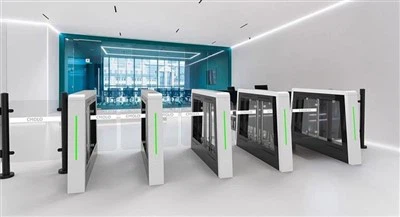
1, Security requirements
Safety is the most basic and important requirement for rotary turnstiles. This is mainly reflected in the following aspects:
Personnel safety: Rotary turnstiles should be designed with a comprehensive anti pinch mechanism to prevent injury accidents during personnel passage. Especially during the movement of the door leaf, if someone is detected in the operating area of the channel blocking part, the blocking part should be able to immediately stop moving or automatically operate to allow passage. In addition, the gate should also have an emergency control device, such as a central rotating arm that can rotate freely in the event of a power outage to ensure smooth passage.
Security and safety: Rotary turnstiles should have powerful functions for detecting, preventing, and alerting against illegal entry. This includes a tailgating detection function, where if unauthorized personnel attempt to enter through the channel and are detected, the gate will sound an alarm and display an indicator light. This function effectively prevents the occurrence of personnel following and enhances the safety of the venue.
Performance safety: The motor technology, fault free operation time, personnel throughput rate per unit time, and system maintainability of rotary turnstiles are all important factors that affect their performance safety. High end rotary turnstiles usually use DC brushless servo drive technology, which has the advantages of fast operating speed, no mechanical loss, accurate positioning, and smooth operation, greatly improving the reliability and stability of the turnstile.
2, Appearance requirements
The appearance of a turnstile is also an important reflection of its quality, mainly including the following aspects:
Surface quality: The surface of the gate should be flat and clean, without defects such as burrs, burrs, sand holes, pores, scratches, deformations, damages, rust, corrosion, etc. The surface of the coating and coating layer should have no traces after finishing, no impurities embedded or attached to the surface, no cracks, bubbles, or surface peeling.
Sign requirements: The gate sign should be clear and firm, including product name, specifications, manufacturer's name or trademark, safety warning signs or symbols to prevent hand clamping, dangerous voltage signs, safety grounding signs, etc. These signs should be prominently marked on the gate body or corresponding location, and not easily erased.
3, Functional requirements
The functional requirements of a turnstile are the key to its ability to meet usage needs, mainly including the following aspects:
Access control: The gate should be able to receive input signals from manual operation or entrance/exit control systems allowing/prohibiting access, and correspondingly enter the allowed/prohibited access state. When the gate receives a signal to allow passage and transitions to the allowed passage state while in the prohibited passage state, if it exceeds the allowed entry time and detects that no personnel are passing through the part of the channel where the finger is pulled, it should automatically return to the prohibited passage state.
Warning function: The gate should have a complete warning function, such as detecting personnel entering the channel without receiving the permission signal, detecting personnel entering the channel in reverse after receiving the permission signal, failing the self check of the gate when turned on, or when the actual time for personnel to pass the channel exceeds the set permission time. The gate should be able to issue a warning.
Anti tailgating function: Gates with anti tailgating function should issue warnings for tailgating events and take corresponding measures.
Self checking function: The gate should have self checking functions for control, driving, blocking, and visual/auditory indication, and have corresponding actions or instructions.
Communication interface: The gate should support one or more communication interfaces, such as RS485/232/422, Ethernet, CAN bus, etc., to facilitate communication with the upper computer or control system.
4, Installation requirements
The installation of rotary turnstiles has a crucial impact on their effectiveness and lifespan, mainly including the following aspects:
Develop a reasonable plan: Before installation, timely and complete communication with the customer should be conducted to understand the environmental conditions on site and determine the plan. Including selecting whether to use waterproof boxes based on the on-site environmental conditions, determining the number and shape of gates based on the width and length of the passage, etc.
Preparation work: Prior to installation, plastic pipes should be pre embedded and slotted on site according to the actual size of the turnstile for power and signal lines. There should be a certain gap between the gate equipment to facilitate opening the top cover, adjusting the gate equipment machine, and maintenance.
Fixed adjustment: The turnstile should be placed horizontally with the ground to ensure its optimal performance and lifespan.
Check the grounding wire: After installation, check whether the chassis is grounded to ensure the personal safety of the user.
5, Maintenance and upkeep requirements
In order to ensure the long-term stable operation of the turnstile, regular maintenance and upkeep are also required, mainly including the following aspects:
Exterior Cleaning: Conduct exterior cleaning at least once a week to remove rust spots, polish the exterior of the chassis with a soft cloth and baking powder, and apply rust proof oil.
Electrical control inspection: Check if there are any problems with the electrical control part, inspect if the power supply is exposed and wrapped, check if the wires are aging and replace them, etc.
Gate inspection: Regularly check whether the gate (blocking body) of the gate is damaged. If it is damaged, it should be dealt with in a timely manner and attention should be paid not to collide with the gate.
Power management: When repairing or maintaining the power gate, be sure to turn off the power connected to the machine, and it is strictly prohibited to plug in or unplug the port with electricity to connect to the socket.
Screw inspection: Regularly check whether the fixing screws between the gate plate, motor, and rotating arm of the gate are loose. If they are loose, they should be tightened in a timely manner.
https://www.cmolo.com/forefront-turnstiles/retractable-flap-barrier-system.html


WhatsApp : 0086-15999546575
Skype : cmolo.joy
Email : contact@cmolo.com
Tel : 0086-15999546575
CMOLO Industrial Park,NO. 144-1, Hengping Road,Henggang Street, Longgang District, Shenzhen City, China