1. Mechanical Structure: Finding a balance between space use and traffic flow
Subway Scene:
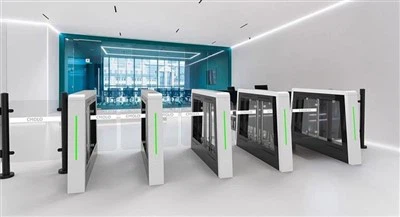
The underground is the major means for people to get around cities, and it often has millions of passengers every day. Its turnstiles need to quickly let out a lot of people in a very short amount of time. The Turnstile Turbines system at the Miromesnil station of the Paris Metro is an example of how to optimise the gear gear ratio and motor torque to shorten the transit time to 1.2 seconds. At the same time, it creates a steady flow of traffic in a small area with a 120° rotation angle design. A lot of the time, this kind of gate machine has a bridge structure with a channel width of 900mm. It can handle tens of thousands of mechanical collisions each day and respond to emergencies in milliseconds thanks to anti-pinch sensors and stainless steel anti-collision rods.
Shopping Mall Scene: The number of people coming and going at the mall changes a lot over time, and the turnstile needs to find a balance between being able to handle a lot of traffic quickly and being able to adapt to specific situations. The twin channel rotating gate from Foshan Dunbiao Protection Equipment Technology Co., Ltd. has a modular design that lets you change the width of the channels (600–800 mm). It also has removable fence doors that let you quickly add more channels during sales events. It has a double-layer ratchet mechanism, with the upper ratchet controlling the flow of traffic and the lower ratchet preventing reverse movement. This makes traffic flow 30% faster than with a standard single-layer structure. At the same time, the silent motor keeps the noise level below 55 decibels, which is what commercial places need for their sound environment.
2. Smart Integration: The Balance Between Security and User Experience
Subway Scene: The subway gate must follow the rules for counter-terrorism and riot control in the "Regulations on the Operation and Management of Urban Rail Transit." Its smart system has the features of "hardcore security." The wing gate system on Beijing Metro Line 10 has 12 sets of infrared sensors and millimetre wave radar. It can keep an eye on the size of passengers' bags, how fast they are travelling through and how far behind they are. If something goes wrong, the gate's wing flaps will close on their own in 0.3 seconds, and the alert information will be sent to the control centre by a 5G module. Some high-end models also have biometric modules that can provide multimodal verification, such facial, palm print, iris, and so on, with an error rate of less than 0.0001%.
Shopping Mall Scene: Shopping mall turnstiles focus more on making the customer experience better, and their smart systems have a "lightweight" function. Shanghai K11 Shopping Art Centre has a swing gate technology that processes data locally through an edge computing architecture. This cuts the time it takes for traffic to respond to 0.8 seconds. The system has a module for analysing consumption data that may find VIP clients and automatically start welcome speech and lighting effects. It also uses UWB location technology to make heat maps of passenger flow, which helps the mall run better. Some turnstiles now enable more than one payment method, like NFC, QR codes, and digital RMB. The time it takes to execute a single transaction is no more than 1.5 seconds.
3. Safety Standards: Two Limits: Public Safety and Business Insurance
Subway Scene: The subway gate needs to get EN 50121-4 electromagnetic compatibility certification, IEC 61508 functional safety certification, and GB 3836.4 explosion-proof certification. Its safety design is based on the idea of 'fault safety'. The sliding gate system on Guangzhou Metro Line 3 has a twin circuit redundant power supply and an uninterruptible power supply (UPS). This means that it can keep working normally for 30 minutes even if the power goes out. It is comprised of 304 stainless steel and has passed 100,000 fatigue tests. Electromagnets and reducers, which are important parts, come from Germany and have a mean time between failures (MTBF) of 500,000 hours.
The mall gate must follow the rules in the "Code for Electrical Design of Commercial Buildings" for fire evacuation, and its safety design focusses on "emergency orientation." The Chengdu Taikoo Li has a quick access door system that can be used in an emergency to get people out. When a fire alarm goes off, the braking wing flaps will automatically unlock and stay open at a 90° angle. The sound and light guiding system will also show the way out. The technology uses both force feedback sensors and infrared light curtains to defend against pinching. The gate will stop working and sound an alarm right away if the resistance is more than 15N or the obstructions are higher than 20 cm.
4. Energy Management: Finding the Right Balance Between Going Green and Keeping Costs Down
Scene on the tube:
The energy use of subway turnstiles makes roughly 3% to 5% of operating costs because they run all day, every day. The Turnstile Turbines method is an innovative way of doing things that gives the industry fresh ideas. The device uses micro generators to change the mechanical energy that comes from people moving around into electrical energy. A single gate can make 2.2 kWh of electricity every day, which is enough to power its own lights and sensors. Some tube operators also use energy recovery braking technology, which changes the kinetic energy when the brakes are closed into electrical energy storage. This cuts down on energy use by 40%.
In the shopping mall scene, the energy management of mall turnstiles focusses increasingly on working with smart building systems. The Shenzhen Wanda Plaza mall has an intelligent rotating gate that is connected to the mall's BA system using a LoRa wireless communication module. This allows the gate to automatically change its operational power based on the flow of people. The gate goes into sleep mode when it's not being used, and the power use lowers below 5W. During the promotional period, the system starts a warm-up program early using predictive analysis to make sure that traffic flows smoothly during peak hours. The gate also has a solar-assisted power supply system and monocrystalline silicon photovoltaic panels on the roof. These panels produce 1.8 kWh of electricity every day, which is enough to cover 30% of the gate's electrical needs.
Fully Automatic Turnstile Gate


WhatsApp : 0086-15999546575
Skype : cmolo.joy
Email : contact@cmolo.com
Tel : 0086-15999546575
CMOLO Industrial Park,NO. 144-1, Hengping Road,Henggang Street, Longgang District, Shenzhen City, China