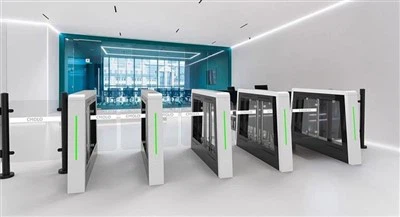
1. The technological structure and how rotary turnstiles work
A turnstile, often called a revolving door or turnstile, is an electromechanical device that is controlled by a microprocessor. It has a mechanical gearbox system, an electrical control system, and an intelligent identification module at its core. The following key steps make up how it works:
Structure and transmission of power
There are two parts to the turnstile's mechanics: the structure and the movement. 304 stainless steel is used to make the structural structure. This material is resistant to corrosion and impacts. The movement has a motor, a gearbox shaft, an electromagnet, and a limit device. When the system is turned on, the main control board runs the self-test program. The left and right positioning arms lock on their own, creating an initial blocking condition. When people walk by, the motor turns the gearbox shaft, which turns the 'Y' or 'X' shaped blocking body made of 3–4 metal rods. This controls traffic in one or two directions. Some high-end models have hydraulic shock absorbers that automatically change the hydraulic damping to keep the noise level of the brake rod movement below 55 decibels, which is quiet enough for public locations like shopping malls.
Logic for Electrical Control and Safety
The industrial-grade main control board is the heart of the control system. It has an ARM processor and DFC dynamic limit technology, and it can process input data from card readers, infrared sensors, and manual buttons in real time. The main control board tells the relay what to do when the pedestrian passes the legal check (such swiping a card, reading a code or recognising their face). The relay then powers on the electromagnetic iron, which pulls open the positioning arm and starts the motor. The system sets a 10-second passage time limit by default. If people don't pass through the gate in the time limit, it will automatically reset and set off an alarm that may be heard and seen. If the power goes out, the battery takes over right away, the main control board switches to fire mode, and the driving motor turns the gate to the "normally open" position so that people may get out of the building safely.
Smart recognition and managing permissions
Rotary turnstiles can use more than one type of identifying technology to create multi-level safety protection. For instance, at the entrance of upscale shopping malls, the system can have a "face recognition+QR code+IC card" three-in-one verification module that uses deep learning algorithms to detect liveness and stop photo or video forgery. In the storage area, UHF RFID technology can read employee identification information in batches, allowing for quick passage. Some models additionally have a feature that lets you compare blacklists. The gate will not open if it detects dishonest people or equipment that are not authorised. It will also send notifications to the security terminal at the same time.
2. The main reason why retail businesses need rotary turnstiles
Because retail situations are so variable, they have different needs for channel management equipment. Rotary turnstiles address these needs through technological adaptation:
Control for anti-tailgating and anti-theft
There is a gap of 0.3 to 0.5 meters between traditional swing gates or wing gates, which makes it easy for more than one person to fit through at once. The turnstile has a blocking design that can rotate 360 degrees, and the space between the gate rods is only 550mm. When used with infrared sensors, it can correctly tell if a single person is passing by. When the system sees someone tailgating, the gate will stop turning right away and sound an alarm. At the same time, the surveillance camera will start recording the scene. The real test data from a certain chain supermarket shows that after putting in turnstiles, the number of stolen items went down by 62% and the cost of security staff went down by 35%.
High efficiency in the flow of traffic
Retail stores can have hundreds to tens of thousands of people pass through their gates every day, therefore the pace of the gates must be quite fast. By optimising the motor output and gearbox ratio, the rotary gate can handle 30 to 40 people per minute, which is 40% more than the three roller gate. During the holiday sale, the system can automatically switch to "fast mode," which increases the gate's rotation angle to 120 degrees and speeds up the time it takes to pass through.
Ability to adapt to several situations
The retail industry includes a lot of different situations, like shopping malls, supermarkets, convenience stores, and logistics for storing goods. The rotary turnstile may do many things because it is made up of modules. For instance, a gate with an LCD screen at the entrance to the VIP area in the mall can be set up to show information on member advantages at the same time. A moisture-proof movement with an IP65 protection rating is utilised in the cold chain warehouse to make sure that everything runs well at -20 °C.
3. Typical use cases and checking the value
Control of entry and exit from the market
The main entrance of a high-end shopping centre in Shanghai includes 12 full-height turnstiles that can check both facial recognition and health codes. The technology works with the mall member database in real time. The camera automatically takes pictures of VIP guests' faces and finishes the comparison when they get close to the gate. The gate opens in less than 0.8 seconds, which starts the welcome voice and lighting effects. During peak hours, this plan cut the amount of traffic at the entry by 78% and raised customer satisfaction to 92 points.
Managing who can access the storage space
JD Asia No. 1's unmanned warehouse uses a mix of rotary turnstiles and an AGV scheduling system. To get inside the storage area, employees must show both their "work ID" and their "fingerprint." The gate is linked to the WMS system so that it can get real-time information about order tasks. This means that only the current operator can enter the right cargo area. After the system was put in place, the rate of wrong deliveries dropped from 0.15% to 0.03%, and the speed of picking went up by 22%.
How to stop theft in retailers without employees
The first Amazon Go store in China has put up a mix of turnstiles and computer vision technologies at the exit to keep things from getting broken. The system makes a virtual shopping list when the user is done shopping and leaves. It does this by using a multi-camera fusion algorithm to compare the list to the electronic price tag data that the gate reads. The gate will stay locked and play a voice prompt if the products haven't been paid for. Staff will be notified to step in and deal with the matter. The product loss rate stays below 0.08% using this method, which is much lower than the industry norm.
Office Security Turnstiles Digital


WhatsApp : 0086-15999546575
Skype : cmolo.joy
Email : contact@cmolo.com
Tel : 0086-15999546575
CMOLO Industrial Park,NO. 144-1, Hengping Road,Henggang Street, Longgang District, Shenzhen City, China