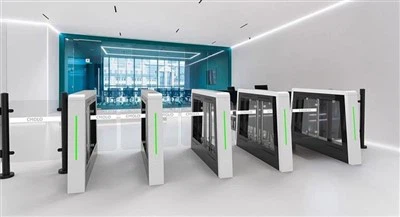
1. Technological Innovation: Moving from physical barriers to smart hubs
Most of the time, traditional turnstiles are only mechanical structures that can only control the flow of people. The newest turnstiles are now the "smart entrance" of stores because they use biometrics, the Internet of Things, edge computing, and other technologies.
Multi-modal recognition technology changes the way people travel.
Modern turnstiles have several verification modules, like 3D structured light facial recognition, palm vein detection, NFC near-field communication, and more. They are 99.99% accurate and respond in under 0.3 seconds. For instance, a certain international chain supermarket has put turnstiles in its stores that work with the membership system through facial recognition. This lets VIP customers "swipe their face and get card free" for quick entry, which makes the VIP channel 40% more efficient and raises the customer satisfaction index by 22%. This "seamless travel" experience not only cuts down on wait times, but it also makes people feel more connected to the company through technology.
Movement that changes according on how many people are on board
The fourth generation movement uses servo motors and hydraulic shock absorption technologies to change the rotation speed dependent on how many people are on board at any given time. The gate automatically adjusts to high-speed mode (45 people per minute) when there are a lot of people passing through, and to slow mode (20 people per minute) when there are mothers and babies or when people are carrying big things. After using this technology in test locations, a certain chain of convenience stores witnessed a 67% drop in customer complaints and a 0.02% drop in equipment failures, which made their operations much more stable.
Decision about Edge Computing and Localisation
The turnstile has an ARM architecture CPU built in, so it can do complicated tasks like checking access permissions and analysing unusual behaviour without using cloud servers. In very bad scenarios, like when the network goes down, the device can continue do fundamental tasks thanks to an offline rule engine. This makes sure that retail stores can keep running. The test data from a regional chain store supermarket shows that the edge computing architecture cuts the system response time from 1.2 seconds to 0.15 seconds and uses 85% less network bandwidth. This supports the "instant service" demand of omni-channel retail.
2. Scenario Empowerment: Going from Single Control to Full Link Optimisation
Turnstiles have moved beyond the traditional security category and are now an important part of fundamental scenarios including member operations, promotional activities, and security prevention and control in retail chain stores. They have created a complete closed loop of "drainage conversion retention."
Deep operation of the membership system
Rotary turnstiles are now a real way for members to get rewards. A high-end chain department store has raised the percentage of members who buy again by 18% and the percentage of members who spend money by 42% to 59% by giving members of different levels different access rights (for example, black gold members don't have to wait in queue and gold card members have their own channels). AI analysis of the device's traffic data (such how often people visit and how long they stay) may reliably forecast what members will buy, which is useful for personalised marketing. For instance, if the system knows that a member goes to the store every Wednesday afternoon, it may automatically send them special deals for that time, which will boost the marketing conversion rate by 31%.
Exact control of advertising efforts
In situations like limited-time sales and discounts, turnstiles are connected to POS systems and member databases in real time. During the "Double 11" period, a certain chain supermarket set up a "exclusive channel for customers over 500 yuan" rule through the gate, allowing only eligible customers to enter the activity area. This increased the conversion rate of high net worth customers by 31%, while keeping the activity area from being too crowded with regular customers. The equipment's passenger flow heat map capability can keep track of how many people are in different places at any given moment. This data can be used to change the layout of the activity on the fly, which can boost sales by 25% in regions that aren't as popular.
Taking steps to protect against security threats
The full-height rotating gate has safety features including anti-tailgating radar and a pressure sensing matrix that can spot strange behaviour like illegal entry and reverse passage in real time. A chain convenience shop was able to stop 12 thefts of products after installing the system. This led to a 76% drop in losses from the previous year. In case of an emergency, the equipment is connected to the fire protection system so that it may immediately unlock and sound an alarm. This makes sure that escape routes are clear. The gate's entry and departure data can also help with epidemic prevention and control, emergency tracing, and making retail environments safer for the public.
3. Cost Restructuring: Changing from Capital Expenditure to Operational Optimisation
The new generation of turnstiles cuts down on the initial investment and long-term operating costs of retail chain stores by a lot compared to traditional turnstiles. This is done through "light asset deployment" and smart operation and maintenance systems.
The leasing strategy lowers the need for funding.
For example, a chain supermarket in a second-tier city would need to spend 3 million yuan to buy a system with 50 turnstiles. But after switching to a leasing arrangement, the first year's cost drops to 800,000 yuan, and you don't have to worry about hidden costs like system upgrades and equipment depreciation. The lease service provider's "7 × 24-hour" remote operation and maintenance service keeps the equipment available more than 99.5% of the time, which keeps passenger flow from being lost when equipment breaks down.
Dynamic growth to deal with changes in business
Retailers may simply add more turnstiles during busy times like holidays and store celebrations by renting them from rental service providers. During the Spring Festival, a certain chain supermarket put up 20 extra turnstiles for a short time. It took only 4 hours to set them up. They were taken away right after the event so that resources wouldn't go to waste. This "elastic resource pool" concept lets retailers accurately match the costs of their gate configurations with actual demand, which increases capital use by 40%.
Optimising energy efficiency lowers the cost of running a business.
The new turnstiles use less electricity than older ones, with each device using only 0.8 kWh of power every day, which is 60% less than older models. Some models come with solar-assisted power supply modules that let them run without using any energy in places where there is enough sunlight. A particular green chain supermarket has cut its carbon emissions by 12 tonnes a year by making its energy use more efficient. It also got a 500,000 yuan government grant and lowered its energy costs.
Airport Security Turnstile


WhatsApp : 0086-15999546575
Skype : cmolo.joy
Email : contact@cmolo.com
Tel : 0086-15999546575
CMOLO Industrial Park,NO. 144-1, Hengping Road,Henggang Street, Longgang District, Shenzhen City, China