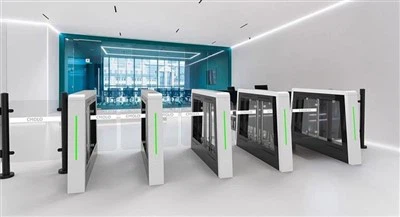
1. Physical Isolation: The First Line of Defence for Security
The main reason turnstiles are good at stopping theft is because of how they are built. The YT-G063 one-way rotary brake from Kezhen Zhiyi is a good example. Its channel width of 0.8 to 1.2 meters is designed with the demands of shopping carts and security in mind:
Controlling the width of the channel: The channel width is reduced to 0.8 meters by precisely computing ergonomic data. This not only fits the needs of a single person passing through, but it also successfully stops "hurdle style" thieving behaviour. Based on real testing data from a certain chain supermarket, putting up turnstiles cut down on the number of people carrying unpaid products by 67%.
Anti-climbing structure: The top of the gate is more than 2.2 meters from the ground and is composed of 304 stainless steel, which makes it impossible to climb over. Customers at the Yunna AI unmanned store at Shanghai Hongqiao Airport once tried to slide things out from beneath the gate, but they couldn't since the bottom of the gate was closed.
Emergency reaction mechanism: has an automatic rebound function and a manual unlocking device so that people can quickly leave in case of an emergency like a fire. During the Spring Festival promotion time in 2025, a certain warehouse-style membership store was able to warn about three cases of passenger congestion. The gate's automated opening mode made evacuations 40% faster.
2. Smart Recognition: Building a Defence Network That Changes
Modern turnstiles have gone beyond only controlling traffic and become part of an intelligent anti-theft network thanks to the use of multimodal identification technology.
The composite authentication system supports face recognition, scanning two-dimensional codes, NFC near-field communication, and the third mock examination authentication. The SA101 series turnstiles used by a regional chain supermarket have cut down on unauthorised entries to 0.3 times per month by using "member ID+facial features" dual factor authentication.
Behavioural semantic recognition: It can keep an eye on how people are standing in real time thanks to 16 sets of infrared sensors and millimetre wave radar. The gate locks right away and sounds an alarm when it sees strange actions, such bending down or a quick impact. During the pilot phase of a community supermarket in Shenzhen, five people were caught hiding products.
Linking electronic tags: the system is fully integrated with the EAS electronic anti-theft system, and it automatically compares the SKU database of items as they pass through the gate without demagnetisation. According to an international chain warehouse supermarket, this technology has cut the number of goods that are missed when they are scanned from 1.2% to 0.3%, saving the company more than 2 million yuan a year.
3. Data linking: getting loss prevention management just right
The traffic data that turnstiles collect is now a key factor in making judgements about how to stop losses in supermarkets:
Analysis of heat flow in passengers: You can make a customer flow heat map by getting data on how often and when people enter and leave through turnstiles. One member store was able to enhance the exposure rate of high gross profit products by 30% after employing this technology to improve the display on the shelves. At the same time, it was found that there were strange stops in the fresh produce area. An internal staff stealing group was found during an investigation.
Warning about strange behaviour: The system automatically records strange modes like high-frequency entry and exit, entry outside of work hours, and so on. A Beijing supermarket found out by looking at gate data that three cashiers had "not scanned codes to pay for friends and family." They got back 150,000 yuan after looking into the matter and gathering evidence.
Loss traceability system: connects with POS machines and electronic price tag data to track "product customer time" in three dimensions. The loss rate went down from 1.8% to 0.9% after the system was put in place at a chain supermarket in Shanghai. The loss control effect was most in the fresh food category, where it went down by 1.2 percentage points.
4. Strategy for using scenarios
Different-sized supermarkets need different types of turnstile solutions:
Small community supermarket: employing lightweight rotary turnstiles (width ≤ 0.8 meters), integrated with QR code+NFC dual-mode recognition, with an emphasis on avoiding the carryover of unsettled items. A pilot project for a certain brand of convenience shop reveals that expenditures can be recouped within 18 months of buying new equipment by cutting down on the number of people who have to be there.
A medium-sized supermarket with a wide range of products: Use high-speed turnstiles that can handle at least 60 persons per minute and have 3D structured light cameras and millimetre wave radar to find a compromise between keeping losses low and being efficient. After the regional chain supermarket was updated, traffic moved 65% faster during busy times, and the loss prevention system stopped over 500,000 yuan worth of stolen items each year.
For a large-scale warehouse member store, build a "rotary gate+swing gate+quick pass gate" combo plan. The main entry should have a dual channel rotary gate for maximum safety control, and the exit to the fresh food area should have swing gates to let shopping carts through. This approach has led to a 40% rise in the number of high-net-worth customers visiting a certain worldwide chain's stores, while also lowering the risk of employee theft by 35%.


WhatsApp : 0086-15999546575
Skype : cmolo.joy
Email : contact@cmolo.com
Tel : 0086-15999546575
CMOLO Industrial Park,NO. 144-1, Hengping Road,Henggang Street, Longgang District, Shenzhen City, China