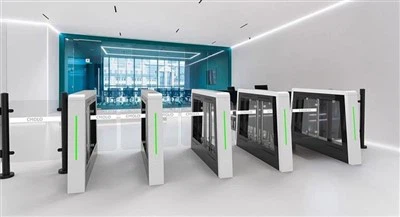
一,Anti-tailgating in the physical structure: complete height design and mechanical linkage
1. The climbing path is blocked by the totally enclosed structure.
The old half-height fence, which is around 1.2 meters high, has clear openings that people can get around by climbing over or drilling through. The full-height turnstiles developed for sports venues are made of stainless steel boxes that are 2.5 to 3 meters high. They provide a vertical barrier with no points of force. For instance, a big sports stadium has a three-bar full-height turnstile with a box thickness of 3mm and a surface that has been coated to resist salt spray. This makes it strong enough to withstand forceful impacts and extreme weather degradation. This design makes it impossible for anybody to break in by climbing or crawling.
2. The multi-pole connection method makes traffic control very accurate.
The multi-bar linkage structure is what makes the full-height rotary gate's anti-tailgating system work.
Three-bar rotating type: The gate rods are spaced uniformly at 120 degrees, and every time someone turns 120 degrees, the channel stays in a semi-closed state. When the three-bar gate at a given World Cup location turns to 60 degrees, it sets off infrared detection. The technology closes the gate right away and sounds an alarm if it sees a second person in the channel.
Cross type: There are four sets of gate rods that make up a cross dynamic closed construction that can rotate 90 degrees. This design is common in basketball arenas. Its best feature is that the channel space changes all the time as the gate rod turns. The system will still recognise two persons trying to closely follow since they are not in the right place.
3. Design that can withstand impacts and an emergency mechanism
Because there are a lot of people and things that can go wrong at sports stadiums, the gates need to be very reliable:
Industrial-grade movement: it has a brushless motor and a planetary reducer that can last for more than 10 million cycles and can handle lateral impact forces of up to 200 kg without bending.
Emergency power outage feature: comes with a UPS uninterruptible power supply and a mechanical unlocking device. If the power goes out, you can manually push the gate all the way open to make sure that people can get out of the building quickly in an emergency.
Anti-pinch protection: a built-in infrared light curtain and pressure sensor. When an obstruction is found, the brake lever turns backward in less than half a second to keep from pinching the audience.
二, Intelligent perception and anti-tailgating: accurate recognition through the use of many different technologies
1. Matrix detection using infrared or laser
Put several sets of infrared sensors in the gate channel to make a three-dimensional detection network:
Horizontal detection: 16 sets of infrared emission/reception tubes keep track of how many people are in the channel and where they are in real time.
Vertical detection: Put laser sensors above the gate to find out how tall people are and keep kids or people with dwarfism from being misconstrued for tailgating.
A certain Olympic venue's gate system can detect trailing behaviour from a distance of 0.3 meters using an infrared matrix, and it has a false alarm rate of less than 0.1%.
2. 3D structured light for seeing depth
Make a three-dimensional representation of the channel using TOF (time-of-flight) cameras or structured light sensors:
Analysing the shape of the human body: Using point cloud data to find attributes of the human body, such as shoulder breadth, height, gait, etc., and figuring out if it is a single person passing.
Dynamic distance monitoring: Calculating the distance between people in real time before and after. If the distance is less than 0.5 meters and the time is more than 1 second, an alarm goes off to stop tailgating.
A certain NBA venue's gate system, along with 3D cameras and AI algorithms, can spot behaviours like bending and stooping on purpose to avoid being seen.
3. Biometric recognition that works in more than one way
High-end sports arenas use "face+IC card+fingerprint" as a way to check people in:
Live detection: Use near-infrared cameras and deep learning algorithms to find fake attacks like photographs and movies.
Behavioural analysis: Using gait recognition technologies to look at things like passage speed and limb movements to help figure out which random images belong to a tail.
Multimodal recognition has raised the tailgating interception rate to 99.2% at a certain European Cup venue's gate system.
三, Anti-tailgating through system linkage: going from single-point prevention and control to global control
1. Full integration of the ticketing system
The electronic ticketing system and the turnstile need to work together perfectly:
Dynamic permission management: To keep people who shouldn't be there from getting in, set various access permissions for different sorts of tickets, such VIP tickets and normal tickets.
Real-time updates to the blacklist: connected to the public security database, it automatically stops dishonest or fleeing people.
Flow control: The gate counting function lets you see how many people are coming and going in real time at each entrance and exit. If the density goes beyond a certain level, the flow is automatically limited.
2. Working together to run the security system
The gate is the first part of the security system and needs to be connected to the alarm and monitoring system:
Abnormal behaviour capture: As soon as the tail is seen, the gate sends a signal to the cameras around it to take pictures and send them to the management backend.
Sound and light deterrence: The gate makes a 110-decibel alarm sound, and the venue's sound system plays a warning voice to scare people away.
Security response: The gate sends strange information to the security personnel's mobile terminal, which helps them find and deal with it immediately.
3. Analysing and optimising big data
By gathering long-term operating data and constantly improving anti-tailgating strategies:
Behaviour pattern mining: Find the times and places when tailgating happens the most and increase regulation in those areas.
Equipment health management: Keep an eye on how well parts like gate sensors and motors are working, and do predictive maintenance to lower the number of failures.
Emergency plan drill: Use past data to create fake tailgating occurrences and improve how security staff respond to them.
四, Common use cases: from the Olympics to stadiums in the neighbourhood
1. A big event space: the Beijing Winter Olympics Ice Hockey Arena
Using a full-height cross-shaped turnstile with an infrared matrix, a 3D camera, and live face recognition to do the following:
Traffic speed of 0.3 seconds per person covers the need for 12,000 persons per hour during peak hours.
99.8% accuracy in stopping tailgating: By combining different technologies, it effectively stops both intentional and inadvertent tailgating.
In unmanned mode, the system takes care of 80% of traffic occurrences on its own. Only a few security guards need to respond to unusual situations.
2. Community Sports Park: Shenzhen's smart stadium
Use cheap three-bar turnstiles, QR code tickets, and remote administration together:
Low-cost solution: The cost of one gate is 60% less than that of high-end models, making it a good choice for situations when money is tight.
Mobile control: Administrators may see the condition of turnstiles in real time through the app and fix problems like card tickets and power outages from a distance.
Flexible traffic rules: Allow free opening at different times and switching between charging modes to accommodate the demands of the community.


WhatsApp : 0086-15999546575
Skype : cmolo.joy
Email : contact@cmolo.com
Tel : 0086-15999546575
CMOLO Industrial Park,NO. 144-1, Hengping Road,Henggang Street, Longgang District, Shenzhen City, China