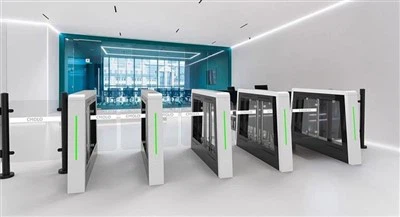
一, The technical features of rotary turnstiles are: the physical basis for changing lines
The most important thing about turnstiles is that they can only let people through in one direction and can change who can go through them at any time. The full-height rotating gate, for instance, has a motor-driven 120 °/90 ° rotation mechanism that makes sure that only one person may go through at a time. It can detect unauthorised entry in real time when used with an anti-tailgating optocoupler sensor. For instance, when someone is following someone else via a turnstile system used by a certain chain supermarket, an alert goes off and the door locks on its own. The integrated monitoring system also sends real-time photographs to the security centre, which has led to an 82% drop in illegal intrusion instances from one year to the next.
There are three main types of turnstiles based on how they work: mechanical, semi-automatic, and completely automatic:
Mechanical: uses manual push rods to let people through; works well for low-frequency traffic;
Semi-automatic: A card or QR code unlocks the door, and people have to press the push rod to get in.
Fully automatic: The motor and encoder are built in, and when a pedestrian walks through the legal signal, the gate automatically turns to let them past.
This technology makes it a great tool for redirecting traffic since it keeps people separate and forces them to follow a set path, which prevents passenger flow intersections and traffic jams that happen with regular open entries.
二, The main idea behind flow diversion is the three main ways to use rotary turnstiles.
1. Entrance flow diversion: from "disorderly influx" to "orderly guidance"
The entry to the supermarket is where the flow design begins, and it is also a dangerous place for passenger flow disputes. When customers cluster in front of promotional heaps at traditional open doors, it creates a "swarm effect" that makes shopping less enjoyable and makes safety risks worse. Rotary turnstiles improve the flow of people entering by doing the following:
Unidirectional traffic control means making sure that all customers come in through the same door so that there are no problems between those coming in and going out. For instance, after putting turnstiles at the entrance of a community supermarket, the amount of people crossing the street dropped by 65%, and the time it took for consumers to get into the store dropped by 40%.
Managing permission grades: By using facial recognition or membership systems, separate access rights are defined for distinct categories of customers, like employees, suppliers, and regular customers. For instance, the turnstile at a high-end membership-based supermarket allows palm vein authentication, which lets members walk through swiftly instead of having to be checked manually. This changes the flow of customers and makes members happier.
Linking emergency responses: If there is an emergency, like a fire, the gate will unlock on its own and turn on the ground LED evacuation indicator to let people get out fast. The real test data from a big supermarket in Beijing reveals that the rotary gate with built-in fire protection has cut the time it takes to get people out of the building in an emergency from 8 minutes to 3 minutes.
2. Inter-floor flow diversion: a "intelligent dispatcher" for traffic going up and down
The elevator entry is another important place for traffic to change in multi-story supermarkets. Because many people use traditional elevator doors at once, they are sometimes crowded. Turnstiles can help vertical flow lines work better in the following ways:
Design of a passenger flow buffer: Put a rotary gate in front of the elevator entry to regulate how many people can get into the elevator at once. This will create a "buffer zone." For instance, after a shopping centre in Shanghai put turnstiles at the entrance to the elevator, the time it took to get to the elevator during busy times went down from 15 minutes to 5 minutes.
Route guidance linkage: works with the floor guidance system to show the location of goods on each floor on the gate screen and let clients choose the right floor. For instance, Chengdu IFS's turnstile system may send out real-time advertising messages, which lets customers plan their shopping itineraries ahead of time while they wait for the elevator.
Reverse passenger flow interception: Turnstiles stop reverse traffic during non-business hours or in certain areas (such warehouses and office spaces) to keep consumers from accidentally accessing areas that aren't open. There were no unauthorised entries into the supermarket warehouse after a turnstile was put in at the entrance.
3. Special area flow diversion: from "passive isolation" to "active guidance"
Some parts of the store, including the fresh produce section and the precious goods section, need extra care. The turnstile can better regulate the flow of people in the following ways:
Design for regional isolation: Put a revolving gate at the entrance to the fresh food area and a mechanism for controlling temperature and humidity to create a separate "microenvironment." For instance, the revolving gate in the fresh produce section of a certain supermarket is connected to an air curtain that keeps cold air from leaking out and stops people from going in and out of the shelves at random, which would make the shelves messy.
Guidance on how to buy: Put turnstiles at the entrance to the section where costly items are kept (such jewellery and electronics). Customers must swipe their cards or show their faces to get in. The technology keeps track of how long a consumer stays and what they do while they are there. The turnstile data at a given jewellery counter suggests that this design makes customers remain longer (2 minutes on average) and raises the sales rate by 18%.
Management of theft and damage: With the help of the turnstile's anti-tailgating feature and the electronic price tag system, it is possible to keep an eye on the path that items take in real time. A certain supermarket's practice demonstrates that this method cuts the loss rate of products by 37%, and the loss rate of high-value products by 62%.
三, Dynamic optimisation based on data: the "smart brain" of turnstiles
Turnstiles are useful not only because they keep people apart, but also because they collect a lot of traffic data. By using AIoT technology, turnstiles can become the "smart brain" that helps supermarkets run more smoothly:
Analysis of the heat flow of passengers: You can clean up and combine the turnstile's daily traffic data (entry time, stopping area, flow direction) to make a "digital twin" of how the supermarket works. For instance, a supermarket used gate data to find out that just 12% of the people who went to the B2 level food section also went to the L1 level beauty area. Based on this, the placement of the surveillance cameras was changed so that blind spots were covered by 67% less;
Warning of strange behaviour: Turnstiles can set a baseline model for how people behave in traffic when they work with machine learning algorithms. The system automatically starts an investigation when it sees behaviour that is different from the baseline (such an employee who often enters the warehouse area outside of business hours). With this feature, a certain chain supermarket was able to stop three internal thefts, which led to a 76% drop in the amount of money lost from the previous year;
Evaluation of marketing activities: The close integration of turnstiles and membership systems makes it possible to measure how well marketing works. For instance, during the promotional period, Guangzhou Tianhe City connected the dynamic QR code gate to the membership system to keep track of the activity area's real-time conversion rate of passenger flow. The data shows that this plan raised the number of people who took part in the activity by 41% and stopped all unauthorised intrusions.
四,Industry Trend: "Scenario Based Evolution" of Rotary Shutters
As digital transformation moves faster in the retail sector, turnstiles are moving towards an integrated "perception decision execution" model:
Metaverse entrance: The turnstile can help clients reach the right product section fast by using AR navigation technology. The pilot study for a certain type of supermarket reveals that this feature cuts down on the time it takes customers to find what they want by 65%. Carbon point management: Customers can earn carbon points by choosing eco-friendly shopping bags. A certain supermarket's experience reveals that this method cuts down on plastic bag consumption by 58%. Sensorless payment: combines computer vision technologies to create a "pay as you go" shopping experience. The pilot study for a new supermarket in Shanghai indicates that this technology has made the checkout process 300% faster.


WhatsApp : 0086-15999546575
Skype : cmolo.joy
Email : contact@cmolo.com
Tel : 0086-15999546575
CMOLO Industrial Park,NO. 144-1, Hengping Road,Henggang Street, Longgang District, Shenzhen City, China