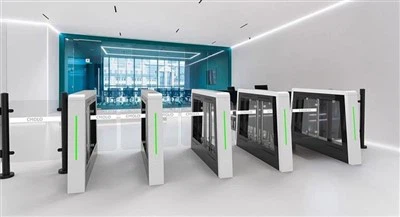
The rotary gate allows for very accurate identity checks by using a system that combines facial recognition, fingerprint recognition, and iris recognition, all supported by deep learning algorithms. For instance, a certain brand of turnstiles used 3D structured light facial recognition technology at the Shanghai Hongqiao hub with an average daily passenger flow of over 500,000, which can complete liveness detection and identity matching within 0.3 seconds with an error rate of less than one in a million. This method can handle special situations like recognizing people wearing masks and detecting bright backgrounds, making it effective at solving the problem of easily faking a single type of identification.
The rotary gate's built-in edge computing module-like NVIDIA Jetson AGX Xavier-can enable localized data processing. This module in the practical application at Guangzhou South Station supports offline face database comparison and can perform 2000 facial image feature extractions per second. Apart from less reliance on cloud networks, this architecture design compresses the traffic response time from 1.2 seconds in cloud mode to 0.8 seconds, therefore optimizing traffic efficiency by 30% during peak hours.
IoT sensors placed at the turnstile end allow one to build a digital twin traffic model. By gathering real-time data, including gate opening and closing times, traffic speed, and fault codes, the digital twin system installed at Hangzhou East Station dynamically depicts the equipment's operating state on a 3D modeling platform. More than 2000 turnstiles' real-time functioning conditions can be remotely monitored by management staff; they can also predict mechanical component wear 14 days in advance and change equipment maintenance from passive response to active prevention.
Turnstiles of Chengdu Tianfu International Airport are tightly linked with the elevator dispatch system. Within 0.5 seconds, the system automatically analyzes the boarding gate position of passengers passing through the facial recognition gate and finishes elevator reservation and path planning. Particularly in busy times like the Spring Festival travel rush, this strategy significantly increases luggage check-in efficiency by 25% and lowers the walking distance for transit users by 40%. This helps to thus ease terminal congestion.
At Beijing Daxing International Airport, the vertical elevator and revolving gate system accomplish elevator control linkage. All gates will automatically run to the specified evacuation floor and complete emergency release within 0.3 seconds following the fire signal activation in an emergency. In simulation tests, the system attained an evacuation capacity of 5000 people per hour, 60% higher than conventional methods, and established a new benchmark for emergency management in big hubs.
Turnstiles and logistics robots find clever cooperation at Shenzhen North Station. Using UWB positioning technology, the gate guarantees stable passage of the 1.2-meter-wide logistical channel, automatically changes the opening and closing angle of the wing, and detects the identification of the robot. This strategy drastically lowers running expenses by 40% by improving the effectiveness of on-site material distribution and therefore lowering the frequency of manual interventions to less than three times a month.
Using historical traffic data and real-time passenger flow, the turnstile system at Shanghai Pudong International Airport builds an LSTM neural network prediction model. With an error rate kept within 8%, this model can forecast the entry 2-hour peak passenger flow ahead. Based on the expected outcomes, the system automatically adjusts the number of open security checkpoints, thereby reducing the average passenger waiting time from 18 minutes to 7 minutes and optimizing resource use during peak hours.
The clever turnstiles at Nanjing Lukou Airport combine light sensor control modules and power factor correction (PFC) circuits. The device automatically moves to low-power mode during off-peak hours; a single gate saves up to 1200 kWh of electricity yearly. Simultaneously, the system generates a carbon footprint report, logs the energy consumption data of every gadget, and enables the airport to reach its 2030 carbon neutrality target.
The turnstile system collects passenger traffic data-such as average journey duration and number of repeated verifications-to create a model for evaluating service quality at Xi'an Xianyang International Airport. The system creates a "Passenger Experience Daily Report" automatically, pointing out areas of gate optimization need. This strategy led to a 62% drop in the passenger complaint rate and increased the NPS (Net Promoter Score) to 82 points.
Automatic Pedestrian Speed Lanes


WhatsApp : 0086-15999546575
Skype : cmolo.joy
Email : contact@cmolo.com
Tel : 0086-15999546575
CMOLO Industrial Park,NO. 144-1, Hengping Road,Henggang Street, Longgang District, Shenzhen City, China