1. Technical specifications and safety rules knowledge of rotary turnstiles
Type of equipment and where it is used
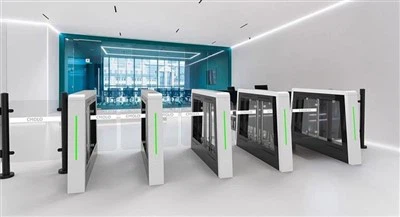
There are two types of rotary turnstiles: full-height and half-height. Full-height turnstiles (with a gate height of 1.8 to 2.3 meters) are the most popular choice for the main entrance of shopping malls since they keep people separate and are hard to climb. Its main jobs are:
Control of permissions: Supports many forms of authentication, like IC cards, QR codes, and facial recognition, to make sure that "one person, one gate" is managed correctly.
Finding traffic: It can find unusual behaviors like tailgating and reverse infiltration by using six or more pairs of infrared sensors that have a false alert rate of less than 0.2%.
Responding to an emergency: It has a built-in battery and fire linkage module that automatically opens the gate after a power outage to make sure that people can get out of the building quickly in an emergency.
2.Standard system for safe operation
The Safety Technical Specification for Pedestrian Channel Gates (GB/T 38637-2020) says that shopping malls must set up a three-level safety control system:
Standards for daily operations: Employees must keep the gate passage clean and check the anti-pinch sensor's sensitivity on a regular basis.
How to respond to an emergency: Make sure you have consistent strategies for how to respond to things like fires and equipment breakdowns. Make sure everyone knows the evacuation routes and how long the gate will be open.
Managing the security of data: Follow the rules of the Personal Information Protection Law and strictly manage how biometric data, such facial recognition, is stored and sent. Building a training system in stages
Basic cognitive training (8 hours)
Analysis of the construction of the equipment: Use a 3D model to show how the gate mechanism (motor, transmission shaft, and electromagnet) and the control system function together.
How to use functional modules in real life: group practice card distribution, face registration, authorization settings, and other fundamental tasks. The main goal is to learn how to switch between different types of verification.
Security Case Study: Look at the public opinion event about keeping customers after a gate failure at a given mall, and raise awareness of risk prediction.
Scenario-based skill training (16 hours)
Managing traffic during peak hours: Simulate the flow of passengers during peak vacation times and teach personnel to make traffic flow more smoothly by changing the speed of the gate rotation (0.5–1.2 seconds per turn).
Handling strange situations: Set up 10 different emergency situations, like unlawful entry, gadget jamming, and false alerts from sensors, and have people act them out.
Services for special groups: Make special access arrangements for kids, seniors, and people with disabilities, including giving them 15 more seconds to open the gate.
12 hours of special training on how to keep everything in good shape
Checklist for every day: Make a standard operating procedure (SOP) handbook that has 23 inspection requirements, such as how to check for wear on mechanical parts, how to calibrate sensors, and how to test emergency buttons.
Training in fault diagnosis: Employees learn how to find problems in system logs by using a virtual simulation system to replicate 15 common defects, such as motor overheating and optocoupler board failure.
Plan for preventative maintenance: Use data from how the equipment works to build a maintenance cycle model. For example, change the gearbox oil every 5000 runs.
3. Using new ways to train people
Platform for digital learning
To reach your goals, create a mobile learning app that has features like 3D gadget disassembly, AR failure simulation, and online testing.
Employees can use the 10-minute meeting before class to do micro-course learning, which is a type of fragmented learning.
Tracking based on data: Find out what knowledge gaps there are by looking at how people learn and then give them targeted reinforcement training.
Incentives that are like games: Set up device operation to pass level games, link point ranking with performance evaluation
Simulation of a sand table based on a scenario
Make a real sand table with a main entrance, an emergency channel, a VIP channel, and various scenarios to act out:
Multi-gate linkage control: Teach workers how to immediately change the direction of passenger flow when some gates break down.
Managing public opinion during a crisis: Set up fake situations where customers complain about injuries caused by gate machines to improve how well you can talk to people in an emergency.
Working together across departments: To make it easier for security and customer service to work together, do joint exercises with both departments.
4. Evaluation of the success of training and ongoing improvement
System for multi-dimensional assessment
Assessment of theory: Testing employees' knowledge of the "Gate Safety Operation Regulations" by randomly selecting them
Evaluation in the real world: Set up routine passenger flow situations and keep track of how quickly and how well personnel deal with unusual circumstances.
Feedback from all sides: Get feedback from customers, security, and the equipment maintenance department on how well personnel do their jobs.
Dynamic optimization system
Set up a training database to keep track of the outcomes of the tests, the sorts of equipment failures, and the advice for how to improve for each training session.
Meeting for a quarterly review: Look at training data, find frequent problems, and change and improve training content.
Learning through industry benchmarking: Go to safety management meetings often benchmark retail complexes, add additional training courses for technology like gates that can recognize faces and assess temperature


WhatsApp : 0086-15999546575
Skype : cmolo.joy
Email : contact@cmolo.com
Tel : 0086-15999546575
CMOLO Industrial Park,NO. 144-1, Hengping Road,Henggang Street, Longgang District, Shenzhen City, China