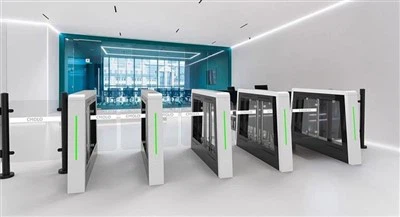
In the pedestrian passageway management system, the turnstile is widely used in subway stations, airports, office buildings, factories and other places as a kind of traffic control equipment. These places not only need to ensure the orderly and safe daily passage, but also need to be able to respond quickly in emergency situations, such as fires or earthquakes, to ensure the safe evacuation of personnel.
1. Requirements for pedestrian access gates in emergency situations
(1). Quick response: In case of emergency, the security turnstiles needs to respond immediately to remove the traffic restrictions in the shortest possible time.
(2). Ensure that the passageway is smooth: the swing barrier gate must be opened or kept open quickly to ensure that personnel can be quickly evacuated.
(3). Provide clear instructions: In an emergency, the speed gates needs to provide clear evacuation instructions to guide the safe evacuation of personnel.
2. Emergency response mechanism of speed gate turnstile
(1). Automatic unlocking function: Modern intelligent gates usually have automatic unlocking function. Once a signal is received from the fire alarm system or earthquake warning system, the turnstile will automatically unlock and remain open immediately, ensuring that the passage is unimpeded. For example, when the fire alarm is triggered, the turnstile will automatically open the gate, allowing all personnel to pass through quickly.
(2). Standby power system: Power failure may occur in an emergency, the gate should be equipped with a standby power system (such as UPS uninterruptible power supply) to ensure that it can still operate normally in the case of power failure, and automatically unlock and open the passageway.
(3). Emergency button: An emergency button is set near the gate for manual activation by staff or the public in an emergency. When the emergency button is pressed, the turnstile system will immediately unlock and remain open, providing access to evacuation.
(4). Evacuation indicating system: the turnstile system should be equipped with evacuation lights or voice prompt devices. When an emergency signal is received, these indication systems are automatically activated to provide clear evacuation instructions and guide personnel to evacuate quickly and safely.
3. Case study: Practical application of pedestrian turnstile in emergency
(1). Subway station: In the subway station, the turnstile is automatically unlocked in case of emergency by connecting with the fire alarm system and earthquake early warning system to ensure that passengers can quickly evacuate. Subway stations are usually equipped with emergency lighting and signage, in conjunction with the evacuation indication system of the gate, to further ensure safety.
(2). Airport: Airport gates are designed with the needs of emergency situations fully in mind. In the event of a fire or earthquake, the turnstile entrance gates will automatically unlock and guide passengers to safety through voice prompts and indicators. The airport's emergency plan also includes the management of gates to ensure a quick response in an emergency.
(3). Office buildings and factories: The pedestrian turnstile gates in these places are also linked to the emergency alarm system to unlock immediately in the event of a fire or earthquake and provide evacuation instructions. In addition, these places are usually equipped with emergency escape routes to further ensure the safety of personnel.
4. Future development direction
With the advancement of technology, pedestrian barrier gate will become more intelligent and efficient in responding to emergencies. Future directions include:
(1). Intelligent linkage system: Further enhance the linkage between the turnstile and other emergency systems in the building to achieve a faster and more accurate response.
(2). Internet of Things technology: The use of Internet of Things technology to achieve real-time monitoring and remote control of the state of the gate, improve the efficiency and accuracy of emergency response.
(3). Humanized design: Pay more attention to humanization in the design of the gate, considering the needs of different groups of people, such as the elderly, children and disabled people, to ensure that they can also safely and quickly evacuate in emergency situations.


WhatsApp : 0086-15999546575
Skype : cmolo.joy
Email : contact@cmolo.com
Tel : 0086-15999546575
CMOLO Industrial Park,NO. 144-1, Hengping Road,Henggang Street, Longgang District, Shenzhen City, China