1. Choosing the right materials is the key to durability.
Choosing strong materials is the first step in making the revolving gate in sporting facilities last. Most products employ 304 or 316 stainless steel as the main frame. These types of steel are very resistant to corrosion and impacts, and they can handle tough conditions like salt spray and humidity. For instance, the rotating turnstile at an international sports arena exhibited no symptoms of corrosion on its casing after five years of use in high-humidity coastal areas. This proves that the stainless steel material is stable over time.
Gate blades are generally composed of high-strength engineering polymers or aviation-grade aluminium alloy in the portions that move. Using precise casting technology, aluminium alloy blades find a balance between being light and strong. Engineering plastic blades, on the other hand, make them more resistant to impact by adding glass fibre reinforced material (GF). A football field case demonstrates that a gate using 30% GF reinforced PC/ABS alloy blades remained intact and did not undergo irreversible deformation despite being subjected to crowd pushing and shoving.
2. Structural design: the most important thing for impact resistance
When designing turnstiles to be impact-resistant, both physical protection and dynamic response should be taken into account:
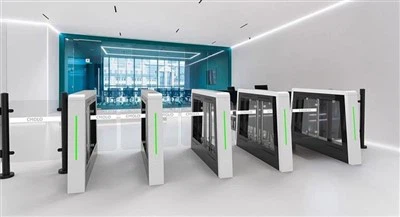
Full height contained structure: The full height rotating gate (height > 2.2 metres) creates a physical barrier with a 360° enclosed design that stops forceful collisions. The distance between the blades is rigorously managed at 550–600mm, which not only allows one person to pass through, but also keeps the audience's limbs from getting stuck. A test in a prison demonstrated that the full-height gate can handle a side impact force of 1000N without breaking down.
Buffer damping system: There are hydraulic dampers or spring damping devices at the point where the gate base and the blades meet. The shock absorption system spreads the impact force throughout the whole structure when the gate blades are hit by unusual outside forces. This stops tension from building up in one area. The real test data from a basketball court demonstrates that when a 200kg object hits the gate, the shock absorption system cuts the swing amplitude of the blades by 60% and the recovery time to 0.8 seconds.
Modular design: By breaking the gate down into separate parts including the base, drive module, and blade components, it is easy to quickly replace parts that are damaged. The maintenance staff replaced the blade module in just 15 minutes after the audience broke the gate at an Olympic venue on purpose. This is four times faster than the usual way of maintaining an integrated design.
3. Test standard: Measure the technical basis for durability
International and national standards give a way to measure how strong and durable rotary turnstiles are:
According to the DIN EN 1517:2020 standard, the gate must pass a free fall impact test from a height of 1 metre using a steel punch with a diameter of 11.3mm and a mass of 800g. After testing, the gate's surface should not have any cracks, delamination, or persistent indentations (indentation depth ≤ 0.5mm). A specific brand of gate still worked normally after 50 consecutive impact tests in the lab.
Test for fatigue life: Simulate the opening and closing of the gate blade around 500,000 times throughout a 10-year service cycle. After the test, the connection between the blade and the gate should not be loose or broken. A specific company made the gate with a reinforced hinge design. After 800,000 fatigue testing, the switch resistance change rate was just 3%, which is far better than what is required by the industry.
Testing for adaptability to the environment, which includes very hot (50 °C), very cold (-20 °C), and salt spray (48 hours), among other things. The drive module of the gate at a certain northern ice and snow venue may still work normally after running for 72 hours straight in a -30 °C environment. This proves that low-temperature lubricating technology and heating devices work.
4. Industry Practice: Putting technology into practice in the real world
For a big event in 2025, the organiser set up 200 full-height turnstiles at the main stadium. The gate has a failure rate of less than 0.2% when it is used continuously under heavy loads (with 80,000 people passing through it every day). This is three times higher than traditional gates. This is because it has a dual motor drive system (which automatically switches between the main and backup motors) and an IP65 protection level design.
A football pitch on the seashore has 316 stainless steel turnstiles and an automatic drainage system. Even when the venue floods with up to 800mm of water during a storm, the bottom sealing construction of the gate keeps the internal circuit dry, which prevents short circuits.
In a high-security situation, a jail uses impact-resistant rotary turnstiles at the entrance, with blades constructed of solid stainless steel (8mm thick) that can handle 2000N of pressure without bending. The gate also has a biometric and alarm system that goes off in three seconds and locks the channel when it detects an illegal entry.


WhatsApp : 0086-15999546575
Skype : cmolo.joy
Email : contact@cmolo.com
Tel : 0086-15999546575
CMOLO Industrial Park,NO. 144-1, Hengping Road,Henggang Street, Longgang District, Shenzhen City, China