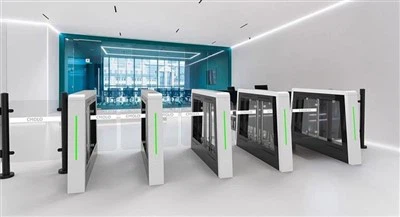
一, The technical features of rotating turnstiles are that they provide both physical separation and smart verification.
The turnstile is a fully enclosed piece of equipment for walking on sidewalks. Its main design has three main technical modules:
The gate's rotating blades go from the bottom to the top and are normally more than 2 meters high. They make up an autonomous "single person passage unit." Only one person can go through each round, which stops behaviours like crossing and tailgating. In a large football stadium in Europe, for example, the rate of turnstile tailgating went down from 15% of traditional equipment to 0.3%, and disagreements caused by ticket-free entry went down by 82%.
Smart verification system: works with many different ways to verify identity, such as QR codes, ID cards, facial recognition, passports, and more. It is also connected to the ticketing system in real time. For instance, in a certain major marathon event in 2025, the gate machine used facial recognition technology to allow people to enter. It could let 35 people through a single channel every minute, which is three times faster than verifying tickets by hand.
Dynamic control mechanism: It has smart sensors and flow algorithms that let it change the rotation speed on its own dependent on how many people are walking by at the time. The gate can turn at a speed of 0.8 to 1 revolution per second during peak hours and 0.5 revolutions per second during off-peak hours, which is a good balance between safety and efficiency.
二,The four main uses for turnstiles are crowd control at sports events, when they are used throughout the entire event.
1. Admission diversion: working together across many channels and using a staggered method
Most people arrive at large events within an hour of the start time, and typical single-channel ticket checking can easily cause delays. Rotary turnstiles efficiently redirect traffic in the following ways:
Multi-channel deployment: Set up dozens to hundreds of gates in a grid pattern that includes a "main entrance" and a "diversion channel" based on the size of the venue. In 2025, for example, a certain Olympic venue set up 200 sets of turnstiles, which cut the number of people waiting in a single channel from 20 to less than 5.
Advice for times when there aren't many people: By combining ticket information with APP push, you can tell people to enter from different doors. For instance, the passenger flow system looked at past data during a football game and concluded that traffic was low at the east gate between 18:00 and 19:00. So, an app was utilised to send a message to people who had tickets for that time period, telling them to use the east gate first.
Special channel design: Put in wide channel gates (1375mm wide) so that people with big bags, strollers, or wheelchairs may get through. A certain concert venue illustrates that wide channel turnstiles cut the time it takes for special groups to get through by 60%, while also keeping them from having to compete with regular crowds for space.
2. Mobility on site: regional isolation and path optimisation
During the tournament, people who watch have to go back and forth between the arena, the dining area, the bathroom and other places a lot. Rotary turnstiles improve the flow of people on site in the following ways:
Functional area isolation: Put barriers at the entrances to dining areas, VIP lounges, and other locations so that those who aren't supposed to be there can't get in. For instance, a certain tennis event has put up gates at the entrance to the VIP area. Only those with certain types of tickets can get in, which cuts down on the number of people who don't need to be there.
Dynamic path guidance: Cameras and sensors inside the venue work together to keep an eye on how many people are walking around in different sections and show "shortest path prompt" through gate screens. For instance, during halftime of a basketball game, the gate screen automatically shows "shortest path to the lavatory: turn left, walk 50 meters" to keep people from becoming stuck in traffic when they take shortcuts.
3. Evacuation and evacuation: one-way traffic and emergency response
After the event, a lot of people leaving at once might easily cause stampedes. Rotary turnstiles help people leave safely in the following ways:
Unidirectional traffic mode: The gate automatically turns to one-way rotation during busy departure times to keep people from going back. For instance, a music festival changed all of its gates to "exit mode" 30 minutes before the finish, which made it 40% easier for people to leave.
Emergency linkage mechanism: The gate is connected to the fire protection system and the security system so that it will immediately unlock in event of an emergency, like a fire or a terrorist attack. This makes it possible for people to leave the building. It was tested during a fire drill at a certain sports stadium that 5,000 people could leave the building in 3 minutes after the gate was unlocked.
4. Managing events across borders: linking many systems and checking blacklists
Turnstiles during events with people from other countries, such the Olympics and World Cup, must be able to check passports and visas from other countries and be connected to the customs blacklist system. For instance, in 2025, the gate at a Schengen border checkpoint can check the information on both a passport and a visa at the same time. If the system finds that the visitor is on the "restricted entry" list, the gate will lock right away and customs will be notified. Verified visitors will not take more than 10 seconds to get there.
三,Three main ways to put in rotary turnstiles: balancing technology, management, and experience
1. A mechanism for leasing and deploying modules
The need for turnstiles at big events is transient, expensive to buy, and hard to keep up with. The lease model is now the most popular choice:
On-demand configuration: Choose the number and kind of turnstiles you need for the event, like wing turnstiles, swing turnstiles, and three-roll turnstiles. For instance, modest sports arenas can rent 20 sets of turnstiles, but big sports venues need more than 200 sets.
Guarantee for backup equipment: Rental companies offer backup turnstiles that can be swapped out in 10 minutes if they break down. During a marathon, the backup gate cut the channel's downtime from 30 minutes to 5 minutes when it broke down.
Full process service: Rental services include setting up and starting up the equipment, operating and maintaining it on-site, and recovering lost data. For instance, a concert rental firm sets up the gates 24 hours before the event and sends out a report on passenger traffic within 48 hours following the event.
2. Using a lot of different technologies together and making decisions based on data
To create a closed loop of "perception analysis decision," rotary turnstiles need to work well with other technology systems.
Linkage with the passenger flow system: The gate machine sends real-time traffic data to the passenger flow system, which then makes heat maps and flow forecast models. For instance, the analysis of the passenger flow system showed that the flow of people in the north stand went up in the 75th minute of a given football game. So, the gate screen told them to leave and go to the south stand.
Collaboration with mobile apps: People can bind their tickets in advance using the app and scan the QR code at the entrance to cut down on the time they have to spend on site. A certain Olympic Games showed that pre-binding the APP makes it 25% faster to get through the gate.
Along with AI behaviour analysis, gate cameras use AI algorithms to collect data on how people behave and predict traffic jams. For instance, a behaviour analysis of a basketball game showed that the number of people entering the arena would increase by 10 minutes before the game ended, so security staff were sent ahead of time to help.
3. Design that is friendly to people and services that are easy to get to
To avoid a "technical chill," rotary turnstiles need to find a balance between safety and user experience:
Barrier-free access: Build special gates for groups like pregnant women and disabled persons, and make sure they have voice prompts and help with their hands. The barrier-free gate at a certain performance venue has cut the travel time for some groups from 3 minutes to 30 seconds.
Support for several languages: The gate screen and audio prompts can switch between several languages, including English, French, Spanish, and others, during cross-border events. A certain World Cup venue's experience demonstrates that bilingual support makes 40% more international fans happy.
Emergency button: The gate has an emergency stop button that can set off an alarm for the audience right away in case of an injury or fall. Testing at a certain sports stadium indicated that the emergency button cut the time it took to respond to an accident from 2 minutes to 10 seconds.


WhatsApp : 0086-15999546575
Skype : cmolo.joy
Email : contact@cmolo.com
Tel : 0086-15999546575
CMOLO Industrial Park,NO. 144-1, Hengping Road,Henggang Street, Longgang District, Shenzhen City, China