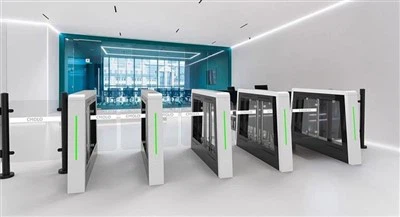
1. The technical idea is that machines and electronics must work together with great accuracy.
The main purpose of a turnstile is to let people past quickly with the help of a motor and smart control. It has a frame, a movement, a transmission shaft, and an electromagnet as its mechanical parts. The movement has a tiny board with two optocouplers and an industrial-grade main control board that can accurately control the speed and angle of rotation. When the audience passes, the system checks the following steps:
Signal triggering: The primary control board gets an opening command when the audience swipes their tickets, scans codes, or uses facial recognition.
Electromagnetic unlocking: The electromagnetic iron is turned on to open the positioning arm and let go of the mechanical lock.
Dynamic passage: The revolving arm, which is powered by a motor, moves 30 to 40 persons every minute. The default passage time is 10 seconds. If the qualification goes above that period, it will be automatically canceled.
Emergency response: If the power goes out, the battery will start up and the rotating arm will stay open so that people can get out of the building in case of a fire.
This design strikes a good mix between safety and efficiency. The mechanical barrier structure keeps people who shouldn't be there out, and the electronic control system makes sure that the system responds quickly. The 16 binocular liveness recognition turnstiles at the Shaoquan Sports Center in Hefei, for instance, can process 12,000 persons every day at a speed of 0.3 seconds per person, which is 200% more efficient than older approaches.
2. Functional innovation: Combining different technologies increases traffic capacity.
To handle the complicated layouts of sports venues, modern turnstiles have combined several new technologies:
Multimodal recognition: offers a number of ways to verify identity, including QR codes, ID cards, facial recognition, and NFC (near-field communication). The Taixing Mass Sports Center has raised the rate of catching bogus tickets to 99.7% by using "hand brushing+facial recognition" as a second element. This avoids the technological problem of using only one technique of recognition.
Smart diversion design: change the amount of open lanes based on how many people are walking through. For instance, during major events, the system can automatically add more gates to regular audience channels and create separate channels for athletes and VIPs to better manage traffic.
Anti-tailgating and anti-interference: employing infrared sensors and pressure sensing technology to keep track of how many users are in the channel at any given time. If the gate sees more than one person following or carrying a big item, it immediately stops and sounds an alert to make sure that only one person can pass through at a time.
Accessibility: The gate channel may be made wider than 900 mm and come with voice prompts and a low-speed rotation option, which shows that it was designed with people in mind.
3. Scenario application: covers everything from event planning to regular tasks
Turnstiles are now used for more than just single events; they are also used to manage the whole lifecycle of sporting stadiums.
Large scale event guarantee: Turnstiles can handle a lot of people at once, therefore they can handle the fast flow of people at big events like the World Cup and the Olympics. For instance, a certain international football event employs 64 turnstiles to make a circular channel that can hold 2560 people each minute and cut the time it takes to get in from the usual 90 minutes to 15 minutes.
Daily exercise services: The community sports facility uses turnstiles in a lease arrangement to lower the costs of starting up. Through the small program, users can reserve the venue ahead of time. The gate will then automatically check the order information, allowing for "contactless" admission.
Security and data integration: The turnstile is connected to the security system so that it can send real-time information on who is entering the venue, when they do, and where they are going. The Taixing Mass Sports Center built a heat map of passenger movement using a data analytic platform. They also changed the open spaces on the fly, which made the venue 45% busier.
Emergency management: If there is an emergency, such a fire or a terrorist attack, the gate can swiftly transition to typically open mode and work with video surveillance and broadcasting systems to help people get out. A test at a certain sports venue showed that the rotary gate concept cut the time it took for people to leave by 60% compared to regular iron gates.


WhatsApp : 0086-15999546575
Skype : cmolo.joy
Email : contact@cmolo.com
Tel : 0086-15999546575
CMOLO Industrial Park,NO. 144-1, Hengping Road,Henggang Street, Longgang District, Shenzhen City, China