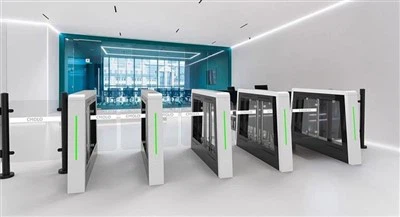
1. A fundamental working concept and several turnstile designs
The circular motion of the gate rod is the basic foundation for a rotary gate's operating concept. Usually 120 degrees, the gate rod will rotate a specified angle to allow staff members to pass and automatically reset following personnel passing through the gate. Rotary gates can be split into four roll gates, three roll gates, single pole rotary gates, and double pole rotary gates depending on the number and configuration of the gate poles. Although traffic efficiency varies among different kinds of turnstiles, generally they can efficiently control personnel's entrance and exit.
2. A turnstile can effectively handle even the smallest amount of pedestrian traffic.
Various elements affect the number of individuals a turnstile can handle per minute: the type of turnstile, the speed of the recognition technology, the level of competency, pass width, and the layout design. Generally speaking, depending on the combined effect of the foregoing elements, a turnstile passes between 20 and 60 individuals every minute.
Gate type: Traffic efficiency varies among several kinds of turnstiles. For sites with heavy foot traffic during peak hours, wing gate turnstiles-which have fast opening and shutting speed-can let 40 to 60 persons pass through every minute. The three-roll gate and four-roll gate have a quite slow single-pass speed, but with adequate layout and control system optimization, they can still reach a throughput of 20 to 30 persons per minute; therefore, they are appropriate for locations with rather constant personnel flow.
Typically, rotary turnstiles incorporate identity systems such as card swiping, facial recognition, and fingerprint recognition. The speed of identification technology directly influences the traffic efficiency of the gate. Fast and precise identity verification made possible by advanced identification technology helps to lower staff waiting times and increase traffic efficiency, thus lowering traffic congestion.
Turnstile traffic efficiency depends in great part on personnel's operational competency as well. Turnstiles will be more efficient if staff members can swiftly swipe cards and stand in the proper position, enhancing their utilization.
Channel width and layout design: These factors directly influence the traffic efficiency of the turnstile. Reasonable channel width and layout design help to lower personnel's waiting time and congestion, thus enhancing traffic efficiency.
3. Practical applications: influencing elements and optimization techniques
Practical applications additionally influence turnstile capacity to control pedestrian flow per minute through other elements, such as location type, pedestrian flow distribution, management level, etc. These techniques can help to maximize the turnstile's traffic efficiency:
Based on the site, decide on the appropriate kind of gate: People's flow and demand fluctuate depending on their location; thus, the suitable kind of gate should be chosen based on the real circumstances. For instance, areas experiencing significant pedestrian flow during peak hours, such as subway stations, can select wing-style turnstiles to increase traffic efficiency.
Raise the recognition technology's speed and accuracy. Use cutting-edge recognition technologies, including facial recognition, intelligent sensing, etc., to lower personnel waiting times and accelerate response and recognition. Simultaneously, keep and calibrate the identifying system to guarantee its stability and correctness.
Strengthen staff direction and training. Train and mentor staff members using turnstiles so they may master their use of them. Staff members should be able to move through the gate quickly and accurately by placing clear signals and instructions next to it.
Maximize channel layout and design. Optimize the channel's layout and design based on the venue's state and pedestrian flow. To evenly distribute the flow of people in areas with high foot traffic, consider arranging multiple paths or adding additional gates. Install unambiguous signage and guiding lines in the channel to direct staff members toward orderly passing through.
Enhancement of the management level and service quality. Regular maintenance and turnstile maintenance help to strengthen the venue's management and service level; rapid handling of faults and unusual events supports this as well as high-quality customer service. These steps will assist in increasing turnstile user experience and traffic efficiency.
Tripod Gate Access Control System


WhatsApp : 0086-15999546575
Skype : cmolo.joy
Email : contact@cmolo.com
Tel : 0086-15999546575
CMOLO Industrial Park,NO. 144-1, Hengping Road,Henggang Street, Longgang District, Shenzhen City, China