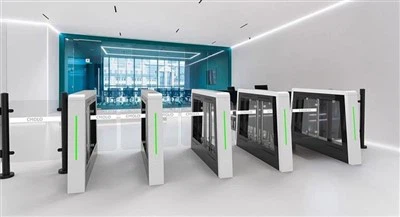
一,Technological adaptation: moving from "rigid control" to "flexible passage"
The main problem with turnstiles is finding the right balance between "safety control" and "traffic efficiency." Because they are basic mechanically and only have one way to check, traditional turnstiles often get stuck or tailgate. And via technological evolution, modern turnstiles have changed from "passive defense" to "active perception."
1. Algorithm for dynamic speed control and flow
Modern turnstiles use smart flow algorithms to change the pace of rotation based on how many people are walking through at any given time. For example, during the morning rush hour at a subway station, the turnstile will rotate at a speed of 0.8 to 1 revolution per second, with a single channel capacity of 30 to 35 people per minute. This is the same as the efficiency of traditional wing turnstiles. During off-peak hours, the speed will automatically slow down to 0.5 turns per second to lower the risk of injury from people rushing through. This design of "more people make it faster, less people make it stable" not only prevents traffic jams during busy times, but it also lowers the number of accidents during slow times.
2. Technology for verifying many modes
The turnstile has been improved so that it can now check both a face and a card, as well as a fingerprint and a QR code. For example, the gate at a certain technological park uses dynamic liveness detection technology with an error rate of less than 0.0001% and can compare faces in less than 0.3 seconds, which strikes a balance between security and convenience. Some turnstiles also have the "facial recognition payment" feature, which lets users verify their identification and pay their fees without having to do anything manually. This makes the procedure of passing through even easier.
3. Design that prevents pinching and is safe in case of an emergency
Infrared sensors, pressure matrices, and anti-pinch strips are frequent features of rotary turnstiles. The brake lever will stop moving and bounce back right away if it sees something alien. For instance, one model of turnstile uses 15 ° anti-reverse technology. If someone tries to get in from the other side, the gate will lock right away and sound an alert. All gates also have a power-off free passage function, which makes sure that people can get out quickly in an emergency.
二,Scenario optimization: a move from "universal solutions" to "customized services"
The need for turnstiles changes a lot depending on the situation. The industry makes travel better in some situations by designing them to fit those needs.
1. Big bags and exclusive group access
The standard width of a gate channel (52–60 centimeters) can make it hard for people with luggage or wheelchairs to get through. The Shanghai Metro Line 3 has made it much easier for those with large bags to get around by updating the "wide channel revolving door gate" and making the channel 90 cm wider. Some turnstiles also use a "double leaf small door" design instead of the usual three-bar structure. This gives people greater room to enter and escape.
2. Managing permissions for places with a high level of security
In places like jails and military administration areas, turnstiles need to find a compromise between severe control and easy entrance. For instance, a full-height turnstile for a prison uses ARM control technology and has a 15° anti-reverse mechanism. This stops reverse incursion and makes less noise by moving silently. Also, the gate has multi-level authorization settings so that only people who are allowed to pass through at certain times can do so.
3. Stability under tough conditions
The gates at public transportation stations need to be able to handle thousands of people opening and closing them every day, as well as humidity and dust. The full-height rotary gate is made of 304 stainless steel, has an anti-corrosion treatment, and is modular so that it can last for more than 10 years. For instance, during the Spring Festival travel rush at a certain train station, six sets of full-height turnstiles saw the most traffic in an hour, with 1200 people passing through. The failure rate was less than 0.3%, which is far lower than that of regular turnstiles.
三, User Experience: Moving from "Passive Adaptation" to "Active Perception"
The user experience of turnstiles has changed from just "physical passage" to "emotional interaction," which has made users happier by making the design more detailed.
1. Help with sight and sound
The gate has LED lights and speech prompts that clearly tell users what is going on with the passage. For instance, a green light will show up and the message "Please proceed" will be read out loud after the verification is complete. If the permissions aren't enough, a red signal will come up and "Contact administrator" will be shown. Some turnstiles have screens that show the number of people now using them and how long they will have to wait, which helps calm users down.
2. Trend of no influence passage
With the advancement of UWB ultra wideband positioning technology, future turnstiles are anticipated to facilitate "proximity verification" frictionless passage. For instance, when a person with an authorized device gets close to the gate, the system automatically verifies their identification and opens the channel without anyone having to do anything. This design cuts transit time to less than 1 second, which makes things much more efficient during busy times.
3. Improving services based on data
The turnstile collects traffic statistics through the backend system and helps administrators make decisions. For instance, a shopping mall looked at gate data and determined that the busiest times for people to come in are between 3 and 5 p.m. on weekends. Because to this, temporary channels were added during this time, cutting the wait time from 8 minutes to 2 minutes. This data-driven dynamic modification makes the user experience better right away.
4. The industry agrees that convenience is the most important thing about turnstiles.
According to industry standards and customer feedback, rotary turnstiles are quite useful.
Improving efficiency: A test study at a given subway station found that using turnstiles cut the tailgating rate from 15% to 0.3%, cut arguments by 82%, and overall traffic efficiency by 30%.
Security Improvement: The turnstile stops things like unauthorized entrance and proxy check-in by physically separating people and using smart verification. For one business application, it cut down on proxy check-in by 82%.
Optimizing the user experience: The turnstile may be used by a wide range of people, including the elderly, children, and disabled, thanks to its wide channel design, anti-pinch feature, and non-impact technology.
Intelligent Swing Gate


WhatsApp : 0086-15999546575
Skype : cmolo.joy
Email : contact@cmolo.com
Tel : 0086-15999546575
CMOLO Industrial Park,NO. 144-1, Hengping Road,Henggang Street, Longgang District, Shenzhen City, China