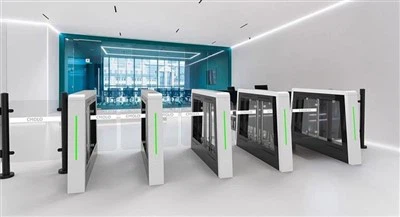
1. System architecture: A layered, distributed design makes sure that the system is reliable.
The centralized control system for multi-channel turnstiles is based on a "centralized management decentralized control" design. It has three layers: the local control layer, the network communication layer, and the central management layer. Each layer works on its own and is redundant with the others, so the system can keep working even if one part fails.
Layer of local control
An independent local control unit (LCU) is built inside each rotary gate channel. This unit includes a PLC controller, drive motor, encoder, sensor group (infrared radiation, human body induction, anti-pinch sensor), and an electromagnetic locking mechanism. For example, in a prison environment, the 90-degree full-height turnstile needs to be able to control the angle very precisely using a 15-degree anti-reverse mechanism and ratchet structure. Using the Modbus TCP protocol, the local PLC sends real-time information about the turnstile's position, passage status, and motor current to the central management layer.
Layer for network communication
To build a redundant ring network, each local control unit is connected to two separate fibre optic links by dual network cards. This makes sure that data can be sent in real time and that interference is avoided. Edge computing gateways can be used to preprocess data and convert protocols locally in a distributed gate cluster (like when the gates are in different buildings) to lighten the strain on the central server. For instance, Gezhouba Ship Lock's centralized control system uses a three-layer network architecture (local layer, sub control layer, and central layer) to handle three ship locks at the same time, with a communication delay of less than 50ms.
Management from the centre
The central management platform runs on servers or in the cloud and connects HMI touch screens, database servers, and alarm management modules. Using the OPC UA protocol and local PLC connection, you can see the state of the gate, give out rights in batches, store traffic logs, and get alerts when something goes wrong. For example, at a train station with a single-channel full-height rotary turnstile, the central platform can show the position of each channel's gate, the number of people walking through, and the temperature of the equipment in real time. It can also sound alarms and lock the turnstile when trailing behaviour is detected.
2. Main Function: From one control to smart collaboration
A multi-channel centralized control system is useful because it gets beyond the problems that come with managing a single device. It allows gate groups to work together and make smart decisions. Its main functions are:
Managing permissions in batches
Support batch granting of access rights by role, time period, and channel group to prevent having to set up each device separately, which is a waste of time. For instance, at a chemical factory, the system may automatically provide employees on different shifts the right channel access permissions and send them an SMS reminder to renew their permits before they run out. AES-256 encryption is used to protect the permission data from being changed without permission.
Scheduling traffic dynamically
Using infrared sensors and sensors on the human body, the system keeps track of the pressure in real time. The central platform then uses algorithms to change the state of the gate opening and closing. For instance, during the morning rush hour, the system can automatically open more channels and speed up the time it takes to reset the gate (from 3 seconds to 1 second), which increases the flow of traffic from 30 people per minute to 50 people per minute.
A system of alarms on multiple levels
The system features a built-in self-checking feature that can find more than 20 sorts of problems, including motor overload, encoder abnormality, and communication disruption. It can also provide alert information through WeChat, email, and SMS. For example, if the prison gate is broken violently, the system not only sets out sound and light alarms in the area, but it also locks nearby channels and sends video snapshots to the security terminal.
Optimization based on data
The central platform keeps track of each gate's traffic logs (including time, direction, and type of permission) and uses big data analysis to make traffic heat maps and equipment health reports. For instance, a military management area looked at traffic statistics for three months and noticed that Channel 2's traffic volume went up a lot during the lunch break. So, the channel gate's reset time was changed to cut down on traffic by 40%.
3. How to put it into practice: Building an intelligent environment together with software and hardware
A multi-channel centralized control system needs a lot of collaboration between choosing hardware, software algorithms, and communication protocols to work. Here are the most important technical points:
Choosing hardware: Both high dependability and compatibility are quite crucial.
PLC controller: To make sure that local sensors and drive motors work together without any problems, choose models that support industrial protocols like PROFINET and EtherCAT. For instance, the Siemens S7-1200 series PLC can handle four rotating turnstiles at the same time. It also has a built-in PID adjustment feature that can make the motor start and stop more smoothly.
Motor for driving: To regulate the gate position in a closed loop, a servo motor with an encoder is employed. For example, the motor in the full-height quiet turnstile must be able to start at 100% load and have a position precision of 0.1 ° to make sure it works well in temperatures between -20 °C and 60 °C.
Group of sensors: Infrared radiation sensors must withstand sunlight interference (for instance, with a 940nm wavelength), human body sensors must detect human movement within a 5-meter range, and anti-pinch sensors must have a response time of under 50 milliseconds.
Algorithm for Software: From Rules to Data
Control of traffic logic: Use the finite state machine (FSM) technique to build gate state transition rules, and explain the five requirements for the "standby authorization pass reset exception" state transition. For instance, if the system sees lagging behaviour, it forces the gate to leap from the "pass" state to the "abnormal" one and locks it.
Model for predicting traffic: We utilize an LSTM neural network to look at past traffic data, guess how busy each channel will be in the next 15 minutes, and make dynamic scheduling possible. The real-life measurement of a chemical plant indicates that the model can anticipate with 92% accuracy and change the strategy for opening and closing the gate 10 minutes ahead of time.
Managing the health of your equipment: Make an Equipment Health Index (EHI) using things like motor current and vibration frequency. When the EHI drops below a certain level, start preventive maintenance. For instance, this feature helped a certain prison turnstile fleet cut the number of times their equipment broke down from three times a month to half a time.
Protocol for communication: Finding the right balance between low latency and high bandwidth
Communication in the area: The Modbus TCP protocol is used to send and receive data between PLCs, sensors, and drive motors. Its 100Mbps bandwidth is fast enough for real-time data transfer from many sensors.
Communication between the central platform and the local PLC is done through the OPC UA protocol, which works on several platforms. Its secured transmission method can keep data from leaking. If you have a lot of gateway clusters (more than 100 units), you can use the MQTT protocol to make a lightweight communication system that doesn't put too much strain on the network.
4. Application Case: Testing from Theory to Practice
For instance, a big chemical facility had eight entrances and exits, each with its own turnstile. This caused problems including scattered permit administration and low traffic efficiency. Using a multi-channel centralized control system, the following improvements can be made:
Better efficiency: The speed of traffic has gone up from 25 people per minute to 45 people per minute, and the wait time in line during the morning rush hour has gone down by 60%.
Management cost savings: The number of security guards has gone down from 12 to 4, and the frequency of equipment maintenance has gone down by 50%.
Improved security: The accuracy of tailgating detection is now 99.8%, and there are no more unlawful intrusions.


WhatsApp : 0086-15999546575
Skype : cmolo.joy
Email : contact@cmolo.com
Tel : 0086-15999546575
CMOLO Industrial Park,NO. 144-1, Hengping Road,Henggang Street, Longgang District, Shenzhen City, China