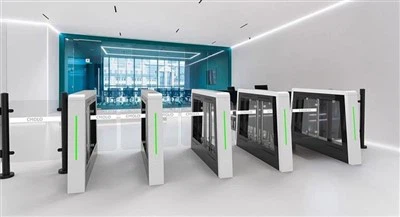
1. Learn the fundamental features of rotary turnstiles.
A turnstile, sometimes referred to as a full-height turnstile or full-width turnstile, is a sort of gate equipment whereby staff can enter and exit using the rotation of a metal fence. It is appropriate for locations needing rigorous monitoring of personnel's entrance and departure and boasts great security protection qualities. Depending on the number of doors, we can categorize rotary turnstiles as single-door turnstiles, double-door turnstiles, three-door turnstiles, and four-door turnstiles.
2. Think about the real requirements of corporate office structures.
When choosing the rotary gate's parameters, one must carefully evaluate the real needs of the corporate office building, including design style, space constraints, pedestrian movement, and safety criteria.
The movement of people in corporate office buildings significantly influences the choice of turnstile specifications. Office locations with heavy pedestrian flow, such as lobbies and elevator doors, should opt for wide passage turnstiles to enhance traffic efficiency. One might also think about installing multi-channel turnstiles to help further disperse the crowd.
Usually, enterprise office buildings have strict security standards. Therefore, when choosing a turnstile, one should prioritize gates that prevent tailgating and intrusion. These kinds of turnstiles are usually designed with specific size changes to satisfy particular safety protection criteria.
Space constraints: Corporate office building layouts differ, and turnstile installation space is thus subject to certain limitations. Therefore, when deciding on the parameters of a rotating gate, it is advisable to thoroughly analyze the actual installation environment and select a gate model with an appropriate body size and simple installation.
Design style: Another consideration when selecting the turnstile's parameters is the general architectural style of the corporate office building. The turnstile's look should complement the building's general design style to improve its overall attractiveness.
3. Consider the key technical aspects of rotary turnstiles.
Choosing the specifications of a turnstile also requires considering its main technical parameters: size, material and process, power supply voltage and working voltage, door opening and closing speed, traffic capacity, detection and anti-tailgating technology, communication and control, etc.
The rotating gate has length, breadth, and height among other dimensions. Typically, the corporate office building and its foot traffic requirements determine these dimensions. Usually, depending on the type and gate arrangement, the channel's width ranges from 550 to 1200mm.
Materials and workmanship: Usually composed of 304 stainless steel and with a 1.5mm thickness, the rotating gate's casing Other techniques, such as wire drawing, help to condition the surface so as to avoid corrosion and provide durability and strength. Premium materials like stainless steel or acrylic primarily construct the door wings and passageways.
Usually AC 220V or AC 85-230V, a turnstile's power supply voltage is AC; its working voltage is DC 24V. The gate operates normally only with these values.
Door opening and shutting speed: To guarantee quick passage of people, the turnstile has a rather rapid opening and closing speed-usually not exceeding 0.5 seconds.
Capacity: Depending on the type and design of the turnstile, it typically turns between 30 and 45 people per minute. When choosing gate parameters, one should carefully evaluate whether its traffic capacity satisfies real requirements.
Rotary turnstiles frequently employ technologies such as light curtain detection, utilizing a minimum of ten detection sites to prevent tailgating. One of the key steps is to guarantee staff members' safety both indoors and outside.
In order to achieve precise control and detection, the rotary gate incorporates DSP control technology, a mechanical encoder positioning structure, and communication interfaces such as RS485/RS232. The sophisticated turnstile management depends on this technology.
4. Think about the other purposes that rotary turnstiles serve.
Apart from the fundamental technical requirements indicated above, businesses should also take into account other characteristics, such as QR code scanning and facial recognition, while deciding the turnstile specifications. For these purposes, visitor registration and management can become more efficient, thereby strengthening the safety and management effectiveness of buildings.
5. Select trustworthy vendors and service providers.
At last, companies choosing rotary turnstile specs have to pick dependable vendors and service providers. Along with premium gate equipment, a trustworthy provider can provide after-sales service and professional technical support. One might take into account elements such as brand awareness, market share, and user reputation while selecting a supplier.
Smarter High Glass Security Turnstiles


WhatsApp : 0086-15999546575
Skype : cmolo.joy
Email : contact@cmolo.com
Tel : 0086-15999546575
CMOLO Industrial Park,NO. 144-1, Hengping Road,Henggang Street, Longgang District, Shenzhen City, China