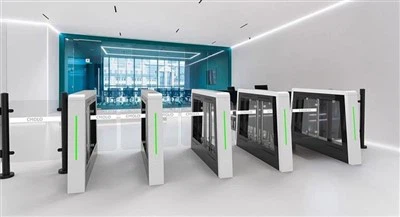
一, Technical architecture: from device integration to system level fusion
The integration of turnstiles and membership systems is essentially a two-way binding of "physical channels" and "digital identities". Its technological implementation needs to break through three key links:
1. Hardware layer: Integration of multimodal recognition devices
Modern turnstiles have broken through the single card swiping mode and integrated multimodal biometric technologies such as facial recognition, QR code scanning, NFC near-field communication, and fingerprint recognition. For example, the 3D structured light facial recognition gate deployed in a high-end shopping mall in Shanghai can complete liveness detection and identity verification within 0.8 seconds, with an error rate of less than 0.0001%; Hangzhou Wanda Plaza integrates NFC modules through turnstiles, supporting NFC sensing access for members' mobile phones, increasing peak traffic efficiency by 40%. The core of the hardware layer is to ensure a balance between recognition accuracy and traffic speed, while reserving expansion interfaces to be compatible with future technological upgrades.
2. Data layer: Real time synchronization of member information and traffic records
The traffic data generated by the gate needs to be synchronized with the membership system at the millisecond level. Taking Zhongfa Baiwang Shopping Mall as an example, its membership system is directly connected to the gate controller through API interface. When a member passes through by facial recognition, the system synchronously retrieves information such as member level, point balance, coupon pool, etc., and displays personalized welcome messages and exclusive discounts on the gate screen. The real-time nature of data synchronization directly determines the continuity of service experience - a test conducted by a chain gym showed that data delay of more than 1 second can lead to a 27% decrease in members' trust in system reliability.
3. Application layer: intelligent control of permission management and abnormal behavior
The membership system needs to dynamically allocate gate access permissions based on membership levels. For example, Wanda Plaza divides its members into five levels: point card, silver card, gold card, platinum card, and black gold card. Black gold card members can access the VIP channel 24 hours a day, while regular members only open the regular channel during business hours. At the same time, the system needs to have the ability to recognize abnormal behavior: a shopping center integrates weight sensors and pressure sensing devices through the gate. When it detects that the number of goods carried by customers does not match the shopping receipt, the gate automatically locks and triggers an alarm, reducing the theft loss rate by 92%.
二, Scene Revolution: From Single Pass to Full Link Experience Upgrade
The integration of turnstiles and membership systems is reshaping the four core scenarios of mall operations:
1. Members can accurately reach the scene
As the first point of contact for customers entering the store, the gate can carry personalized marketing functions. For example, a community mall in Suzhou embedded AR makeup mirrors on the gate screen, allowing members to experience virtual makeup while brushing their faces and receive a "50 yuan discount on purchases after makeup" coupon, resulting in a 28% increase in weekly sales of the beauty category. In addition, the gate can also be linked with the member's birthday system, playing customized blessing voice messages and giving exclusive parking vouchers on the member's birthday to enhance emotional connection.
2. Peak period diversion scenario
During the promotional period, the system can dynamically adjust the gate access strategy based on the member's historical consumption data. For example, a department store in Beijing increased the gate speed from 30 people/minute to 45 people/minute during the "Double 11" period. At the same time, high-value members were guided to prioritize the use of self-service devices through the "fast checkout channel" sign on the self-service checkout terminal, resulting in a 40% reduction in peak queue time and a 19% increase in sales rate.
3. Unmanned retail scenarios
In small businesses such as community convenience stores, gates and membership systems can form a "contactless payment" loop. After customers enter the store through facial recognition, the system automatically associates their payment account; When checking out, the gate automatically completes the deduction by double verifying the weight sensor and the RFID tag of the goods. The pilot project of a chain convenience store in Shanghai shows that this model has increased the daily average customer flow of a single store by 35% and reduced labor costs by 60%.
4. Emergency management scenarios
The gate machine needs to be equipped with 12 safety mechanisms such as automatic power-off and fire linkage. In the 2024 shopping center fire drill, the emergency response speed of its turnstile was three times faster than traditional access control. At the same time, the membership system automatically suspended transactions and generated an unsettled order list for subsequent customer service follow-up.
三, Data driven: from traffic statistics to in-depth insights into consumer behavior
The structured data generated by the turnstile and membership system is restructuring the operational decision-making system of the shopping mall
1. Thermal analysis of passenger flow
By integrating Wi Fi probes and Bluetooth beacons, the system can draw customer flow heat maps. For example, Hangzhou Wanda Plaza found that 65% of customers stayed at the entrance of the gate for more than 8 seconds. Based on this, the promotional booth was moved 3 meters forward, resulting in a 22% increase in try on rates. In addition, the system can also analyze gate traffic data at different time periods to optimize security personnel scheduling - a test at a certain shopping mall showed that the gate traffic during lunch peak hours was 2.3 times that of weekdays, and adjusting the scheduling improved security response speed by 40%.
2. Prediction of consumer behavior
Combined with membership system data, the gate can identify high potential customer characteristics. For example, a certain mother and baby shopping mall analyzed the dimensions of customers' gestational age and baby age, and pushed personalized product recommendations 3 days in advance, which increased the conversion rate by 34%. In addition, the system can predict the consumption cycle of customers based on the frequency of gate passage, automatically trigger reminder messages before restocking, and improve customer satisfaction.
3. Optimization of operational efficiency
Real time monitoring of gate traffic efficiency and membership service utilization, with the ability to dynamically adjust resource allocation. For example, a shopping center found through data analysis that the membership traffic in the fitness area reached its peak at 8 pm, while the yoga area had the highest usage rate at 3 pm. Based on this, the front desk staff were adjusted from fixed positions to mobile services, resulting in a 28% decrease in member complaint rates.
四, Implementation Path: From Equipment Selection to Ecological Construction
The deployment of turnstiles and membership systems in shopping malls must follow the "four step eight step" implementation method:
1. Requirement diagnosis stage
Passenger flow analysis: By manually counting or using temporary cameras to track peak passenger flow, determine the required speed for gate operation. For example, community shopping malls choose 90 ° turnstiles due to space limitations, which can save 30% of the area while maintaining traffic efficiency.
Route planning: Based on the layout of the shopping mall, design the relative position between the gate and the membership service terminal. A department store test showed that setting the gate within 5 meters of the elevator entrance can increase the proportion of customers flowing to the member service area by 40%.
2. System integration phase
Interface development: Ensure data interoperability between the membership system and the gate controller, payment gateway, and ERP system. For example, a certain shopping mall has developed a customized API that automatically synchronizes the parking payment information of members after the gate recognizes them, thereby improving the efficiency of departure.
Payment docking: integrate multi-channel payment methods such as WeChat payment, Alipay, UnionPay cloud flash payment, and support member points deduction. Tests have shown that shopping malls that support "points+cash" hybrid payments have a 15% higher membership repurchase rate than shopping malls that only support a single payment method.
3. Operation optimization stage
Data dashboard construction: Establish a real-time monitoring platform that includes 12 core indicators such as gate efficiency, member conversion rate, and stored value consumption ratio. A shopping mall found through data analysis that the gate failure rate on Friday night was 40% higher than usual. Based on this, the equipment maintenance cycle was adjusted to increase the system availability to 99.97%.
Employee training: Train employees to master skills such as emergency operation of turnstiles and handling of abnormal member services. According to statistics from a certain shopping mall, employees who have received systematic training have a 60% higher efficiency in handling gate abnormal events compared to untrained employees.
4. Continuous iteration phase
Technical upgrading: regularly update the gate biometric algorithm and the payment agreement of the member system to keep the technology progressiveness. For example, a certain shopping mall upgrades its gate face recognition model every quarter, increasing the recognition accuracy from 98% to 99.5%.
Scenario expansion: Explore the linkage between gate machines, virtual fitting mirrors, intelligent shopping carts, and other devices. A pilot project for a fast fashion brand shows that the linkage between turnstiles and virtual fitting mirrors can extend customer stay time by 10 minutes, resulting in a 25% increase in sales rate.
五, Future trend: From a single device to a smart retail entrance
With the integration of 5G+AIoT technology, turnstiles and membership systems are evolving into super entrances for smart retail:
1. Sensorless payment integration
By using UWB ultra wideband technology to achieve "face recognition and instant payment", a pilot project at a convenience store showed that this feature increased transaction efficiency by 65% and customer satisfaction by 40% during breakfast time.
2. Health management extension
Integrated infrared temperature measurement and health code recognition function, during the epidemic, a certain shopping mall passed the gate health screening, which increased customer confidence index by 41% when entering the store, and the speed of passenger flow recovery was 30% faster than shopping malls without gate deployment.
3. Metaverse interaction entrance
Through the linkage between AR glasses and gate screens, customers can receive virtual shopping guidance services when entering the store. A sports brand test showed that this feature increased the try on rate of new products by 38% and extended customer stay time by 8 minutes.


WhatsApp : 0086-15999546575
Skype : cmolo.joy
Email : contact@cmolo.com
Tel : 0086-15999546575
CMOLO Industrial Park,NO. 144-1, Hengping Road,Henggang Street, Longgang District, Shenzhen City, China