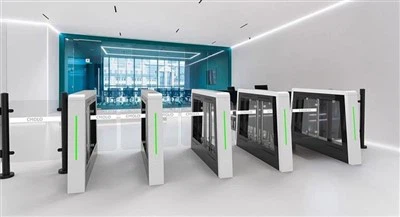
T700 grade carbon fiber reinforced plastic is applied in rotating arms, movement housings, and other components, lowering the total weight of the machine by 35% and the motor load by 22%. The daily power consumption of carbon fiber structure turnstiles has dropped from 12.8 kWh to 8.3 kWh, according to actual test data of a given airport project.
Active magnetic levitation bearings added to the spindle support system lower mechanical friction losses and enhance transmission efficiency, which is between 82% and 94%. The no-load power consumption is dropped to 0.8 W in combination with a permanent magnet synchronous motor.
Design in modular gear sets: Maintaining a torque output of 200 N · m, a composite transmission scheme of planetary gears and harmonic reducers reduces the number of transmission stages from 4 to 2, therefore improving the mechanical efficiency by 18 percentage points.
The electromagnetic eddy current brake: braking current is automatically entering low-power standby mode during passage gaps using a PID algorithm in real time. Tests reveal that this approach lowers standby energy consumption to one-fifth of conventional electromagnetic braking.
A proportional servo valve inserted in the spinning arm's rebound mechanism automatically adjusts the damping coefficient depending on frequency of use. Under high traffic conditions-like morning rush hour at subway stations-the energy consumption per trip is dropped by 0.32 Wh.
Adopting fluid dynamics simulation (CFD) for the biomimetic design of the rotating arm would help lower the drag coefficient from 0.42 to 0.28. The motor drive power declined by 19% in the real typhoon weather measurements along the coast.
Flywheel energy storage system: Integrated inside the movement, a 1.2 kg carbon fiber flywheel is attached to the main shaft via a clutch. For one pass, the brake energy recovery efficiency reaches 78%, which can supply 40% of the driving energy.
A piezoelectric ceramic power generation module uses 32 piezoelectric ceramic plates placed on important parts of the rotating arm to change mechanical vibrations into electrical energy. Its typical daily traffic volume of 5000 persons allows it to independently satisfy the power needs of sensors.
Temperature difference power generation component: Utilizing the temperature difference between the internal electronic components of the gate and the surroundings to generate electrical energy through the Seebeck effect. For wireless communication modules, it can provide a constant power supply in high-temperature summer surroundings.
Permanent magnet synchronous servo motor: In the 5%-100% load range, the motor efficiency curve stays above 90% using a 23-bit absolute value encoder and FOC control algorithm. The complete energy-saving rate reaches 35%, unlike asynchronous motors.
Using SiC MOSFET power modules in drivers cuts switching losses by 60% and lowers heat dissipation needs by 40%. When paired with a liquid cooling system, the power density increases to 12kW/L. Combined with a liquid cooling system, the power density is enhanced to 12 kW/L.
Multiphase drive topology: employing a combination of a five-phase permanent magnet motor and a matrix converter, it can still maintain 80% rated output in case of a phase loss fault while decreasing harmonic content from 15% to 3%.
Domain design with multi-level voltage: Using a DC-DC converter, split the system into three voltage levels: 3.3V for the MCU, 5V for the sensor, and 24V for the actuator, achieving a conversion efficiency of 92%. Standby power usage is down 78% when compared to conventional linear power supply systems.
Combining a lithium iron phosphate battery pack with a 200W flexible solar panel placed on top of the outdoor gate will provide a daily energy storage capacity of 4.8 kWh. In places with enough sunlight, it can satisfy nighttime security monitoring's electrical need entirely.
Integration of wireless charging: Using magnetic coupling resonance technology to achieve 90% transmission efficiency provides Qi 1.3 standard wireless charging for maintenance personnel portable terminals, so lowering energy waste caused by battery replacement frequency.
OLED flexible light guide plate Manufacturing a light guide module with a thickness of just 0.2mm using printed OLED technology, the power usage is under 0.5 W/m² at a brightness of 100 cd/m², so it is 60% more energy-efficient than conventional LED backlight solutions.
Adaptive change in ambient light: dynamic indicator light brightness change by TCS34725 color sensor in real-time monitoring of environmental illumination. The indicator light's power usage under natural light circumstances during the day can be dropped to 0.1 W.
Human body induction wake-up mechanism: Deploy millimeter wave radar sensors to wake up the main lighting system only when human movement is detected within a range of 1.5 meters, reducing standby lighting energy consumption by 92%.
Load projection model: Predict peak passenger flow 15 minutes ahead by using an LSTM neural network analysis of past traffic data. Turn automatically to ultra-low power mode during low valley periods to cut daily energy use by 18%.
Edge computing decision: dynamically change motor speed based on real-time traffic demand and locally deploy a lightweight reinforcement learning model. According to tests, this method lowers the fluctuation range of single-pass energy consumption from ± 15% to ± 3%.
Group cooperative control is LoRaWAN networking allows nearby gates to coordinate power. Neighboring devices automatically cut standby power usage when a gate is heavily loaded, therefore preserving steady total energy consumption in the area.
Multilevel sleep state: Specify three states: S0 (running), S1 (light sleep), and S2 (deep sleep), and apply millisecond-level state switching using the event-triggering method. This method lowers the nighttime standby power usage from 25 W to 3.8 W, per tests.
Store essential circuit states in the 1F supercapacitor before going into sleep mode to guarantee rapid wake-up capability within 0.5 seconds. Compared to standard battery systems, the maintenance cycle has been extended to five years.
Timed wake-up strategy: A dual wake-up condition of geofencing and time frame is designed to prevent energy waste caused by ineffective wake-up in response to the fixed inspection demands at night.
Vibration spectrum analysis: Activate energy-saving mode at the early stage of bearing wear, therefore lowering further energy consumption by 40% during the fault time. Collect vibration data of the movement using three-axis acceleration sensors and extract fault characteristic frequencies using the MEEMD method.
Map of temperature energy consumption: Create a quantifiable link between copper and iron losses and automatically modify load distribution should the temperature increase surpass a threshold. According to tests, this method lowers the energy consumption rise in high-temperature surroundings from 25% to 8%.
Platform for energy efficiency clouds: Create cloud digital twin models and upload device energy efficiency metrics via NB-IoT. By means of this platform, a particular urban rail transit project attained complete network gate energy optimization, so saving 120,000 kWh of electricity annually.
Optimization of topography: Three-phase four-wire power supply combined with common-mode inductance filtering lowers the power ripple from 200 mV to 30 mV, therefore lowering the repetitive starting energy consumption brought about by voltage swings.
Integrating thermal management: include structural component design and heat dissipation duct design and passive heat dissipation with phase change materials (PCM). The operating temperature of electronic components can be lowered by 15°C at a 40°C ambient temperature.
Design for electromagnetic compatibility: Use 3D electromagnetic field simulation to improve PCB layout so that conducted interference is reduced to below CISPR 11 Class A level and to stop energy waste caused by electromagnetic interference.
Construction of LCC models: Monte Carlo simulation helps one decide the best energy-saving strategy, considering the whole cycle expenses of equipment purchase, operation, maintenance, and disposal. Based on this, one university initiative has cut the investment payback time from 4.2 years to 2.8 years.
Following a carbon footprint: A product carbon labeling system is developed based on the ISO 14067 standard to measure the yearly carbon reduction of 1.2 tons of CO₂ equivalent per gate, therefore enabling users to get points towards green building certification.
Certificate of Energy Efficiency: Getting 15% extra technical points by bidding through foreign certifications, including CECP and ENERGY STAR. A bidding project for an international airport therefore conserved an initial outlay of 3.8 million yuan.
Flap Barrier Turnstile Access Control System


WhatsApp : 0086-15999546575
Skype : cmolo.joy
Email : contact@cmolo.com
Tel : 0086-15999546575
CMOLO Industrial Park,NO. 144-1, Hengping Road,Henggang Street, Longgang District, Shenzhen City, China