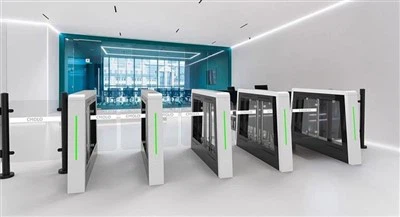
Maintenance of rotary turnstiles presented several challenges before the self-diagnosing feature emerged. First, of course, troubleshooting is challenging. The turnstile's interior construction is complicated and involves several pieces, including mechanical transmission components, an electronic control system, sensors, etc. When equipment breaks down, maintenance staff members sometimes have to rely on experience to examine each component one by one, which not only wastes a lot of time and effort but also makes it challenging to rapidly and precisely find some concealed problems. A tiny defect in a gate's sensor, for instance, can prevent the gate from properly sensing personnel passing, but maintenance staff might have to spend hours or even days troubleshooting all conceivable components to locate the issue.
Second, upkeep expenses are expensive. Because troubleshooting is tough, maintenance staff must allocate significant personnel resources for on-site repairs. Simultaneously, it is usually advisable to save many spare components to handle several conceivable failure scenarios so that the equipment can resume regular operation as soon as feasible. Along with raising labor expenses, component procurement and inventory control eat a lot of money. Extended equipment downtime for maintenance further disrupts the normal running of the site and results in financial losses to users.
Moreover, maintenance staff has outstanding technological standards. Rotary turnstiles are technologically advanced, combining expertise from several disciplines, including machinery, electronics, and automation. Rich professional knowledge and practical experience are prerequisites for maintenance staff members to effectively identify and fix flaws. Practically speaking, though, there are rather few maintenance staff with such high standards, which makes it challenging to guarantee the effectiveness and quality of maintenance projects.
Advanced sensor technology, microprocessor technology, and communication technology underlie the turnstile's self-diagnosing ability. Inside the rotary gate, encoders, pressure sensors, infrared sensors, etc. are among the several kinds of sensors fitted. Real-time monitoring of the equipment's running condition by these sensors covers the gate's rotation position, personnel's passing through, and motor running parameters.
Analyzing and processing the data acquired by the sensors falls to the CPU, the turnstile's "brain." It will ascertain, depending on predefined methods and reasoning, whether the device's running condition is normal. The microprocessor will start a self-diagnosing software right away as aberrant data is found to preliminarily discover and examine the fault. Concurrent with this, the turnstile has a communication interface that allows maintenance staff to quickly grasp the equipment's fault situation by sending the self-diagnosing results in real time to the mobile terminals of the remote monitoring center or maintenance staff.
When the gate of a rotary gate jams, for instance, the pressure sensor will identify aberrant variations in the motor load and send this information to the microcontroller. By means of comparison with the set normal load value, the microprocessor finds a fault in the gate's rotation. It will then examine the several possible causes of the malfunction, including mechanical component wear and tear, motor drive circuit faults, etc., and forward comprehensive fault information to the remote monitoring center.
Fast fault location
Reducing maintenance hassle depends on the turnstile's fast and precise ability to find the trouble site. While self-diagnostics directly identify defect information for particular components or modules, traditional troubleshooting techniques may require maintenance staff to do a thorough inspection of the whole equipment. When the self-diagnostic system alerts a sensor to malfunction, for instance, maintenance staff just need to check and replace the sensor, therefore saving a lot of time for troubleshooting other components.
Maintenance for preventives
Apart from tracking the real-time equipment operation state, the self-diagnostic capability offers early warning for possible flaws. By means of long-term analysis and sensor data processing, the system can forecast the component's remaining service life as well as the likely time of failure. Based on this warning information, maintenance staff can create advance maintenance plans and perform preventative replacement or repair of components that might malfunction to prevent unexpected equipment failures during operation and so influence the normal operation of the site. For instance, the system will signal maintenance staff in advance to check and maintain the motor to prevent damage resulting from too much wear and tear when it detects unusual changes in the running parameters of the motor.
Remote assistance and upkeep
Communication technology has helped the turnstile's self-diagnosing capability to reach remote maintenance and support. Through the remote monitoring center, maintenance staff can access real-time operating status and defect information for equipment without personally visiting the site. Using remote control technologies for equipment diagnosis and debugging, they can even remotely repair equipment when necessary. This increases the effectiveness of maintenance and reduces maintenance costs. For example, when a turnstile fails in remote places, maintenance professionals can immediately remedy the problem through remote maintenance, avoiding the arduous process of long-distance travel and on-site repairs.
Reduce technical requirements for maintenance personnel.
The emergence of self-diagnostic features makes the maintenance of rotary turnstiles easier and more feasible. Even people without extensive professional experience can do fault diagnosis and repair depending on the system prompts; it gives thorough fault information and repair guidelines for maintenance staff. This feature considerably lessens the reliance on the technical level of maintenance staff and helps to solve the issue of inadequate maintenance resulting from insufficient staff competency.
Painting Access Control Speed Gate Turnstile


WhatsApp : 0086-15999546575
Skype : cmolo.joy
Email : contact@cmolo.com
Tel : 0086-15999546575
CMOLO Industrial Park,NO. 144-1, Hengping Road,Henggang Street, Longgang District, Shenzhen City, China