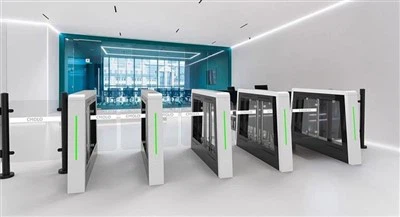
1. Physical separation: Making sure that the peak traffic level is safe
The turnstile is a structure that is completely closed off and is usually more than 2 meters tall. It works as a "single person passage unit" that the rotating blades keep from being able to do things like tailgating and overtaking. According to pilot data from the Beijing Metro, the rate of tailgating reduced from 15% to 0.3% after full-height turnstiles were put in place. The number of discussions about entering without tickets also dropped by 82%. This ability to physically separate is very important in the following situations:
A circumstance in which security is very important
Prisons, military administration areas, and other sites use rotary turnstiles with 15 ° anti-reverse technology and hydraulic shock absorbers. They can stop reverse entry and take a lot of force. For example, the SA101 cross turnstile at a certain prison employs ARM control technology and multi-level sensors to work quietly and stop in milliseconds, ensuring sure safety control in very dangerous scenarios.
Transportation hub with a lot of traffic
Shanghai Hongqiao Railway Station set up six full-height turnstiles during the busiest time of the Spring Festival traffic flow. These turnstiles could accommodate 30% more people than regular turnstiles, or 1200 people each hour. It has a wide channel design (up to 1.375 meters wide) that can handle things like luggage carts and wheelchairs. This keeps special crowds from getting caught and generating traffic congestion.
2. Dynamic regulation: clever changes to make traffic move more smoothly
During busy times, the number of people on the bus changes swiftly and in an uneven way. The turnstile employs speed regulation, multi-channel coordination, flow prediction, and other technologies to keep a "fast when there are many people and stable when there are few" balance.
Speed grading control
The technology changes the rotation speed to the quickest gear (0.8–1 circle per second) during the morning rush hour at the subway station (7:30–9:00). This lets 30–35 people pass through a single channel every minute, which is the same as how well standard wing gates work. When it's not busy, the pace will automatically drop to 0.5 turns per second to lessen the risk of damage from those speeding through. A high-speed train station in Shenzhen employed AI algorithms to look at past data and switch to "peak mode" three days before holidays. This made it easier to recognize people and kept the doors open longer, which enhanced the station's daily capacity to handle passengers by 40%.
Smart diversion over many channels
For big events, there are sometimes more than one set of turnstiles, and the system maintains track of how many people are going through each channel in real time. When there are more than five people in a channel, LED screens or audio alerts encourage them to go to the channel that is unoccupied. Dynamic sorting helped a sports center in Guangzhou minimize the average wait time at the entrance of a concert from 12 minutes to 3 minutes. This stopped the entrance from being too crowded.
System for elastic scaling
The turnstile can easily get bigger for short-term peak times, like when there are a lot of people visiting a picturesque place or an exhibition. During off-peak times, it combines channels to save energy, while during peak times, it separates channels to make more area for transit. The main stadium for the Hangzhou Asian Games is modular, and one hour before the game starts, facial recognition gates that can be moved will be added to the entrance channel. This will double the number of groups from 8 to 16, which will get 40,000 people in swiftly.
3. Smart recognition: Cutting down on the time it takes to get through once
The turnstile uses a number of biometric and mobile payment technologies to cut down on the time it takes for one person to get through to 1–2 seconds. It can also recognize more than one person at a time (some high-end models can recognize 3–5 people at simultaneously), which stops the line from getting backed up with "one person recognition, multiple people waiting":
Biometric recognition that can use more than one type of input
Even in bad illumination, 3D facial recognition technology can still be more than 99% accurate. Optimized algorithms can even recognize someone wearing a mask in a matter of seconds. Prisons and research labs utilize iris recognition to stop identity theft. The turnstile at a Shenzhen shopping mall can do both "face recognition and QR code scanning." This speeds up traffic by 60% during peak times.
Simple to connect mobile devices
You can check your phone by being close to the gate, just like you would with a bus card. This is possible because of NFC (near-field communication) technology. You can use it to limit who can get into businesses, neighborhoods, and other places. NFC gates and staff badges work together to make "seamless passage" in a special tech park in Shanghai. This implies that there are no more lines during the morning rush hour.
Checking the Integrated Health Code
To make epidemic prevention and control more natural, health code recognition modules can be installed to turnstiles and linked to ticketing systems. In 2025, athletes will have to swipe their ID cards to enter into a marathon. After that, the system will check their health codes, nucleic acid records, and whether or not they are eligible to compete. It only takes four hours to inspect 30,000 athletes in one day, which is ten times faster than doing it by hand.
4. Working together as a system: Making a whole emergency response system that works in all situations
Peak entry tests how well equipment works, but it also needs a lot of work on security, navigation, operation, and maintenance systems to fully handle the "prevention guidance recovery" process:
Guessing how many people will be on board and setting appropriate timetables
You can estimate when the busiest times will be by looking at video footage, heat maps, and historical data modeling. Then, they can change how they work on their own. A huge shopping mall in Beijing adjusted the underground garage gate to "fast release mode" an hour before the weekend rush hour. At the same time, they used the app to send out information like "current congested entrance" to help clients locate a way in that wasn't too crowded.
Finding and fixing problems on your own quickly
Smart sensors that are included in keep an eye on the motor and rotating shaft in real time. If they fail, the system rapidly switches to the backup channel and sends out alarm information. The revolving gate on one line of the Guangzhou Metro is made up of different parts. This reduces the time it takes to rectify motor problems from two hours to thirty minutes and cuts the number of times channels are blocked by equipment shutdown by 85%.
System for emergency backups
If there are a lot of people trying to get through or the system goes down, the turnstile can be opened with one click to enter "emergency mode." In this mode, the door leaf is usually open, and manual verification is employed instead. We built up manual sliding doors as a backup. This technique helped Zhengzhou East Station transport 20,000 people who were stuck there out of the station in 10 minutes during the busy Spring Festival travel season in 2026. This kept people from getting hurt in stampedes.


WhatsApp : 0086-15999546575
Skype : cmolo.joy
Email : contact@cmolo.com
Tel : 0086-15999546575
CMOLO Industrial Park,NO. 144-1, Hengping Road,Henggang Street, Longgang District, Shenzhen City, China