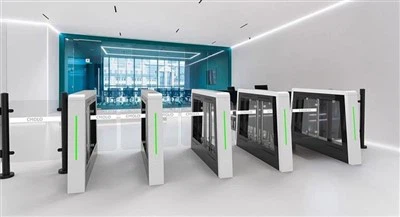
一, Core requirements for compliance inspection
1. Mechanical structural strength and stability
Material and Craftsmanship:
The General Safety Requirements for Small and Medium sized Rotating Electrical Machines (GB/T 14711-2013) state that the surface should be treated with 320 mesh wire drawing to guarantee corrosion resistance and aesthetics and that the rotating arm of the rotary gate should be made of SUS304 stainless steel material. After three months of operation, it was found that the use of inferior steel had resulted in rusting of the turnstile arm during the acceptance of a subway project, thereby necessitating replacement of all turnstiles.
To guarantee that the structure does not distort in high passenger flow conditions, the gate must pass both static load testing (≥ 200N) and dynamic fatigue testing (≥ 100000 cycles). Beijing Daxing International Airport tested every gates' structural strength 1.5 times rated before its 2019 opening to make sure it complied with criteria.
Following installation, the gate's overall skew should be ≤ 2mm and each joint's offset should be ≤ 0.5mm. The ground must be re laid and the bracket height changed as the ground in a certain office building is uneven and the infrared sensor of the gate cannot be aligned.
2. Electrical safety and protection
The "Code for Design of Low Voltage Distribution" (GB 50054-2011) specifies that the grounding resistance should be ≤ 4 Ω and the gate motor's insulation resistance should be ≥ 1M Ω (measured with a 500V megohmmeter). All gates in Xi'an Metro's equipment upgrade in 2022 must be fitted with leakage protection devices with an operational current of less than 30mA and a response time of less than 0.1 seconds.
Outdoor turnstiles have to satisfy IP65 protection criteria; inside turnstiles have to satisfy IP54 protection criteria. Equipment regularly broke in an industrial park using IP42 grade turnstiles during the rainy season; eventually, IP65 grade items were used in lieu of them.
Stable functioning in complex electromagnetic conditions depends on the gate passing tests including electrostatic discharge immunity (GB/T 30148-2013) and electrical rapid transient pulse group immunity.
3. Waterproof and moisture-proof measures
Base and Seal:
The gate machine must be fitted with a cement base of 100mm or more and sealed with silicone gel to close the gaps in wet and water prone surroundings. The base was not located in a park, thus the gate machine was submerged in water during a downpour and the motor was abandoned because of water infiltration.
Anti-condensation design: The gate must include a heating module inside and a humidity sensor that will initiate dehumidification upon relative humidity of ≥ 85%. Long-term loss of power supply led to internal condensation and corrosion of the circuit board resulting from a particular university gate, which resulted in a maintenance cost up to 40% of the initial value of the equipment.
The cable sealing ring and interface must be bonded with silicone using a glue thickness of at least 3mm and without gaps. Rainwater poured into the gate along the cable and burned the main control board from faulty gluing in a specific project.
4. Safety warnings and signage
Product name, model, manufacturer, safety warning signs-like "prevent pinch"-dangerous voltage signs, etc. should all be labels on the gate machine. Lack of safety warning labels was found to be mostly responsible for minors breaking through and getting wounded by the gate operator of a certain shopping mall.
Identification durability:
To guarantee long-term clarity and visibility, the label has to pass 50 wet wipe tests (GB 16796-2009). Three months later, the regulatory department ordered the gate sign of a certain picturesque location corrected by bad printing technology, therefore producing hazy handwriting.
Emergency release indicator:
Clearly marked should be the position and operation technique of the emergency release button of the gate to guarantee quick personnel evacuation in case of an emergency such a power loss.
二, Technical directions for installation
1. Preinstallation survey needs
Ground conditions: Ground levelness (error < 2mm/m), material should be confirmed; prevent installation on easily deformed ground; and water accumulation risk should be checked. Uneven ground caused the gate of a particular unit to have an infrared sensor false alert, which finally required re pouring on the ground.
Space dimensions: The distance between the gate group and the wall has to be ≥ 1.2m; the width of the passage has to be ≥ 550mm (regular passage) and ≥ 900mm (wheelchair passage). The gate group will be relocated back 1.5 meters in Beijing Capital Airport's redevelopment in 2023 to guarantee that the fire escape satisfies regulations.
Environmental audit:
One must assess the humidity, temperature, illumination, and other installation site variables. Direct sunlight has long been present in the gate of a certain subway station, which has hastened the aging of the display screen and reduced its service life by 60%).
2. Technological and installation process
Fundamentally, construction:
Pre-embedment of M10 or M12 expansion bolts depends on the kind of gate; the number depends on the bolt burial depth of ≥ 80mm. A particular project's inadequate bolt burying depth caused the gate to slant one month of use.
Assembling components:
Assembling in the sequence "multi-faceted frame → single-sided frame → top box → bottom bracket → gate rod" will help to guarantee that the direction of the gate rod corresponds well with the top box and bottom bracket. The gate cannot revolve normally at a given building site since the gate pole is installed sideways.
Specifications for wiring:
Separately routing the power line and signal line using metal conduit with a diameter of at least 20mm and a burial depth of at least 50mm will help to Signal interference is common in a given park since strong and weak electricity cannot be separated; the gate operates with a misoperation rate as high as 20%.
3. Acceptance standards and debugging
Functional tests:
Door wing opening and closing, sensor response speed (infrared ≤ 50ms, facial recognition ≤300ms), traffic logic (bidirectional anti tailgating), alarm mechanism (anti pinch, power-off emergency), etc. must all be checked. Three percent of the turnstiles at Guangzhou South Station revealed sensor offset problems during the 2022 acceptance examination. Re debugging, they passed the acceptance inspection.
To confirm system stability, model high flow pressure testing (≥10000 opening and closing cycles). Following "preventive maintenance" at Chengdu East Railway Station in 2023, the annual turnstile failure rate dropped from 0.8% to 0.2%.
Requirements include quality inspection reports, warranty cards, third-party certification certificates (like CE/FCC), installation records, and other documentation. It was impossible to find culpability for equipment failures in the latter phases since quality inspection records for a particular project were lost.
三, Common Problems and Solutions
1. Uneven ground causes sensor false alarms
Reason: The infrared sensor fails to align due to ground tilt.
Re pour the ground or use changeable brackets to modify the levelness.
Case: Uneven ground generated infrared false alarms from a particular unit's turnstile; hence, an adjustable bracket was finally used to fix the issue.
2. Inadequate waterproof measures result in water ingress into the equipment
Reason: The opening is not sealed, the adhesive is not put correctly, and the base is absent.
The solution is to build a cement basis, use adhesive consistently, and block non-essential gaps.
Case: Not placed with a base, the gate machine in a park was submerged in water after a downpour; the motor was dismantled. Once IP65 goods were used instead and set up with a base, the issue was fixed.
3. Lack of identification leads to safety accidents
Reason: Not one emergency release sign or safety warning posted.
The solution is to finish the identification and enhance staff development.
Case: A toddler was hurt bursting through the gate of a certain shopping mall since safety warning labels on it lacked. Later on, the operator finished the labeling and tightened checks; he was judged to be mostly responsible.
Intelligent Outdoor Turnstile Barrier Gate


WhatsApp : 0086-15999546575
Skype : cmolo.joy
Email : contact@cmolo.com
Tel : 0086-15999546575
CMOLO Industrial Park,NO. 144-1, Hengping Road,Henggang Street, Longgang District, Shenzhen City, China