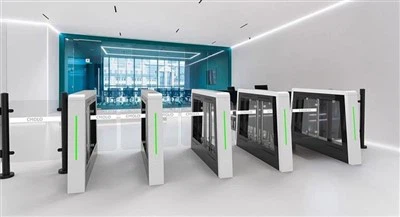
1. Optimising the mechanical structure: going from a physical barrier to a dynamic balance
The main benefit of rotary turnstiles is its unique mechanical design, which uses dynamic space management to find a compromise between safety and efficiency. The full-height rotary gate is a physical barrier that is 2.2 metres high and can rotate 120 degrees. It entirely stops people from climbing or drilling through it. Its hydraulic shock absorber core and industrial-grade stainless steel box keep the equipment running smoothly even with 5000 people passing through it every day, and it can last for more than 10 million uses. This design makes single-channel traffic more efficient, going from 15–20 people per minute on a typical three-roller gate to 30–40 people per minute. A test at a chain supermarket in Shenzhen showed that the wait time at the entrance during busy times was cut by 62%.
Points of technological breakthrough:
Anti-reverse mechanism: This technology is built in at 15 ° and shuts the gate right away when it detects a reverse intrusion. It also sets off an alarm to stop tailgating behaviour from causing more congestion.
Design for emergency mode: When the power goes out, the gate will automatically unlock and stay open, which is what fire safety rules say it should do. It will also reset itself when the power comes back on, which gives you two guarantees of safety and efficiency.
Modular Expansion: lets you run many channels at the same time. For instance, a metro station in Shanghai added four tidal channels to its single station capacity, which went from 12,000 people per hour to 28,000 people per hour. This made morning rush hour less stressful.
2. Intelligent perception upgrade: from being controlled to making decisions on your own
The new rotary gate is a big step forward from a "mechanical switch" to a "intelligent decision-making terminal" since it uses AI algorithms and multiple sensors to make decisions. This makes traffic flow much better in complicated situations.
Implementation of Core Function:
System to stop tailgating: It can accurately record the number, movement path, and body shape of people in the channel using 12 sets of infrared sensors and millimetre wave radar. The gate locks right away when two individuals pass through at the same time. This sets off an alert that can be heard and seen, and it sends the event coordinates to the monitoring system. The test data from a big supermarket reveals that this approach lowers the rate of missing reporting of trailing events from 12% to 0.3% and speeds up processing by 60%.
Dynamic permission control: works with membership systems and payment platforms and enables several ways to log in, such as IC/ID cards, QR codes, and facial recognition. For instance, a certain brand of turnstile has an RFID card reader built in. When the customer pays, the turnstile opens up on its own. If unpaid items are found, the channel should be locked right away and the police should be called. This lowers the loss rate in the self-service checkout area from 1.2% to 0.3%.
Analysis of behaviour prediction: Some high-end models come with behaviour analysis cameras that can spot strange behaviours like wandering and squatting. When the system sees that traffic is getting too heavy, it immediately changes the gate traffic mode (for example, from two-way mode to one-way fast traffic). A retail centre has proved that this function enhances the channel throughput by 45% during busy times.
3. Operations based on data: from optimising one point to working together across the whole chain
The turnstile serves as the front-end node for data collecting. It combines its traffic record and monitoring system, POS system, and passenger flow analytic platform into a closed-loop management system called "prediction scheduling optimisation."
Common use cases:
Passenger flow heat analysis: Use Wi-Fi probes and video analysis to make a mall heat map by capturing the entry and exit times and frequency data through the gate. The smart supermarket has shown that this technology can find high-risk locations (such jewellery and fresh food sections), let security resources be used more efficiently, and cut theft rates in crucial areas by 41%.
Management of dynamic channels: Use historical data to train machine learning models to guess when there will be a lot of passengers and where they will be. A certain chain supermarket looked at the gate traffic data and saw that the flow of people in the fresh food section went up every Friday night. Adding temporary gate channels cut the wait time for people in the area by 58%.
Improving emergency response: The fire alarm system is connected to the gate. When the alarm goes off, the gate automatically unlocks and stays open. The monitoring technology also makes an evacuation heat map to help people stay away from unsafe locations. The fire exercise at a big grocery store demonstrated that the linking strategy cut the time it took to get out of the store from 8 minutes to 3.5 minutes.
4. Scenario-based innovation: moving from standard solutions to services that are tailored to each customer.
Because the demand for rotating turnstiles varies from company situation to business situation, they have come up with a variety of methods to find a balance between lowering costs and improving efficiency.
Examples of industry practice:
Transportation Hub: The North Street Station of Xi'an Metro Line 2 is a transfer hub. During busy times, it uses a tidal gate management system to control the flow of passengers. Based on data from before the sale, the ratio of admission to leave gates is changed in real time, with six switches and a 75% reduction in congestion hotspots. At the same time, the lifespan of equipment has been increased by 40% by using predictive maintenance technologies and creating an intelligent operating and maintenance system.
A 5A level cultural and tourism picturesque place has a language translation feature and an AR virtual tour at the entrance gate. This lets foreign travellers get services in multiple languages and see the whole area. By using both the pre-ticketing system and the reservation system, passenger flow is managed by time slots to keep the number of people from getting too high. This has led to a 29% improvement in visitor satisfaction.
Industrial Park: A big factory has put in the Jiuding brand full height turnstile, which uses an intelligent management system to keep track of who comes and goes. This way, the information about each person who enters and exits can be traced. After implementation, the accuracy of visitor data has gone up to 99.8%, labour expenses have gone down by 30%, and the quality of security management has attained the highest standards in the industry.
5. Experience optimisation: going from functional implementation to emotional resonance
The cutting-edge rotating gate has gone beyond being just a way to get around and is now an emotional carrier for businesses to communicate brand value and keep customers coming back. Like this:
Design that doesn't have barriers: Make separate channels for kids and seniors, and add an AI monitoring feature to the gate system so it can automatically find these groups and give them voice direction and wide channel mode. The use of a communal grocery has cut down on the number of kids who go lost by 90%.
An interactive experience: A high-end brand retailer put OLED panels in the gate. When VIP clients swipe their faces to go in, the screen automatically plays personalised welcome films and suggestions for new products. This makes them 27% more likely to buy again.
The idea of protecting the environment: Encourage the use of electronic tickets, let people into the park through gate scanning, and cut down on the number of paper receipts. A certain gorgeous place saves 12 tonnes of paper every year, lowers costs, and boosts the brand image of eco-friendly tourism.


WhatsApp : 0086-15999546575
Skype : cmolo.joy
Email : contact@cmolo.com
Tel : 0086-15999546575
CMOLO Industrial Park,NO. 144-1, Hengping Road,Henggang Street, Longgang District, Shenzhen City, China