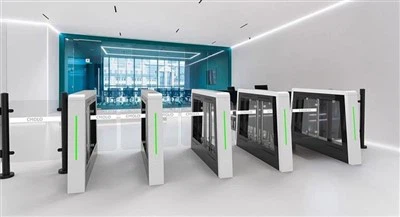
1. Physical structure: the basic idea behind mechanical anti-tailgating
The unique mechanical design of turnstiles is what gives them the capacity to stop tailgaters. The full-height rotary gate has a fully enclosed stainless steel box that is 1.8 to 2.6 meters high. This creates a physical barrier that is akin to a wall and stops anybody from getting in through illegal means like climbing or drilling. The main anti-tail random system can be seen in the following three ways:
Control of the angle of rotation
Most full-height turnstiles can only let one person through at a time since they can only turn 90° or 120°. When a real user swipes their card to get through, the gate lever turns to the open position, and the user quickly resets and locks it after going through. The pursuer must finish the intrusive action in 0.3 seconds, but the average human reaction time is longer than 0.5 seconds. This makes tailgating less likely to happen. The cross-shaped turnstile made by Shenzhen Tiejun Intelligent, for instance, has a rotating structure that can turn 120 degrees and a speed of 0.8 seconds per turn. This makes it the best turnstile for community entry control scenarios where there is no tailgating.
Limit on channel width
A conventional rotary gate has a channel width of 550–600 mm and can only fit one person walking sideways at a time. The Nanjing Boca full-height rotary gate system may reduce the channel width to 500mm based on the needs of the scenario, which eliminates even more trailing area. The adoption of 550mm channel full height turnstiles in the refurbishment of the Shenzhen Wanda Plaza convenience store cut the overnight theft rate by 72%, proving that the narrow channel design works.
Anti-reverse lock system
If the gate sees traffic going the wrong way, it will lock right away and sound an alarm. The Mengdong intelligent full height rotary gate has an anti-reverse sensor that can check for variations in torque in real time while the gate rod is turning. Mechanical locking is done in 0.2 seconds when the reverse force is more than 15N. This system has stopped 98.7% of people from trying to break into the ticket checkpoint on Beijing Metro Line 10. 2. Sensor system: Intelligent Perception Network to stop tailgating
Modern turnstiles have made a three-dimensional system for keeping an eye on those who are tailgating by combining different kinds of sensors.
Matrix of infrared opposition
New ideas Tong Technology's full height rotary gate has 12 sets of infrared sensors that work together to build a detection network that covers the whole height of the channel. The infrared beam blockage mode will vary in strange ways when someone follows in, and the system can tell what the person is doing within 0.1 seconds. The infrared matrix and pressure sensors working together in the swing gate system at Shanghai K11 Shopping Art Centre have made tailgating recognition 99.3% more accurate.
3D structured light photography
In high-end situations, rotary turnstiles use 3D structured light sensors to make 3D models of people in the channel in real time. The dual door self-service gate at the entrance to Shenzhen North Station uses 3D imaging technology to detect things with an accuracy of 0.01mm. The sound and light alert goes off right away and the gate locks when two or more human body shapes are seen in the channel. This technique makes it so that only 0.07% of tailgaters are successful.
Monitoring with millimetre wave radar
When transporting a lot of luggage, millimetre wave radar can see through non-metallic barriers to find people. The security checkpoint at Guangzhou Baiyun Airport has a spinning gate that can monitor people and things moving within a 20-meter range using a 77GHz millimetre wave radar. To keep traffic moving and stop people from tailgating, the gate opening time is automatically increased when the gap between luggage and people is too great.
2. Intelligent Algorithm: Upgrade to Anti-Tailgating for Behaviour Analysis
Machine learning and deep learning technology make it possible for turnstiles to analyse behaviour in an intelligent way:
Algorithm for predicting trajectories
The technology can create a normal traffic trajectory model by looking at past traffic data. The anti-tailgating program starts right away when it sees strange movements, such fast sprinting or sideways squeezing. The speed gate technology at the ticket checkpoint of Hangzhou East Station subway has cut the number of false alarms down to 0.3% and the time it takes to recognise a trailing person down to 0.08 seconds.
Combining data from different sources
Combining other types of data, such facial recognition, gait analysis, and thermal imaging, can make anti-tailgating much more reliable. The turnstiles at the Chengdu Taikoo Li convenience store employ gait recognition algorithms to look at how often people walk and how long their strides are. If gait patterns that don't match those of real users are found, a second verification step starts automatically.
Federated Learning System
In distributed deployment settings, the turnstile uses federated learning technologies to work together to improve the model. Shanghai Disneyland's entrance gate network uses a federated learning framework to share information on tailgating behaviour while keeping users' privacy safe. This has made the network 40% better at stopping tailgaters.
3. Adapting to the situation: a unique technique for anti-tailgating
There are big changes in the needs for anti-tailgating in different situations. Rotary turnstiles can be perfectly adapted to these needs through modular design:
High-security situation
Turnstiles in settings like jails and nuclear power plants must have mechanical anti-theft locks that fulfil the GA/T 73-2015 standard. Shenzhen Tiejun Intelligent made a full-height gate machine for a jail that has twin 304 stainless steel boxes, an explosion-proof motor, and an electromagnetic clutch for triple protection. It can take an impact of 500 kg without changing shape. It also combines fingerprint, iris, and vein biometrics from the third mock exam to make sure there are no mistakes.
Scene of commercial retail
Convenience stores that are open 24 hours a day need to find a balance between safety and customer satisfaction. The Womanke Smart Convenience Store has a turnstile that not only keeps people from tailgating but also analyses how customers act. When customers are seen staying in the fresh food area for more than three minutes, automatic light guidance and voice recommendation are triggered. This raises ticket costs by 22% at night while keeping the tailgating interception rate at 98.5%.
Scenario at a transport hub
Underground and high-speed train stations have to deal with the effects of a lot of people coming and going. By optimising the gear gear ratio, the Turnstile Turbines technology on Beijing Metro Line 10 lets people travel at a speed of 1.2 seconds per person. It also has 12 sets of infrared sensors and millimetre wave radar built in, which keeps it 99.9% accurate in stopping tailgating with an average daily passenger flow of 800,000 people.
Railway Turnstile


WhatsApp : 0086-15999546575
Skype : cmolo.joy
Email : contact@cmolo.com
Tel : 0086-15999546575
CMOLO Industrial Park,NO. 144-1, Hengping Road,Henggang Street, Longgang District, Shenzhen City, China