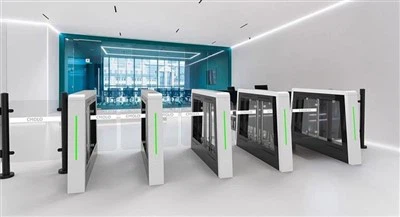
1. The most important part of one-way control technology is how the mechanical structure and intelligent control work together.
The turnstile can only let one car through at a time because of its exact mechanical design and smart control system functioning together. The "one-way rotation+electromagnetic locking" dual guarantee mechanism is the most important part of this.
One-way gearbox system with a ratchet and pawl
The main part of the rotary gate that sends signals is a ratchet and pawl construction. The teeth that stick out on the outer or inner edge work with the pawl to stop the gate from rotating in one direction. The pawl clicks into the next slot to stop the brake lever from turning backward when it turns 120 degrees. This construction is like the one-way locking mechanism of nylon zip ties, but it can take more wear and tear and higher frequency impacts since it is made of metal and is machined to a high level of perfection. A Shenzhen-based producer has test data that demonstrates its ratchet construction stays accurate after 6 million opening and closing cycles. This meets the daily needs of 5,000 people and can run continuously for more than three years in supermarkets.
Technology for locking with electromagnetic attraction
The rotating brake is dynamically locked using an electromagnet that works with a ratchet gearbox. If the system doesn't get a legitimate traffic signal, the electromagnet stays closed, the pawl stays locked in the tooth slot, and the brake lever can't move. Once the signal is verified, the electromagnet loses power and lets the pawl go, letting the brake lever move when pushed from the outside. This design makes sure that traffic only goes one way. Even if a lot of people push on the gate at the same time, the electromagnetic lock's immediate suction force (typically exceeding 200N) may stop unauthorised traffic.
Intelligent control board responds in milliseconds
The main control board of the turnstile has an ARM CPU and DFC dynamic limit technology. It can process input signals from card readers, infrared sensors, and manual buttons in real time. For instance, the system does signal processing and delivers motor driving instructions within 0.2 seconds of a consumer swiping their membership card. The brake lever may be turned between 90° and 120° with great accuracy, making sure that it locks right after one person passes through. The real test data from a certain chain supermarket reveals that the rotating gate machine that works by employing the optical hole location can totally get rid of the problem of "too many people brushing one card." The accuracy rate of passing is 99.97%.
2, The main job of one-way control is to find a balance between safety, efficiency, and adaptability.
There are a lot of reasons why one-way control is needed for turnstiles in a supermarket: to keep things from getting lost, to keep traffic moving quickly during busy times, and to be ready for emergencies like a fire evacuation. The turnstile strikes this equilibrium by doing the following:
Alarm for unauthorised passage and anti-tailgating
The rotary gate comes with an infrared sensor array that can keep track of how many people are in the channel at any given time. If two persons try to go through the gate at the same time, the system locks it right away and sets off an alarm that can be heard and seen. It also sends the event record to the management terminal. For instance, a certain company's turnstile has 12 pairs of infrared sensors that cover a channel height of 0.3 to 2 meters. These sensors can tell the difference between kids and carts with a false alarm rate of less than 0.03%.
Dynamic time limit for passing and automatic reset
The turnstile has changeable passage time limitations (typically 2–60 seconds) to keep channels from getting blocked. If the consumer doesn't pass within the time limit, the gate will lock itself and make a sound to let them know. If the system sees that the brake lever hasn't been reset (for example, because something outside of the system is blocking it), it will reset it within 10 seconds. This design makes traffic flow better by more than 40% during busy times. Test data from a Yonghui supermarket showed that after they put in turnstiles, the entrance congestion rate went down from 35% to 12%.
Fire link and power-off are usually open.
The spinning gate has a fire input interface built in that may be connected to the supermarket's fire alarm system. The gate unlocks automatically when a fire alarm goes off and stays open so that people can leave quickly. The gate also has a UPS backup power source that can keep working for more than 30 minutes after the power goes out. This meets the "Code for Fire Protection Design of Buildings" requirement that "evacuation routes must remain unobstructed during power failure."
3. Scenario adaptation: changing the unidirectional control scheme from standard to custom
The many different types of supermarket settings call for turnstiles that can be changed to fit the needs of each situation, such as changing the channel width, the materials used, and the number of functions.
Find a good balance between the width of the channel and how well it works for traffic.
Standard turnstiles have a channel width of 550 to 800 mm, which is wide enough for one person or a cart to pass through. A dual-channel rotary gate combination method can be used for the entrance channels of big supermarkets. The main control board can be linked to make the movement of people more intelligent. For instance, when more than five people are waiting in channel A, the system automatically directs the next people to channel B and improves the flow of traffic using LED lights and voice instructions.
Changing materials and levels of protection
The store may have problems like excessive humidity and big changes in temperature, thus the turnstile needs to be very safe. For instance, a manufacturer's full-height rotary gate includes a frame made of 304 stainless steel and an IP65 protective chassis that keeps dust and liquids from getting in. It also has a temperature compensation module, so it can work reliably in temperatures ranging from -40 °C to 80 °C. This makes it perfect for outdoor paths in northern areas throughout the winter.
Adding more functions and integrating systems
Supermarkets can use rotary turnstiles in a way that works well with their membership, payment, and security systems. For instance, the gate at a certain chain store can recognise faces and check health codes. The system works with the member database in real time. The camera automatically takes pictures of VIP customers' faces and compares them as they get close to the turnstile. The turnstile opens in 0.8 seconds, and voice and light effects greet customers to make their experience better.
4. Industry Practice: Examples of how rotary shutters have worked well in supermarkets
Plan for Yonghui Supermarket to run 24 hours a day without staff
Yonghui Supermarket has put turnstiles in all of its stores across the country. These turnstiles can check people's faces and health codes at the same time. The technology updates the member database in real time. When VIP clients get close to the gate, the camera immediately takes a picture of their faces and finishes the comparison. The gate opens in less than 0.8 seconds, which starts the welcome voice and lighting effects. This method cut down on traffic at the entry by 78% during busy times and raised customer satisfaction to 92%.
The Case of JD 7FRESH's Cold Chain Warehousing Adaptation
7FRESH, a fresh food store owned by JD.com, has rotary turnstiles with an IP65 protection rating in the storage area. Its moisture-proof mechanism can work well even when the temperature is -20 °C. The WMS warehouse management system is linked to the system, so only current operators can enter the right cargo area. The rate of goods being delivered to the wrong place has dropped from 0.15% to 0.03% after the system was put in place, and the picking efficiency has gone up by 22%.
Hema Fresh's use of loss prevention and flow balance
Hema Fresh has a mix of turnstiles and computer vision technology at the exit to keep things safe. The system makes a virtual shopping list using a multi-camera fusion algorithm after the customer has finished shopping and left. It then compares this list to the electronic price tag data that the gate reads. If the items are found to be disturbed, the gate will stay closed and set off an alarm, which will alert the staff to step in and take care of the matter. This method keeps the rate of lost products below 0.08%, which is much lower than the industry norm.


WhatsApp : 0086-15999546575
Skype : cmolo.joy
Email : contact@cmolo.com
Tel : 0086-15999546575
CMOLO Industrial Park,NO. 144-1, Hengping Road,Henggang Street, Longgang District, Shenzhen City, China