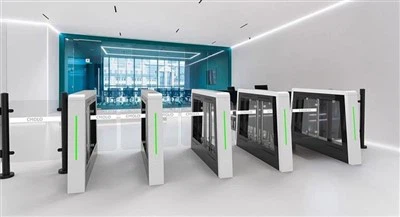
1. Technical Cooperation: Integration at the Bottom Level from Hardware Interface to Data Context
Turnstiles and POS systems work together as a cross-system integration of electronic payment and mechanical control. Three essential modules are necessary for its technological implementation:
Hardware interface standardization
The POS system and the turnstile can communicate via Wiegand interfaces, TCP/IP, or RS485. Some high-end gadgets make use of industrial-grade control boards that can interface with POS machines, facial recognition terminals, membership management systems, and other devices at the same time and handle numerous protocols. For instance, the primary control board of a rotary turnstile installed in a Shenzhen shopping mall incorporates the Modbus TCP protocol. This allows the board to receive real-time consumption data sent by the point-of-sale system and regulate the turnstile's opening and closing based on pre-established regulations. Following the customer's payment, the POS system uses an HTTP API to communicate the transaction data-including the order number, amount, and member ID-to the gateway cloud platform. It takes no more than 0.5 seconds for the platform to verify it and then send a gateway opening instruction.
Connection between traffic logic and payment
The logical principle of "consumption is authorization" forms the basis of collaborative work. Using the catering scenario as an example, the POS system creates an electronic receipt and links it to the member account after patrons have eaten at the restaurant. By scanning the QR code or NFC tag on the receipt, the gate confirms the legitimacy of the consumption. The gate will automatically open if the verification is successful; if it is not used or the receipt is not legitimate, the gate will stay locked. Non-customers are successfully kept out of the dining area by this arrangement. Following a pilot effort in a Shenzhen commercial complex over the 2025 National Day vacation, seat occupancy-related customer complaints dropped by 70%.
Encryption of Transmission and Data Security
The collaborative system uses SSL/TLS encryption communication to protect transaction data. At the POS end, private data (such membership card numbers and payment passwords) is encrypted before being sent to the gate controller. Instead of storing the original data, the gate just saves the transaction results (like the "paid" status). Additionally, offline mode is supported by the system. The gateway can ensure data integrity by storing transaction records locally during network outages and automatically synchronizing them to the cloud upon network restoration.
2. Situation of application: Reaching a commercial environment from a single passage
Turnstiles and POS systems have partnered in a number of industries, and the ways in which they are being used are becoming more varied:
Retail Mall: A channel that is restricted to members and connected to locations of consumption
Gates and POS systems are integrated in upscale shopping malls to give patrons a "seamless" experience. For instance, the member app's electronic credentials can be recognized by the turnstile installed in a Shanghai retail mall. The system immediately looks up the member's usage history for the previous 30 days as they approach the gate. The turnstile will be released immediately if the consumption exceeds a certain level or the points match the criteria; if not, members will be asked to visit the service desk to upgrade their advantages. In addition to increasing the satisfaction of membership, this design uses data to drive targeted marketing. The mall will see a 25% boost in membership repurchases during the 2025 Spring Festival.
Transportation Hub: Combining Gate Payment with Ticket Integration
Turnstiles and POS systems have worked together to create a closed cycle of "ticketing+consumption" in places like rail stations and airports. For instance, a gate installed at a Beijing high-speed train station facilitates "facial recognition payment+ticket verification" in two ways: the system automatically links ticket purchase records once passengers have successfully completed facial recognition in front of the gate. The ticket will be released by the gate if it is valid and has not been used (for example, by not ordering on-site catering). If passengers need to make purchases inside the station, they can scan the QR code on the gate screen to access the POS payment page. Once the payment has been completed, the gate will release them once more. Passengers will have less waiting time thanks to this design, and the station's gate will see a 40% boost in traffic efficiency during the 2025 Spring Festival travel surge.
Cultural and tourist attractions: the connection between secondary consumption and tickets
Gate machines and POS systems work together to intelligently handle "one-stop play+secondary consumption" in the scenic area. For instance, a dynamic QR code recognition module is integrated at the gate of a 5A level picturesque location in Hangzhou. Electronic tickets with expiration dates and consumption rights are generated once tourists have purchased them. The gate examines whether visitors have bought secondary consumption items like transportation and park catering, as well as confirming the validity of the tickets. A suggested consumption package will appear on the gate screen if it is not purchased; once the visitor has paid by scanning the code, the gate will be opened. In 2025, the percentage of secondary spending revenue in this picturesque region will rise from 15% to 30% during the May Day holiday.
3. Industry Practice: Creative Examples of Ecological Construction and Technology Application
Precision operation powered by data
Chengdu's smart mall will incorporate information from POS systems and turnstiles. It will produce a "passenger flow heat map" and a "consumption conversion rate report" by examining gate traffic records and POS transaction data. For instance, the system discovered that at a specific time period, the gate's traffic flow was high, but the area's corresponding POS transaction volume was low. Investigation revealed that incorrect channel direction was the reason for the client loss. Following an instant optimization of the flow design, the mall saw an 18% increase in sales income in that section.
Green energy-efficient design and sensorless payment
An unmanned retail "pick up and go" experience is made possible by the rotary gate powered by a brushless DC motor and the POS system's contactless payment feature. For instance, when customers place their items in their shopping carts and push them through the gate channel in a convenience store in a Shenzhen neighborhood, the system uses RFID tags to automatically settle and release the items, eliminating the need for human intervention throughout the process. Due to lower equipment energy consumption, this method saves 120000 yuan in annual electricity expenditures while increasing the efficiency of vacation cashiers by 60%.
Redundancy Design for Security and Emergency Management
Efficiency and safety must be balanced in the gate and POS system's synchronization during emergencies like firefighting. In order to prevent financial losses due to equipment failures, for instance, the POS system uploads incomplete transaction records to the cloud for automated deduction once power is restored, and the gate of a shopping mall in Shanghai immediately switches to typically open mode following a power outage. By using this design, the mall was able to manage more than 500 incomplete transactions during the 2025 summer power outage incident without any issues.
Painting Access Control Speed Gate Turnstile


WhatsApp : 0086-15999546575
Skype : cmolo.joy
Email : contact@cmolo.com
Tel : 0086-15999546575
CMOLO Industrial Park,NO. 144-1, Hengping Road,Henggang Street, Longgang District, Shenzhen City, China