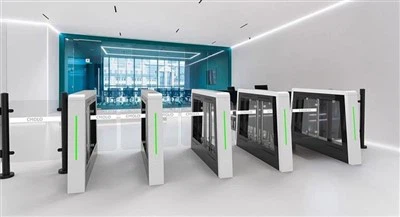
一, Technical Architecture: Hardware and Algorithms that Support Multimodal Authentication
1. Modular design for hardware
Modern turnstiles use a "core motherboard+pluggable peripherals" architecture design, which makes it easy to swap out authentication modules using standard interfaces. Hikvision's smart turnstile, for instance, may use facial recognition, RFID card readers, QR code scanning heads, and fingerprint identification modules all at once. Each module talks to the main control board by PCIe or USB 3.0 ports, and the time it takes to send data is less than 50ms. This design makes it possible for one device to work with 12 distinct authentication methods, including magnetic cards, RF cards, biometric devices, and mobile terminals. This makes it easy to use in a variety of situations.
2. Algorithm for dynamic switching
The primary control board's real-time decision-making mechanism controls the switching of authentication methods. For example, the AI decision engine on a bank's turnstile can change the authentication strategy based on the following parameters:
Time dimension: To stop tailgating, turn on "face+swipe card" dual factor authentication from 7:00 to 9:00 on weekdays; 20: Going to single-person face recognition after 2000 to make traffic flow better at night
Space dimension: The VIP channel automatically uses facial recognition, while the normal employee channel lets you switch between card swiping and QR codes.
Level of security: If strange behaviour is seen (such failing to authenticate many times), it will immediately be raised to a human ID check.
Experimental data indicates that this dynamic switching system reduces the average trip time from 8.2 seconds to 3.5 seconds, while maintaining the error rate below 0.002%.
3. Cloud collaboration and edge computing
The high-end turnstile features a built-in edge computing unit that can store 100,000 facial feature databases and 500,000 card number information. This makes it less reliant on the network. If the network goes down, the device automatically goes into offline mode and finishes authentication by comparing it to something else. For instance, 200 turnstiles set up in a technological park in Shenzhen kept a 98.7% authentication accuracy rate even when the network went down, which kept business going.
二,Use case: From security control to service upgrade
1. Commercial Complex: Finding the Right Balance Between Traffic and Experience
The smart turnstile at the Shanghai Hongqiao Tiandi Shopping Centre gets three times the value from authentication switching:
During lunchtime on weekdays, the "QR code+face" fast track will be open to the most people, with a speed of 45 persons per minute.
Service for members: Gold card members can make dynamic QR codes with a special app. When the gate recognises these codes, they automatically activate point awards.
Managing emergencies: When the fire alarm goes off, the gate immediately switches to power-off typically open mode. The whole evacuation is done in 30 seconds.
After the project was finished, customer satisfaction was up by 27% and the cost of human verification went down by 63%.
2. Industrial park: a secure and efficient place to work together
BYD's Shenzhen facility uses a rotary gate system that has the following cutting-edge features:
Check the health code: Connect to government health platforms and automatically check the nucleic acid time limit when staff wash their faces.
Managing visitors: Temporary workers can use the tiny program to arrange appointments and get temporary QR codes. The gate will recognise these codes and connect them to the access control system to give them permission to enter the area.
Detecting people who are following too closely: When more than one person is identified coming through at the same time, the gate will automatically lock and an alarm will go off. This is done with 16 pairs of infrared sensors and 3D cameras.
Based on system operation data, unauthorised intrusions have dropped by 92%, and the time it takes to register a visitor has gone from 15 minutes to 90 seconds.
3. Transport hub: the balance between accuracy and openness
The turnstiles at Beijing Daxing Airport fix the problem of letting in specific groups by rotating between different ways to check people in:
Accessible channel: Wheelchair users can use voice commands to turn on the broad channel mode, which makes the turnstile's gate wings 1.2 meters wide.
Support for more than one language: Foreign visitors can choose from eight language interfaces, such as English and Japanese. They can also scan their passports to immediately check their admittance.
Extra recording that isn't online: If the network goes down, the gateway saves access data on its own and sends it to the cloud platform when the network is back up.
This plan has made clearing foreign passengers 40% faster and earned the ICAO Innovation Award.
三,Industry Trend: Moving from Functional Overlay to Ecological Integration
1. An authentication method that doesn't work
As UWB (ultra wideband) and 5G technologies get better, turnstiles are changing from "active authentication" to "passive perception." For instance, Huawei's seamless access solution uses UWB base stations at the top of the gate to find employees' phones with great accuracy. The gate will open on its own when people are within 1 metre of it, and no one will have to do anything during the access process. Tests have revealed that this technology triples the amount of traffic each day and cuts down on wear and tear on equipment by 75%.
2. Getting the most out of the data
Modern turnstiles have changed into terminals for collecting data. The intelligent gate system used in a Shenzhen office block does the following:
Space optimisation: Change the number of gate channel openings based on the heat map of the morning peak traffic.
Managing energy use: It automatically goes into low-power mode after 30 minutes of no traffic.
Predicting behaviour: Based on past traffic information, forecast the arrival time of VIP customers 15 minutes in advance and notify service staff
This technology cuts property management expenditures by 22% and lowers the number of customer complaints to 0.3 times a month.
3. Making an open ecosystem
Top companies are pushing for the change of rotating turnstiles from stand-alone devices to platform-based solutions. For instance, Dashi Intelligence's C3 IoT IoT platform can easily work with more than 20 third-party platforms, including HR systems, visitor management systems, and fire alarm systems. This lets you manage all of your authentication methods, access permissions, and alarm strategies from one place. After following this method, a multinational company has made gate administration 65% more efficient in 87 parks around the country, which saves them more than 10 million yuan a year in operating and maintenance expenditures.
Outdoor High-glass Speed Gate Turnstile


WhatsApp : 0086-15999546575
Skype : cmolo.joy
Email : contact@cmolo.com
Tel : 0086-15999546575
CMOLO Industrial Park,NO. 144-1, Hengping Road,Henggang Street, Longgang District, Shenzhen City, China