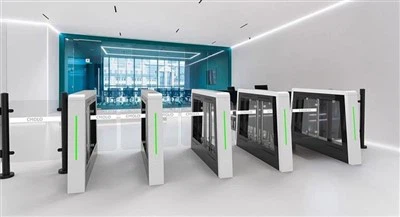
一,Managing rights in a hierarchical way: creating a multi-level regional control system
1. Carefully setting up employee permissions
The turnstile may connect deeply with the mall's HR and attendance systems, and it can give varying access rights based on work level, department, and position. For instance:
Logistics staff: Only open logistics channels such warehouses and unloading sites, and allow workers to work from 8:00 AM to 6:00 PM;
level administrator: Allowing people to enter the office and public areas on this level, but not allowing them to enter critical sections like the finance office;
Senior executives: Set up global access permissions and turn on VIP channel mode (the gate automatically turns 90 ° to greet guests).
A commercial complex in Shanghai has installed SA302 turnstiles to separate staff permissions into 12 levels. This, along with dynamic password technology, has cut down on unauthorized area intrusion instances by 92% and made permission administration 60% more efficient.
2. Dynamic management of visitor permissions
For short-term visits, the turnstile can be used with the reservation system to fully manage the "online application offline verification" process:
Business visitors: Use Enterprise WeChat or DingTalk to send in visitor applications, upload ID information, and the system will immediately make an electronic pass that is good for a certain amount of time (like 2 hours).
Maintenance workers: link the device number to the maintenance work order, only allow access between certain devices, and let the access expire automatically after a certain amount of time.
VIP customers: Link to the mall's CRM system and provide them temporary access to exclusive areas like VIP lounges and fitting rooms based on how much they spend.
After putting this method into action, a high-end retail mall in Shenzhen cut the cost of managing visitors by 75% and the number of arguments caused by ambiguous authorization by 80%.
3. Special emergency authorization for certain situations
The turnstile has emergency features like fire linkage and remote control to make sure that it can respond quickly in an emergency.
Fire alarm: When the fire signal is received, the gate will immediately unlock and connect to the monitoring center, which will send the alarm within three seconds.
Equipment failure: allows for manual unlocking and a backup power supply to keep the channel flow going smoothly;
Epidemic control: An integrated health code verification module that automatically stops and reports people with yellow or red codes to the disease control department.
A shopping complex in Beijing decreased the time it took to evacuate from 5 minutes to 90 seconds during a drill by connecting the gate and fire protection system. This showed that emergency permissions work.
二,Scenario adaptation: satisfy the needs of different regions for control
1. Smart separation between business and office areas
For the mixed layout of office and business sections in shopping malls, turnstiles can intelligently redirect people in the following ways:
Time period control: The office area gate is sealed automatically during work hours (10:00–22:00), and only employees may get in by facial recognition.
Set a one-way traffic mode of "business area → office area" to stop clients from accidentally going into the logistical area. This is called bidirectional authorization.
Item verification: A metal detection door and an X-ray security machine are built in to check people who are bringing big packages into the workplace area a second time.
After putting in turnstiles in a Hangzhou shopping mall, the theft rate in the office area went down by 90%, while employees' productivity went up by 35%.
2. Make sure that sensitive locations are better protected.
For really sensitive places like data centers and finance rooms, turnstiles can be set up with a number of security features:
Two-factor authentication needs both swiping an employee card and entering a dynamic password (or using a fingerprint).
Anti-tailgating design: employing a 120° rotation angle and infrared detection technology to make sure that only one person can go through at a time;
Behavior audit: Keep track of all traffic logs (including time, people, and authorization levels) and help with traceability questions.
A business group in Guangzhou has stopped all unauthorized intrusions in the finance department by installing turnstiles that stop people from following each other, which means they are 100% compliant with audits.
3. Flexible regulation of temporary activity areas
Turnstiles may be swiftly set up and moved around for temporary event spaces like pop-up stores and promotional booths:
Modular design: makes it easy to put together and take apart gate pieces quickly, and closes off an area in two hours;
Temporary permission: Give event workers RFID wristbands that are only good for a certain amount of time (like three days). These will automatically stop working when the time runs out.
Statistics on the flow of passengers: Sensors built into the system keep track of how many people are in the activity area at all times and set off flow limit warnings when the number goes above the limit.
During the Spring Beauty Festival, a retail mall in Chengdu deployed turnstiles to regulate the number of people in the activity area and keep people from crushing each other.
三,Data empowerment: making smart regional control decisions
1. Using a heat map to improve the layout of space
The turnstile collects traffic data that may be used to make a three-dimensional heatmap that shows the density of pedestrian flow and traffic patterns in each region. For instance:
Office area: It was discovered that the busiest times for people to come and go are between 3 and 5 p.m. Cleaning and security patrol times will be changed to fit this.
Area of business: There was an unusual amount of traffic around a certain brand counter, and after looking into it, it was discovered that personnel had let consumers in without permission. After fixing things quickly, sales went up by 12%.
This is a sensitive area: It was found that the financial room gate went off a lot when no one was working. After looking into it, they concluded that it was a false alarm from the system. After changing the authorization settings, false alerts went down by 80%.
2. Analyzing strange behavior and hazards of early warning
When combined with AI algorithms, turnstiles can model and study how people behave when they walk through them:
Unusual frequency: During the week, an employee went into the office area several times outside of work hours. The system immediately marked it and sent it to the security supervisor.
Path abnormality: Visitors didn't follow the planned route, which set off an alarm and connected to surveillance cameras for tracking.
Abuse of Authority: Workers let other people use their work cards, and the system uses gait recognition technology to find and lock up people who break the rules.
By using turnstiles with behavior monitoring capabilities, a shopping mall in Shenzhen was able to stop three internal criminal acts and recoup over 500,000 yuan in lost business.
3. Permission lifecycle management can help cut costs and make things work better.
The rotating gate system can handle the entire life cycle of permissions on its own:
Automatic permission when you join: When a new employee starts, the HR system sends authorization information to the gate controller at the same time.
Dynamic Adjustment of Job Positions: The system automatically updates an employee's access rights when their job changes to avoid mistakes made by hand;
Immediate termination of resignation: After an employee quits, their permissions will end within 10 minutes to stop the chance of information getting out.
Through permission lifecycle management, a business group in Shanghai has cut the cost of maintaining permissions by 65% and achieved a system error rate of zero.


WhatsApp : 0086-15999546575
Skype : cmolo.joy
Email : contact@cmolo.com
Tel : 0086-15999546575
CMOLO Industrial Park,NO. 144-1, Hengping Road,Henggang Street, Longgang District, Shenzhen City, China