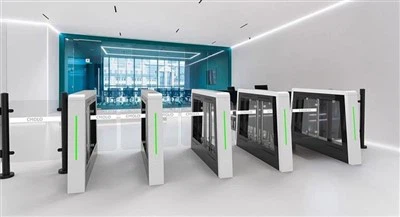
1,Hardware deployment: setting up the systems needed to gather data
The turnstile can collect data because its hardware system has been smartly updated. Its main parts are the recognition module, the sensor array, and the transmission unit.
Terminal for multimodal recognition
Many modern turnstiles use more than one way to identify people, like face recognition, scanning QR codes, NFC (near-field communication), RFID (radio frequency identification), and so on. The Shenzhen Tiejun Intelligent full-height rotary gate has binocular cameras and a liveness detection algorithm that can recognize faces and find out the temperature in just 0.3 seconds. It can also verify multimedia items like ID cards, health codes, membership cards, and more. 99.7% of the time, the gate system at Shanghai K11 Shopping Art Center was able to collect correct data thanks to "face+mobile Bluetooth" dual factor identification.
A very accurate network of sensors
The gate needs to have many types of sensors, like infrared radiation, pressure sensors, and millimeter wave radar, so it can correctly record how people use it. The 12 sets of infrared projection grids in the Nanjing Boka intelligent gate can find a position difference of 0.1 meters. When paired with a bottom pressure monitor (accuracy ± 50g), it can tell the difference between more than 20 situations, such as a single person passing, someone following behind, and an item being held. A 77GHz millimeter wave radar constantly scans the turnstiles at Guangzhou Baiyun Airport's security checkpoint within a 20-meter range. This means that the passage time can be correctly recorded even when people are carrying bags.
Communication gadget made for industry
A stable communication network is needed to send info in real time. Mengdong's smart full-height rotary gate works with 4G/5G, Wi-Fi 6, LoRaWAN, and the third mock test communication method. It also switches to the best channel automatically in places with a lot of interference, like subways. Shenzhen MIXC's gate system allows local pre-processing of data through edge computing gateway. This lowers the effective data transfer frequency from once per second to once every five seconds and frees up 80% more bandwidth.
2,Getting the data: Processing of multidimensional information in a structured way
There are four types of data that the turnstile collects: time, place, behavior, and identity. These data need to be organized and processed using algorithms.
Standardization of facts on space and time
The system keeps track of exactly when a customer enters and leaves the building, down to the millisecond, and combines that information with the GPS locations of the gate or indoor positioning beacons to create a stream of spatiotemporal data with geotags. Through the UTC time synchronization protocol, the speed gate system at the ticket stop of Hangzhou East Railway Station makes sure that the total station gate time error is less than 10ms. This gives accurate time standards for analyzing passenger flow.
Getting features out of behavioral data
Using methods for machine learning to sort and model how traffic moves:
Normal passage: The angle of rotation of the gate matches the path of human moving more than 90% of the time.
Following an intrusion: Infrared blockage lasting more than 0.5 seconds and unusual changes in pressure
Reverse passage: Millimeter wave radar picks up a motion vector that is perpendicular to the gate's rotational direction.
The gate system that Chengdu Taikoo Li Convenience Store uses looks at past traffic data using an LSTM neural network to get a 98.6% success rate in recognizing people's behavior.
Processing of identity info anonymization
So that it can follow data protection laws like GDPR, the system makes sensitive information less sensitive:
A hash algorithm is used to turn a facial image into a unique ID. The original data is saved locally for no more than 24 hours.
MAC address for mobile: Create a fake ID using the randomization method
Member information is kept separate from access records and is only linked when approved queries are made.
Homomorphic encryption technology makes data "usable but invisible" in the gate system at the Beijing SKP shopping mall. It has also passed the third level of identification for national information security protection.
3,Sending and storing data: making a safe and dependable data pipeline
Encrypted broadcast from beginning to end
The TLS 1.3 algorithm encrypts the traffic between the gate and the server, and digital signatures are built into data packets to stop tampering. It was customized by Shenzhen Tiejun Intelligence for a certain jail and now has a national security SM4 encryption module in the transmission layer to meet the security needs of the legal and political sectors. Blockchain technology is used by Shanghai Disneyland's entrance gate network to store entry records in a way that can't be changed.
Architecture for distributed storage
The "edge storage+cloud backup" model is usually used by big business complexes:
Local edge node: saves raw data from the last seven days and can respond to queries in milliseconds
Private cloud platform: uses HDFS distributed file system to store info from the past three years
Service in the public cloud: Match up key indicator data for business research across regions
Guangzhou Tianhe City's choice of a hybrid cloud architecture cuts the cost of storing data by 40% while still passing the Level 3 requirements of Equal Protection 2.0.
An engine for handling streams in real time
Apache Kafka message queue, which can handle 100,000 traffic records per second on a single node, is used to handle data streams that come in at the same time. The Flink flow computing technology is used to run the gate system at Hangzhou Intime Department Store.
Completely set off the odd traffic alarm within 5 seconds
Within one minute, make a heat map of traveler flow
Within 10 minutes, change the individual flow tags.
4,The Path from Data to Value: An Analysis Application
BI tools and AI models can be used to turn the collected access data into multiple business insights.
Analysis of passenger flow and efficiency improvement
How the flow of passengers is spread out at different times: Find peak and off-peak times, and make the best use of scheduling and supply of things.
Thermal Analysis in Motion: Using Monte Carlo simulations to figure out how customers will move through a store to help with layout changes
Stay time monitoring: Send targeted marketing push messages to customers who stay in a certain area for a certain amount of time.
Through gate data analysis, Shenzhen Coastal City Shopping Center has made its cash registers 25% more efficient during busy weekends. For the same reason, sales have gone up by 18% in the women's clothing section on the second floor thanks to better flow.
Warning about security risk
Identifying strange behavior: Set a standard model for normal traffic behavior and set off alarms for things like frequent reverse traffic, strange entry and exit at night, and other behaviors.
Managing the blacklist: Connect to the public safety system to automatically catch fugitives or dishonest people who have been put to death.
Using gate position data and a BIM model to create the best escape route for an emergency evacuation scenario
Beijing Daxing Airport's smart gate system caught 37 dishonest people during the summer travel season of 2023 and increased the accuracy of opening the security check channel to 92% by predicting how many people would be using it.
Targeted advertising and services for members
Analysis of how often people visit the store: Find your most valuable users and offer them special deals.
Keeping track of cross-store purchases: Give each customer's purchase history in different shops a unique ID.
Ways to keep exiting customers: When members don't show up for 30 days, automatically send them a gift.
Starbucks' gate membership system in China has increased the rate of members who buy again by 31% by looking at data about when members enter and leave the system. It has also increased the rate of new product tastings by 22% by making the flow more efficient.


WhatsApp : 0086-15999546575
Skype : cmolo.joy
Email : contact@cmolo.com
Tel : 0086-15999546575
CMOLO Industrial Park,NO. 144-1, Hengping Road,Henggang Street, Longgang District, Shenzhen City, China