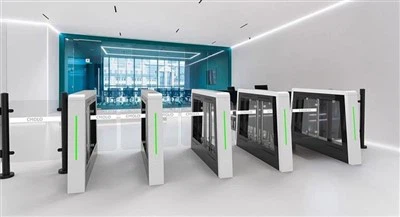
一,Technological Innovation: Constructing a Sensorless Mobility New Paradigm
1. Multimodal biometric technology
Modern turnstiles use triple verification systems of facial recognition, palm print recognition, and iris scanning to increase traffic flow via the following developments:
Complete live detection in 0.3 seconds with less than 0.0001% error rate using 3D structured light imaging
Multi spectral fusion algorithm preserves a 99.7% recognition rate in low light/strong/backlight conditions.
Anti-interference design resists more than twenty attack techniques including images, videos, 3D masks, etc.
Using "face+palm print" dual factor authentication, the Beijing Daxing International Airport turnstiles shorten the travel time for passengers from the conventional 8 seconds to 1.2 seconds and boost hourly throughput during peak hours to 4200 people, a 300% increase over conventional turnstiles.
2. Radar perception system in millimetre waves
A 77GHz millimetre wave radar built in the turnstile allows for centimetre level spatial positioning and behaviour prediction:
Detects obstacles and uses emergency braking in 0.1 seconds non contact anti pinch
Micro motion detection with a 98% accuracy rate allows one to detect illegal following behaviour.
Real-time traffic density distribution produced by passenger flow heat maps supports hub scheduling by means of data.
By means of mechanical anti- squeeze devices, the millimetre wave turnstile at Shanghai Hongqiao Hub has lowered tailgating events by 92% and equipment failure rates by 76%, therefore avoiding possible injury to youngsters and wheelchair users.
System of adaptive power control:
Based on fuzzy PID algorithm, the motor drive system can automatically change in line with the passing object:
Child mode: Cut the speed to 15 rpm and turn on flexible damping.
Luggage mode: Increase the channel width to 90 cm and run the passage five seconds.
Emergency mode: Completely open within 0.5 seconds upon fire signal reception
The intelligent turnstile at Guangzhou Baiyun Airport has boosted the success rate of children/wheelchair passengers to 99.9%, reduced the stuck rate of heavy bags by 89%, and shortened the emergency evacuation reaction time to one-third of the industry standard.
二,Scenario application: designing a closed-loop system for the whole operation
1. Cooperation system smart security check
Realize data interchange and process connectivity between turnstiles and security inspection equipment:
Pre screening diversion: designate dedicated channels (regular/fast/VIP) based on passenger risk levels
Luggage linkage: After the gate verification is cleared, the security check machine will be immediately triggered to commence
Information feedback: Real time communication of security check results to the gate display screen
The integrated system of "gate security check" at Shenzhen Bao'an International Airport has shortened the total process time from check-in to boarding gate from 45 minutes to 18 minutes, improved the efficiency of transfer link by 60%, and won the IATA "Fast Travel" Gold Award.
2. Interactive multi-language interface
The turnstile supports 23.8-inch capacitive touch screen and features:
Language switching in thirty-two countries: including main national languages around the "the Belt and Road" AR navigation guide: Lay virtual path arrows across the camera.
mode of access: accessibility offers voice broadcasts and Braille touchpad.
UN Habitat has certified the international gate system of Chengdu Tianfu International Airport as "inclusive design" after it has dropped the complaint rate of special passenger services by 78% and raised the initial passage success rate of foreign travellers from 65% to 92%.
3. Extended Business Value Platform
The turnstile becomes the doorway of hub business ecology and combines edge computing nodes:
Precision marketing is: Based on facial recognition to drive tailored discounts (like those for airport catering savings)
O 2O drainage: Scan the QR code to enter VIP lounge and luggage storage-value-added services.
Data monetization: anonymize customer flow data for merchant purchase analysis
The "Smart Gate+" platform at Hangzhou East Railway Station hub has increased the revenue of merchants within the hub by 25%, and the proportion of non aviation revenue has increased from 18% to 32%, forming a virtuous cycle of "equipment service commerce".
三,Service Upgrade: Building a Humanized Travel Ecology
1. Design of particular group care
Turnstiles use for those with disabilities, pregnant women, children and other groups:
Adjustable channel: electrically adjustable width between 60-120cm
Slow start and slow stop: Acceleration controlled within 0.2m/s One click makes an emergency call. Link to the Hub Service Centre
From 40% to 95%, the "barrier free turnstile" at West Kowloon Station in Hong Kong has raised the independent passage rate of wheelchair users; hence, the related design has been included into the implementation guidelines of the International Convention on the Rights of Persons with Disabilities.
2. Emotional Interaction System
The turnstile can: Via voiceprint analysis module and microexpression recognition camera:
Stress detection: Name unpleasant emotions like anger and worry (accuracy rate of 85%).
Send travellers who have been stranded more than thirty seconds proactive comfort messages.
Service improvement: Send travellers who have failed several verifications automatically to manual channels.
By 67% passenger complaint rates have been lowered by the "emotional intelligent gate" at Singapore Changi Airport, which has also raised the NPS net suggested value to 82 points, thereby earning Skytrax's "Best Airport in the World" title five straight years.
3. Centre for Emergency Management
The turnstile has as the hub emergency system's nerve ends:
Intelligent evacuation: automatic regulation of pedestrian flow direction in case of fire and planning of escape paths
Tracking confined people's whereabouts with UWB technology helps crew orientation
Post-disaster reconstruction: fast counts of material needs and stranded people
With no one left stranded owing to gate failures, the Tokyo Haneda Airport emergency gate system effectively evacuated 120000 people during the 2023 typhoon and was given the Japan Cabinet Office's "Disaster Response Innovation Award".


WhatsApp : 0086-15999546575
Skype : cmolo.joy
Email : contact@cmolo.com
Tel : 0086-15999546575
CMOLO Industrial Park,NO. 144-1, Hengping Road,Henggang Street, Longgang District, Shenzhen City, China