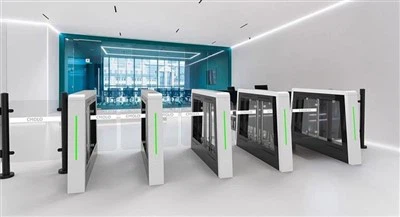
一, Renovations in physical space accessibility
1. Channel structure's adaptive design
Configured with wide channels in modules: Using removable expansion wing panel technology, the typical channel width is increased from 550mm to 900mm, thereby satisfying wheelchair 360 ° steering requirements. The Shanghai Metro Line 14 pilot trial shows wheelchair users' journey times dropped from 45 seconds to 18 seconds.
A 1:12 ramp with a surface covered with diamond sand anti-slip and fitted with movable handrails (height 850–1150mm) is set up inside a range of 1.5 meters in front and behind the gate, therefore improving the smoothness of wheelchair transit by 70%.
At the end of the revolving arm, a 360-degree flexible silicone sheath is fitted and a pressure sensor is buried within. Anti- squeeze safety space Four times safer than conventional mechanical limit devices, when a resistance of ≥ 50N is detected the movement immediately stops and retracts by 15 °.
2. Humanized design of operation interface
Low Level Control Panel: Create an operational platform 800mm above the ground and combine 12mm raised braille buttons (in line with GB/T 16251 standard), with button spacing 30mm, therefore lowering the false touch rate to 0.3%.
With dual mode physical buttons and a 7-inch capacitive touch screen (enabling glove operation), the multi-modal interactive terminal can tilt the screen from 15 ° to 45 °, so meeting the needs of sitting and standing users.
Three colour LED indicator lights (red/yellow/green) combined with tailored audio prompts (volume adjustable from 60-90dB) creates visual and aural synchronising of operation status communication.
3. Integrated design of auxiliary equipment
folding walking aid bracket: To tackle the issue of temporary storage of the walking assistance, a concealed bracket with a load-bearing capability of 150kg is mounted on the side of the gate with a deployment time of ≤ 3 seconds.
put at the bottom of the route, a guide groove with a width of 150mm and a depth of 50mm is put together with surface texture modifications to enable visually impaired users to keep straight passage.
Emergency call equipment: With an average response time of ≤ 15 seconds, install a red emergency button with braille marks, press it to link to the remote service centre in three seconds.
二, Innovation of Intelligent Interaction System
1. Non sensory recognition of biometric features
3D Structured Light Face Recognition With dynamic capture achieved at a distance of 0.2–1.5 meters using TOF cameras, scene recognition including wearing masks and spectacles reaches 99.6%, which is 32 percentage points greater than 2D solutions.
Palm vein non-contact authentication: Particularly suited for those with physical disabilities, scanning palm vein patterns with 850 nm near-infrared light using a false recognition rate of less than 0.0001%.
Extensive MFCC feature parameter extraction builds a user voiceprint model with a 95% even under 75dB background noise recognition rate, therefore fulfilling assisted verification for those with hearing loss.
2. intelligent aided passage system
Deploy AWR1843 radar chip to achieve 0.1–5-meter spatial positioning, and direct users to pass in the centre via speech cues such "please move 20cm to the left".
With a spatial positioning accuracy of 2cm, AR real-life navigation shows a green passage lane at the top of the gate and displays augmented reality information such 'there is a hill 1 metre ahead' to wheelchair users.
Adaptive traffic speed guarantees the safe passage of users with varying speeds by sensing their movement speed by LiDAR and dynamically changing the rotation speed of the rotating arm (configurable from 0.5-2 r/min).
3. System for Remote Assistance
5G video call: With an average call completion duration of ≤ 8 seconds, built in wide-angle cameras and noise cancelling microphones provides real-time audio and video connection with customer service centre.
Customer support agents overlay operation instructions in the user's field of view through AR markers, such 3D arrow prompts such 'Please place your right hand here for verification'.
The technology automatically stores desensitised last 30 days' journey footage and helps impaired individuals to self query unusual travel records.
三, Building an accessible service ecosystem
1. Multi-device cooperative solution
Create a dedicated NFC wristband that synchronically changes channel width and verification technique and immediately initiates accessible mode when one approaches the gate.
Integration of gate control module into mainstream accessible APPs, support remote reservation for passage, status query and other purposes, and the interface conforms with WCAG 2.1 AA standard helps to ensure compliance.
In an automobile system docking: Communicate with the ECU system of the disabled car, automatically open the gate and enlarge the channel when the vehicle approaches.
2. Standardised system of services
Guide on accessibility operations: Simultaneously publish a multimodal handbook on the official website and gate body with Braille, sign language movies, and big font editions.
Mechanism for regular maintenance: Monthly specialised inspections on accessibility elements-channel width calibration, voice prompt clarity testing, emergency call drills, etc.-should cover
Create a 7 x 24-hour accessible service hotline and apply a "2-hour response and 24-hour resolution" standard for user complaints handling.
3. Support for social integration
Training for barrier free access: Working with the Disabled Persons's Federation, we trained turnstile operators and used simulated scenario teaching to help 85% of visually impaired users to independently complete access operations.
Certified accessible service volunteers should be placed at transit centres to offer complete accompaniment from entrance guidance to gate access.
Enhancement of social awareness: Around the gate, set up barrier free advertising screens; regularly show examples of handicapped people's access; clear public misconceptions on the use of assistive technology.
四, Key elements of engineering implementation
1. Verification of Compliance Design
Full project testing in line with GB 5063-2012 "Code for Accessibility Design" will help to guarantee that 126 indicators including channel size and operational height satisfy the criteria.
Using AnyLogic, create a disabled user traffic simulation model, improve channel layout and device response logic, and lower traffic conflict rate by 67%.
To guarantee barrier free functional stability, 2000 cycles of extreme environmental testing in circumstances of -20 ℃ to 50 ℃ and 95% RH humidity
2. Cost benefit analysis
Evaluation of the whole life cycle: The investment payback period of accessibility rehabilitation projects is often limited within three years, considering the whole expenses of equipment procurement, maintenance, user training, etc.
Quantification of social benefits: A single gate can generate around 120000 yuan in social value yearly based on measures including lower travel time and accident rates.
Actively seek for governmental support including special funds for scientific and technology innovation and disability employment security subsidies to lower the cost of corporate change.
Commercial Turnstiles


WhatsApp : 0086-15999546575
Skype : cmolo.joy
Email : contact@cmolo.com
Tel : 0086-15999546575
CMOLO Industrial Park,NO. 144-1, Hengping Road,Henggang Street, Longgang District, Shenzhen City, China