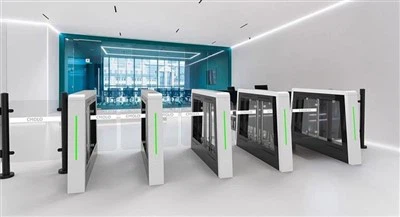
Choose environmentally friendly materials to reduce resource consumption and pollution
Application of Recyclable and Degradable Materials
Certain polymers and metal alloys, which often result in long-term environmental damage once the product lifetime ends, are difficult to recycle or degrade during the design and manufacturing process, hence traditional rotational turnstiles could employ materials of this kind. Consequently, recyclable and biodegradable materials ought to be given top priority in the rotary turnstile design.
For the gate's casing, for instance, bio based plastic or high-strength recycled plastic is possible. Made from processing trash plastic items, recycled plastic is a substance created to produce new ones. It not only lessens environmental pollution and energy use but also results in resource recycling by reducing the demand for virgin plastic. Plastics derived from renewable sources, such starch or cellulose, are known as biobased plastics. Their biodegradable nature allows them to break down into benign compounds in the natural surroundings under specific conditions, therefore lowering pollution to sources of soil and water.
For some interior gate components-such as screws, washers, etc.- recyclable metal materials such aluminum alloy, stainless steel, etc. can be used. These metal products can be remelted and processed once again following recycling, therefore enabling the manufacturing of new goods and better use of resources.
Low volatile organic compound (VOC) materials: their application
Turnstile manufacturing calls for some materials, like coatings and adhesives including volatile organic compounds, which could be harmful. Photochemical fog created by these VOCs forms as they evaporate into the air and compromises the atmospheric environment and human health. Low VOC or none VOC materials should thus be chosen.
For the surface coating of turnstiles, for instance, water-based coatings can be substituted for conventional solvent based coatings. Extremely low VOC content water based coatings employ water as the solvent. The pollution to the environment is consequently decreased as the toxic compounds evaporate during the coating process are considerably lowered. Simultaneously, water-based coatings also have great adhesion and fast drying qualities that could satisfy rotational turnstile needs.
Optimize energy design and improve energy utilization efficiency
Selection of energy-saving motors
The main energy consuming element of the rotary gate is its motor, hence the energy consumption of the whole gate is exactly determined by the amount of energy efficiency of the motor. Thus, while building rotating turnstiles, energy-saving motors ought to be chosen.
With better conversion efficiency and reduced energy consumption, the high-efficiency and energy-saving motor uses modern design and production techniques. Under the same workload, energy-saving motors can save a lot of electricity than standard motors. For instance, rotary turnstiles running permanent magnet synchronous motors can boost efficiency by 10% to 20% over conventional asynchronous motors, therefore drastically lowering energy usage.
Intelligent Energy Management System
An intelligent energy management system can be fitted to increase the rotating turnstile energy usage efficiency even more. Based on the real running status of the gate, the system can automatically change the power output and motor operating mode.
For instance, the intelligent energy management system will automatically switch the motor to a low-power mode when the turnstile is in an idle state, so lowering the motor's speed and power consumption; when pedestrians pass by, the system will rapidly adjust the motor to its normal working state, so ensuring that the gate may run smoothly and quickly. Furthermore, the intelligent energy management system can track and evaluate the gate's energy usage in real time, thereby giving management staff basis for energy-saving decisions and enabling them to implement sensible solutions.
Solar assisted power supply (applicable in some scenarios)
In some outdoor or highly lit areas, such parks, picturesque locations, etc., one could consider installing rotary turnstiles with solar aided power supply systems. Using solar panels to transform solar energy into electrical power, solar energy is a renewable, clean energy source that supplies either partial or whole electricity needs for turnstiles.
Apart from lowering energy consumption and carbon emissions, the solar assisted power supply system can help turnstiles to ensure their proper operation in case of unexpected power outages, therefore reducing reliance on traditional grid electricity. For the park's entrances and exits, for instance, rotary turnstiles with solar-powered devices are being installed. Solar panels gather sunlight and store electricity during the day; at night or when there is not enough sunlight, the stored electricity can cover the turnstile running demands.
Minish noise pollution and establish a pleasant surroundings.
low-noise motor selection
The motor of the turnstile produces some noise during its running state. In addition to compromising the quality of the surrounding surroundings, too loud noise will make walking uncomfortable. Low-noise motors should so be chosen while building rotational turnstiles.
By means of optimal structural design and excellent shock absorption and noise reduction technologies, low noise motors essentially lower the noise level during operation. For instance, rotating turnstiles with brushless DC motors can lower noise by 5–10 dB as compared to conventional brushed motors, therefore improving the driving comfort for pedestrians.
Design in shock absorption and sound insulation
Apart from selecting low-noise motors, sound insulation and shock absorption techniques can also be included into rotary turnstile construction to help to lower noise pollution.
Soundproofing materials such sound-absorbing cotton, soundproofing felt, etc. can be wrapped in the design of the gate's outside shell. By absorbing and reflecting the noise produced by the engine, these soundproofing materials help to lower the noise propagation. Shock-absorbing pads or brackets can be fitted at the motor installation site to lessen the effect of motor vibration on the general gate structural integrity, therefore lowering the noise produced by vibration.
Follow waste disposal rules and attain environmental protection all along the product life.
Simple modular design and disassembly
Easy to disassemble and modular design should be followed to help recycle and dispose of rotating turnstiles following scrapping. The simple to disassemble design helps the several gate components to be readily disassembled, so promoting categorization, recycling, and reuse. Modular architecture breaks out the gate into several independent modules. Separate replacement of a module failing or nearing its service life helps to extend the lifetime of the product by avoiding the need to replace the whole gate, therefore lowering waste creation.
For the rotary gate, for instance, one can arrange the motor, control system, transmission components, etc. as distinct modules. Other modules can be used while the motor is damaged; just the motor module has to be replaced. Apart from lowering maintenance expenses, this helps to minimize waste.
Waste removal and recycling scheme
Rotary turnstile manufacturers should create thorough waste recycling and disposal strategies to guarantee that goods can be correctly disposed of after their service lifetime finishes. The strategy should include exactly the recycling channels, disposal techniques, and environmental needs for abandoned turnstiles.
Working with competent waste recycling firms, building a recycling network, and deconstructing and classifying the recycled rotating turnstiles, for instance, Metals, plastics, etc. are recyclable items; they should be reprocessed and used; non- recyclable items should be carefully disposed of in line with environmental rules to prevent pollution of the surroundings.
Following pertinent environmental certification criteria will help to improve the environmental standing of goods.
Domestic and Foreign Environmental Certification
Manufacturers might actively seek for pertinent environmental certifications to show that the turnstile's design follows environmental protection rules. Globally, such as ISO 14001 environmental management system certification, it mandates businesses to create and apply a thorough environmental management system to control the whole process of product design, manufacturing, sales, and use, so ensuring that their activities follow environmental laws.
Certifications include China Environmental Labeling Product Certification (Ten Ring Certification) exist in China. Products with environmental certifications are more likely to be chosen and acknowledged by consumers as well as more competitive and credible on the market.
Environmental innovation and ongoing development
Getting environmental certification marks a fresh beginning rather than the destination. Turnstile manufacturers should be always attentive to changes in environmental rules and market demand, keep their goods' environmental performance better, and practice environmental innovation.
Developing new materials and technologies that are more energy-efficient and environmentally friendly and implementing them to the design of rotary turnstiles, for instance, will help to optimize the production process of the product, so lowering energy consumption and environmental pollution during the manufacture. We want to raise the environmental level of rotating turnstiles and contribute more to environmental conservation by means of constant improvement and innovative ideas in environmental protection.


WhatsApp : 0086-15999546575
Skype : cmolo.joy
Email : contact@cmolo.com
Tel : 0086-15999546575
CMOLO Industrial Park,NO. 144-1, Hengping Road,Henggang Street, Longgang District, Shenzhen City, China