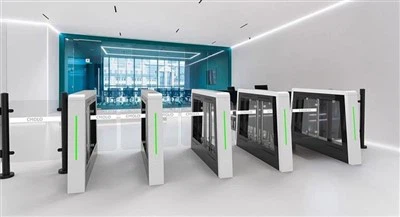
一, Technical principle: The rotary gate's control interface and signal transmission
The access control system sends an authorisation signal to the turnstile's switch control. The main control interface has two types of controls: dry contact and switch quantity:
A dry contact interface uses passive closed/open contacts that are very resistant to interference and don't care about polarity. This makes it great for sending signals over long distances. The dry contact closure signal can immediately operate the gate release mechanism when the fire prevention system goes off.
Switching interface: Active level signals (such DC24V) control it, therefore make sure the polarity matches. Some high-end turnstiles use the RS485/TCP/IP protocol, which lets them connect in more complicated ways.
The full height rotary brake, for example, has an electromagnetic lock and a mechanical limit device as part of its braking system. To make sure that the gate opens automatically if the power goes out or something goes wrong, the power-off release and mechanical unlocking must happen within 0.3 seconds during fire linkage. The actual test data from a smart construction site project demonstrates that the gate controlled by two separate dry contacts only takes 0.18 seconds to open in simulated fire situations. This is much faster than the national standard of 1 second.
二, System architecture: a three-level fire link control system
The Design Specification for Automatic Fire Alarm System (GB50116-2013) says that a three-level control system is needed for the fire connection of rotary turnstiles.
1. The local layer of automatic control
The gate controller has a fire protection module built in. When it gets a fire detector alarm (smoke or temperature), it does the following right away:
Turn off the electricity to the electromagnetic lock.
Let go of the mechanical brake
Start the reset programme for the brake wing blade.
Send a status feedback signal to the fire control host.
An intelligent gate with a command to open the door is used in a certain commercial complex project. The controller can read up to 8 fire signals at the same time and has a signal filtering function that helps prevent false triggering. Real-world tests show that gate release works 100% of the time in simulated smoke alarm situations.
2. Layer for controlling regional links
The fire control room uses bus-based linking modules to let various gate groups work together to control the fire.
If a fire alarm goes out in a compartment, all the gates in that area will automatically open.
Linkage elevator made it necessary to land on the first floor.
Turn on the emergency lights and the system that shows people how to get out.
The Shanghai centre Building project uses a distributed control architecture. Each floor has a regional controller that talks to the fire host through the optical fibre ring network. The system was able to release 68 turnstiles at the same time in 2.3 seconds during the fire exercise in 2024.
3. The central management control layer
The fire management platform combines BIM models with the current status of turnstiles to give 3D visualisation monitoring:
Show the location, status, and history of connections for each gate.
Make a plan to improve emergency evacuation routes
Keep logs of record linkage operations for later analysis
The smart fire prevention platform used in the Shenzhen Ping An Financial Centre project can follow the path of 2300 people as they leave in real time. The accuracy rate for gate linkage data is 99.7%.
三, Linkage mode: a control approach that adapts
A distinct connectivity plan needs to be made based on the building's features and how it will be used:
1. The usual way to link buildings
In automatic mode, the fire control host sends a release command to the gate controller as soon as it gets a confirmed fire signal. It also initiates the sound and light alert.
In manual mode, anyone in the fire control room can use the multi-line control panel to directly open the gate. This is useful for debugging the system or for exceptional situations.
A hospital project in Nanjing has a dual-mode architecture. During the 2025 fire inspection, the manual control response time is just 0.8 seconds, which is perfect for medical facilities.
2. A special strategy for subway stations
Hierarchical release mechanism: First, the gates for the evacuation channel are opened. Then, for 30 seconds, the gates for the non-evacuation channel are held back to stop people from going back.
AFC system linkage: connected to the Automatic Fare Collection System (AFC) so that gates and security gates open at the same time.
This approach is being used for the Guangzhou Metro Line 18 project, which cut the time it takes for single station personnel to evacuate by 42% during the 2025 emergency drill.
3. Tailored solutions for industrial parks
Explosion-proof gate: The chemical industrial park uses an intrinsic safety design, and the control circuit is kept separate from the actuator.
Module for wireless linking: LoRa wireless connection makes it possible to control gates from a distance in distant places.
The wireless connection technology used in a petrochemical business project works 99.9% of the time, even when the temperature drops to -30 °C.
四, Industry Practice: Common Examples and Technological Trends
1. A model proposal for smart office buildings
China Energy Storage Building's gate system contains the following new features: it is the first Class A office building in the world to have intelligent entry control and elevator linkage.
Facial recognition and temperature detection: two functionalities that allow for contactless travel and health checks throughout the pandemic.
Before the elevator is sent: If the gate verification is successful, the elevator will be automatically called, and the average wait time will drop to 18 seconds.
Fire linkage redundancy design: employing two power supplies and a UPS power supply to make sure the system keeps working for two hours after the power goes out.
2. New uses for rail travel in the future
The Beijing Metro Line 22 project uses AI visual recognition technology, and the turnstiles can keep an eye on how many people are in a given area at any one time.
If there is too much traffic in the evacuation path, the gate passage will automatically widen from 900mm to 1200mm.
Connect to the emergency broadcasting system so that the voice that tells people how to get out of the building changes according on where the fire is.
3. Trends in the evolution of technology
5G and edge computing: You may upload and diagnose the status of a gate in real time, and a pilot project has cut the number of equipment failures by 67%.
Digital twin technology lets you make a 3D model of the gate and test how it would work in a virtual world with fire scenarios.
Quantum encryption communication: making it safer to send fire signals. GJB accreditation has been given to a military project.
五, Points of implementation and standard specifications
1. Phase of design
Calculating the load: The power of the gate electromagnetic lock must be added to the total load of the fire-fighting gear. But a certain ultra high-rise project created transformer overload because it didn't take this into account.
Choosing the right cable: The fire link line should utilise NH-RVS fire-resistant wire with a cross-sectional area of at least 1.5mm. ². Grounding for lightning protection: The gate control box must have its own grounding electrode with a resistance of ≤ 1 Ω.
2. The building phase
Signal isolation: There should be at least 300 mm between the fire signal line and the strong current line, and metal sleeves should be put in place when they cross.
Linkage test: To find the standard deviation of the gate release time, you need to run 100 consecutive triggering tests.
Identification management: Red sleeves and the words "FIRE CON" must be on fire linkage lines.
3. Criteria for acceptance
Response time: The gate must fully open within one second of the fire alarm going off (GB50116-2013 standard).
For reliability, the MTBF (Mean Time Between Failures) must be at least 50,000 hours.
Compatibility: It must work with at least three common fire host protocols, like Modbus, BACnet, and OPC UA.


WhatsApp : 0086-15999546575
Skype : cmolo.joy
Email : contact@cmolo.com
Tel : 0086-15999546575
CMOLO Industrial Park,NO. 144-1, Hengping Road,Henggang Street, Longgang District, Shenzhen City, China