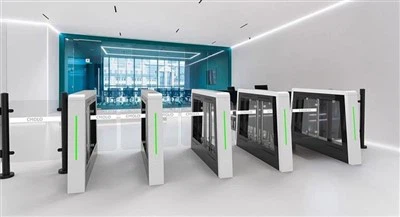
一, The technical architecture and compatibility base of rotary turnstiles
Mechanical constructions and electrical control systems work together to make rotary turnstiles very good at controlling who can enter a building. The most important parts of it are:
The mechanical structure includes a frame made of stainless steel, revolving blades, a transmission shaft, and an electromagnetic lock. You can change the motor settings to change the angle and speed of the blades so that they work better in varied flow situations.
Control system: uses ARM or Cortex processors, supports multi-protocol communication (such RS485 and TCP/IP), and can talk to other systems to share data.
Array of sensors: Real-time monitoring of traffic status to stop tailgating and unlawful entry, using infrared radiation, microwave radar, and pressure sensors.
The technical reason it works with third-party access control systems is:
Open Interface Protocol: Works with standard industrial protocols like OPC UA and Wiegand interface, and it can work with most access control controllers without any problems.
Modular design: The control board has extra ports for adding new modules and lets you plug in functional modules while the system is running.
Data security mechanism: AES encryption is used to send permission data across computers safely.
二, Compatibility examination of widely used third-party access control systems
1. A system for controlling access using biometrics
System for recognizing faces: Use a 3D structured light camera to take pictures of people's faces and compare them in real time with the gate control system. For instance, a certain chain store used a "face+body temperature" dual-mode gate to let people in without touching them and check their health during the pandemic, with a misidentification rate of less than 0.0001%.
Fingerprint/Palmprint Recognition System: This system is good for supermarkets that require a membership. It uses high-precision sensors to capture biometric data and connects to membership databases. A high-end supermarket's use of this plan reveals that it makes it 40% easier for members to get in and stops the problem of proxy brushing.
2. An electronic system for controlling access to credentials
QR code/NFC system: lets mobile phones read dynamic QR codes and NFC tags. A certain unmanned supermarket uses "WeChat QR code scanning + Bluetooth positioning" as a form of dual factor authentication. The QR code refreshes every 60 seconds, and Bluetooth beacon positioning makes it hard to steal screenshots.
RFID tag system: Using 13.56MHz high-frequency RFID to read information from a shopping cart or membership card. The practice of a warehouse-style supermarket demonstrates that RFID gates can cut the time it takes to go to the checkout after shopping by 1.5 seconds. This is three times faster than traditional barcode scanning.
3. A standard way to control access
Card access control system: works with common card kinds like Mifare and CPU cards and lets you define different levels of permission. A regional chain supermarket has put in place a graded management system of "employee card+visitor card." This has made it 25% easier for employees to get in and out of the store and cut the time it takes for visitors to register to 10 seconds.
Fingerprint and card swiping work together: any verification that passes can be released. A factory-run store shows that this strategy lowers the false rejection rate from 5% to 0.3% while keeping safety high.
4. A mechanism for controlling access to the Internet of Things
Cloud access control system: It uses the MQTT protocol to connect to cloud platforms so that you may manage permissions and analyze data from anywhere. A multinational retail business has shown that cloud gateways can cut the time it takes to update cross-regional shop permissions from hours to minutes and save operating and maintenance costs by 30%.
LoRa wireless access control system: good for stores that are far away from the network and need to send data across a low-power wide area network. LoRa turnstiles work well in temperatures from -20 to 50 degrees Celsius, as shown by the case of a rural store. They can last for up to 18 months on a single battery.
三, Common use cases and examples of how to put them into action
1. A supermarket without people
Scheme composition: turnstile, facial recognition, WeChat payment, and remote monitoring.
Effect of implementation: A 24-hour unmanned store reveals that this system cuts personnel expenses by 75% and successfully stops 12 strange traffic occurrences using behavior analysis algorithms.
2. Warehouse supermarket with membership
The scheme is made up of a turnstile, an RFID tag, and license plate recognition.
Effect of implementation: The idea of a membership-based supermarket has been put into effect, and it has been demonstrated to cut the time it takes for members to enter from 30 seconds to 8 seconds, boost vehicle economy by 60%, and raise the yearly membership repurchase rate by 15%.
3. Supermarkets that are part of a community chain
The scheme includes a rotary gate, a QR code, and a fire link.
Effect of implementation: The deployment case of a community grocery indicates that the scheme lowers the interception rate of non-members from 30% to 5%. At the same time, the fire signal is used to force the door to open, which is in line with emergency evacuation rules.
四, Technical Problems and Their Solutions
1. Problems with protocol compatibility
Challenge: Different manufacturers' access control systems utilize their own unique protocols, which makes it hard to connect them.
Solution: To connect different types of systems, use a protocol conversion gateway, like converting Modbus protocol to OPC UA. One integrator's experience demonstrates that this technique can cut the time it takes to integrate systems by 40%.
2. Risks to data security
Problem: It's easy to steal permission info as it's being sent.
Solution: Use the State Secrets SM4 encryption technique along with dynamic token authentication. A certain financial supermarket's use of this approach reveals that it cuts the chance of data leaks by 90%.
3. Problems with the mechanical structure
The third-party system control signal does not match the gate motor drive, which is a problem.
Solution: Using soft start technology and PWM speed control to smoothly manage the rotation of the wing. Tests done by a certain equipment maker show that this method can make motors last 30% longer.


WhatsApp : 0086-15999546575
Skype : cmolo.joy
Email : contact@cmolo.com
Tel : 0086-15999546575
CMOLO Industrial Park,NO. 144-1, Hengping Road,Henggang Street, Longgang District, Shenzhen City, China