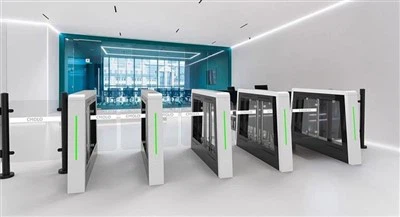
1. Multimodal recognition technology: making travel easy and smooth
The main benefit of turnstiles is that they may use many different ways to verify identity, such as QR codes, NFC cards, facial recognition, and ID card identification. This integration of technology not only makes traffic flow better, but it also makes it much safer.
Facial recognition technology that changes over time
The introduction of dynamic facial recognition gates in a huge sports stadium has increased the efficiency of single-channel traffic to 40 persons per minute, which is 60% higher than standard card-swiping gates. The system can find fake photographs and movies very well using 3D liveness detection technology, with a misidentification rate of less than 0.002%. In a specific international event in 2025, the venue used facial recognition gates to check the entry of 500,000 spectators, with an accuracy rate of 99.7%. There were no tailgating incidents.
Design that works with several media
The turnstile can read QR codes, NFC cards, and ID cards to check tickets for different groups of people. For instance, older viewers can use their ID cards to get in right away, while younger viewers use mobile QR codes or NFC cards. A certain all-inclusive sports center has cut the time it takes for each individual to get there by 0.8 seconds and the length of the line by 70% during busy times by putting in gates that can handle 12 different types of tickets.
Integration of barrier-free access
Turnstiles can be made with wide channels (≥ 1200mm) and low-level card readers for groups including pregnant women and individuals with disabilities. They can also have voice prompts and LED direction indicators built in. A certain Asian Games venue has improved the design of barrier-free gates, cutting the transit time for special groups by half compared to regular channels and raising user satisfaction to 98%.
2, Full digital control of the ticketing system through deep integration
To make a "ticket gate integration" closed-loop management system, the turnstile needs to be closely linked to the ticketing system, security platform, and data analysis tools.
Synchronizing data in real time
The gate access data has to work with the ticketing system in real time so that the status of the tickets may be updated automatically. For instance, a given venue uses a mid-range system for managing ticket sales. Every time the ticket gate checks a ticket, the system automatically labels it as "used" and changes the number of tickets left at the same time. In 2026, the technology used a real-time inventory warning system to stop 12 oversold situations in a certain football league.
Warning about strange behavior
The gate has video analysis and infrared sensors built in, which let it watch what people are doing in the channel in real time. The system locks the rotating rod and sounds an alarm when it sees trailing, stranded, or unusual things. It also sends the alarm to the security terminal. During testing, a certain Olympic location pretended to be a tailgating scenario, and the system was able to finish the whole process of alarm, positioning, and image retrieval in 1.5 seconds.
Dynamic diversion algorithm
The gate system can change the number of open channels based on past passenger flow data and the pace of entry in real time. For instance, a sports center with 10,000 people has used an intelligent traffic diversion algorithm to dynamically raise the gate opening ratio from 50% to 90% one hour before the event starts. This cut the peak wait time from 25 minutes to 8 minutes.
3. Making decisions based on data: improving the way venues run their businesses
The turnstile's traffic statistics can give the venue a lot of different operational information that can help them make good choices.
An examination of the Passenger Flow Heat Map
The venue can find high-density locations and improve flow design by using gate traffic data to make heat maps. For instance, a basketball court saw that the crowd was moving toward the southeast entrance after they got in, so they added two more turnstiles and moved the ticket checkpoint to the square. This cut the entry congestion index by 40%.
Forecast for ticket sales
By looking at past traffic statistics and how popular an event is, venues may guess how many tickets they will need in the future and make sure they have enough on hand. A big sports arena employed machine learning models to look at gate data and cut the time it took to sell tickets from 7 days to 3 days. They also kept the mistake rate in their inventory to 0.5%.
Profile of how users act
The gate system may keep track of things like when people enter and which channel they choose, and then utilize that information to create user profiles that can be used to offer personalized services. For instance, the person in charge of a music event looked at gate data and saw that 30% of the people who came were used to getting there an hour early. So, they set up temporary dining points during this time, which led to a 25% rise in secondary consumption.
4. Real-life example: How turnstiles are used at big events
The organizers of the 2025 International Athletics Championships used 120 full-height turnstiles in the main venue. This led to the following new ideas:
Multi-language support: The gate interface can handle eight languages, including Chinese, English, French, Japanese, and others, to fulfill the needs of people from all over the world.
Emergency mode: If the power goes out because of a downpour, the gate will automatically convert to the standby battery mode to make sure that the escape route is clear.
Visitors don't need to exchange paper tickets anymore because of dynamic QR code technology. They can just scan the code to get in, which saves resources.
The gate system handled 5.2 million traffic requests during the event, with a failure rate of less than 0.01%. This was a key factor in making sure that there were no safety accidents.


WhatsApp : 0086-15999546575
Skype : cmolo.joy
Email : contact@cmolo.com
Tel : 0086-15999546575
CMOLO Industrial Park,NO. 144-1, Hengping Road,Henggang Street, Longgang District, Shenzhen City, China